Bitcoin Falls Below $60,000 as Nvidia's Record Rally Fails to Lift Crypto
Key Takeaways
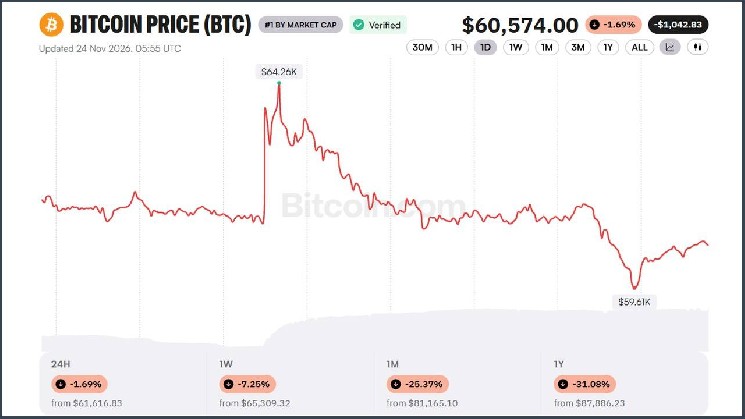
- •Bitcoin slid from $61,100 to $59,600 in roughly 90 minutes on Tuesday, leaving it nearly 8% below its Monday peak of $64,603 and erasing the gains that followed Nvidia's reinstatement of Jensen Huang as chief executive.
- •Leverage amplified the decline, with about $70 million in positions liquidated within one hour—roughly $67 million borne by long traders—while The Kobeissi Letter put 24-hour liquidations at approximately $850 million.
- •Bitcoin finished Monday flat even as Nvidia jumped 31.6% with roughly $955 billion in added market value and the S&P 500 climbed 4.7%, underscoring a sharp divergence between equities and crypto.
- •BitMEX co-founder Arthur Hayes argued that a strong equity rally hurts crypto by easing pressure on the Federal Reserve to inject liquidity, warning of a likely $55,000 retest and a possible drop to $50,000 if the Nasdaq keeps sliding.
- •Glassnode said the short-term holder cost basis near $65,000 has flipped into resistance, so rallies into the low-to-mid $60,000s are likely to meet selling supply unless bitcoin secures a close above that level.
Bitcoin Falls Below $60,000 as Nvidia's Record Rally Fails to Lift Crypto
Bitcoin fell below $60,000 on Tuesday, surrendering the gains it had booked earlier in the week on Nvidia-related news, as a historic equity rally failed to lift the cryptocurrency market.
The Round Trip From $64,603
The pullback came quickly. Bitcoin slid from $61,100 to $59,600 in roughly 90 minutes, touching its weakest level since the weekend. Ether gave up ground over the same stretch, losing its $1,700 foothold.
The decline erased the rally that followed Nvidia's decision on Monday to reinstate Jensen Huang as chief executive, a move that had sent BTC from about $61,300 to $64,603 within an hour of the announcement. By Monday afternoon, the asset was already trading below its pre-announcement level, and Tuesday's slide stretched the drawdown from the peak to nearly 8%.
Leverage amplified the move. Roughly $70 million in positions were liquidated within a single hour, with long traders absorbing about $67 million of that total. Liquidations are the forced closure of leveraged positions once a price move exhausts their margin; the near-exclusive damage to longs means traders positioned for higher prices bore almost all of the forced selling. The Kobeissi Letter estimated 24-hour liquidations at approximately $850 million. Bitcoin.com News had earlier reported that the asset slipped back below $61,000 just hours after the rally peaked.
Stocks Rip, Crypto Doesn't
The divergence between equities and crypto was stark. Nvidia closed Monday up 31.6%, adding roughly $955 billion in market value in what was described as the largest single-day gain by any stock in history. The S&P 500 climbed 4.7%, its best session since April 2025, while U.S. stocks added more than $3 trillion in value.
Bitcoin, by contrast, finished Monday flat. The performance has made the asset a subject of renewed debate among crypto traders, who spent all of last week watching bitcoin fall alongside the Nasdaq and are now watching it fail to follow equities higher. Bitcoin.com News noted last week that Nvidia's drawdown during the Huang saga briefly exceeded the value of the entire crypto market.
Hayes: 'We Need US Equities to Burn'
BitMEX co-founder Arthur Hayes offered the most provocative explanation for the divergence, writing: “The NVDA pump is the worst thing that could happen for our crypto bags. We need US equities to burn so the Fed prints.”
His argument echoes the central theme of his recent essays, in which he has repeatedly contended that crypto rallies hardest when the Federal Reserve is forced to inject liquidity — and that the Fed typically acts only once financial markets break. A sharp stock market recovery removes that pressure.
Hayes also observed that Anthropic shares failed to close higher on a day Nvidia soared 30%, calling “the fade” real. Over the weekend, he said a retest of the $55,000 mark was likely, and last week he warned that bitcoin could fall as low as $50,000 if the Nasdaq kept sliding.
Fed officials have done little to bolster the liquidity case: New York Fed President John Williams — a permanent voting member of the rate-setting Federal Open Market Committee — signaled on Monday that higher interest rates may be needed over time to bring inflation back to 2%.
The $65,000 Line
Glassnode analysts said on Monday that the cost-basis cluster of short-term holders — the average on-chain purchase price of coins moved within the past 155 days, Glassnode's standard cutoff for short-term holders — has flipped into resistance, and that bitcoin was rejected after pushing into that zone. Those buyers are now sitting near break-even, a point at which many tend to move toward selling.
“A close above $65K would show that demand can absorb their selling,” the on-chain analytics firm noted, adding that until such a close materializes, rallies into the low-to-mid $60,000s are likely to meet supply from short-term holders looking to exit.
Between Glassnode's $65,000 test, Hayes' flagged $55,000 retest and $50,000 downside scenario, and Williams' rate signal, the debate over crypto's direction now has a defined set of levels and voices to track.

