Bitcoin Falls as South Korea’s KOSPI Drops 10% Ahead of Fed Decision
Key Takeaways
- •Bitcoin dropped about 2.7% during the session, trading at $63,492.56 after U.S. markets closed.
- •South Korea’s KOSPI index fell 10%, adding pressure to a broader selloff across risk assets.
- •The U.S. Senate delayed consideration of the CLARITY Act, extending uncertainty around crypto regulation.
- •Investors are awaiting the Federal Reserve’s policy decision and major U.S. economic data later in the week.
- •Other major cryptocurrencies, including Ethereum, also declined as market sentiment weakened.
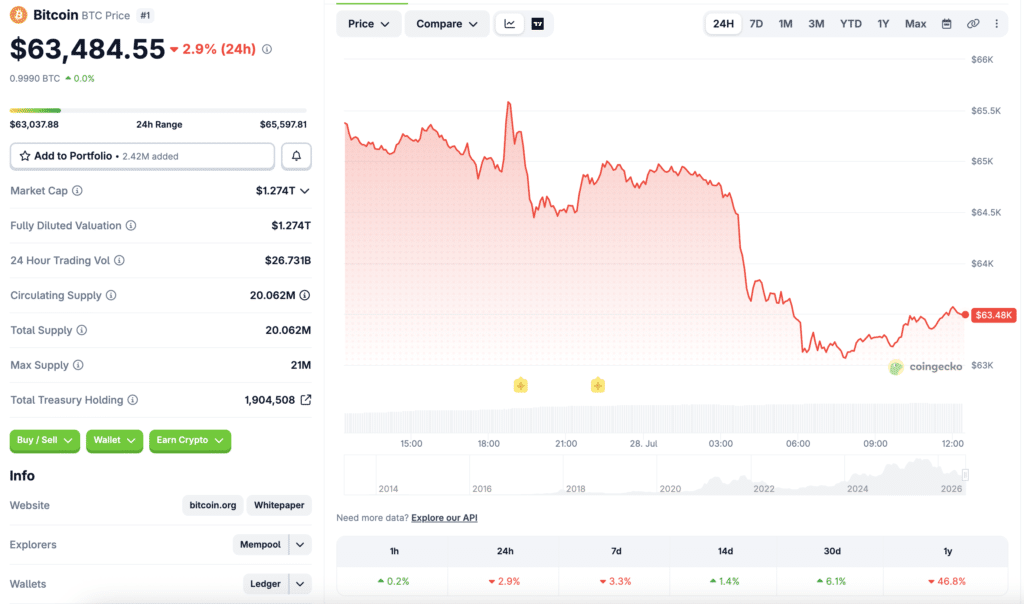
Bitcoin fell about 2.7% after the close of U.S. trading as South Korea’s KOSPI index posted a historic 10% decline, underscoring a broad risk-off move across global markets. The moves came amid heightened concern over an imminent Federal Reserve interest rate decision and key U.S. economic data. In Washington, consideration of the CLARITY Act was also delayed again in the U.S. Senate.
Key Takeaways
Bitcoin fell about 2.7% as investors reduced exposure to risk assets.
South Korea’s KOSPI plunged 10%, reflecting broader weakness in global equity markets.
The U.S. Senate delayed the CLARITY Act, extending regulatory uncertainty for the crypto industry.
Investors are awaiting the Federal Reserve’s interest rate decision and key U.S. economic data.
Bitcoin Slips as Markets Move Into Risk-Off Mode
Bitcoin was the main focus in markets after it fell nearly 2.7% and traded at $63,492.56 during the session. The decline came shortly after U.S. stock exchanges closed and coincided with a sharp one-day drop in South Korea’s KOSPI, which fell 10%.
Other major cryptocurrencies, including Ethereum, also declined as investors moved away from risk assets.
Why Bitcoin Is Falling
The decline is being driven by more than crypto-specific developments. Concerns about the global economy, uncertainty surrounding Federal Reserve interest rates, and a steep drop in Asian equities have led investors to reduce exposure to riskier assets.
Bitcoin has often traded like a technology growth asset during periods of volatility. When stock markets weaken and investors seek safer positions, Bitcoin has tended to sell off alongside equities.
The latest market data show higher volatility across financial markets. Even so, Bitcoin continues to hold a market capitalization above $1.27 trillion, and investors are watching upcoming economic events for the next major catalyst.
KOSPI Drop Adds Pressure to Crypto Markets
The KOSPI decline quickly became a major factor in the broader market selloff. South Korea’s benchmark index lost 10%, one of its steepest recent drops, with selling concentrated in semiconductor and technology stocks.
South Korea is one of the world’s most active cryptocurrency trading regions, so weakness in local equities can spill over into digital assets. That dynamic appeared to weigh on Bitcoin as well as other cryptocurrencies, including Ethereum, Solana, and XRP.
Bitcoin Falls After U.S. Market Close as Investors Await the Fed
The timing of Bitcoin’s decline also drew attention. The move came after the close of U.S. markets and ahead of Wednesday’s Federal Reserve policy announcement, followed by major U.S. data releases on Thursday, including GDP and Core PCE inflation.
Markets often become more volatile before major macroeconomic events, and cryptocurrency trading is no exception. Many traders have preferred reducing leverage rather than taking aggressive positions before announcements that could alter expectations for monetary policy.
CLARITY Act Delay Adds to Uncertainty
Sentiment was also affected by developments in Washington. U.S. senators delayed discussion of the CLARITY Act, a crypto-related bill, in favor of sanctions against Russia. The legislation is now expected to be taken up the following week, when Congress enters its August recess.
The delay does not change current regulations, but investors had been looking to the bill for greater clarity on U.S. crypto oversight. Its postponement added another layer of uncertainty to an already fragile market environment.
Crypto Tracks Broader Macro Trends
The broader crypto market has increasingly moved in line with global financial markets rather than trading independently. Bitcoin has become more sensitive to shifts in equity indexes, bond yields, and central bank policy expectations.
This latest decline reinforces that digital assets remain highly responsive to macroeconomic conditions, especially when inflation and interest-rate expectations are in flux. Institutional investors often respond by trimming exposure to higher-risk assets until the outlook becomes clearer.
Bitcoin and KOSPI Sell Off in Parallel
The latest downturn showed how closely equities and digital assets can react to the same macroeconomic pressures. Bitcoin and the KOSPI were both hit by the same wave of investor caution, even though the two markets are driven by different underlying assets.
The main force behind the selloff was not a single sector-specific issue, but broader market sentiment.
What Could Happen Next
Market participants are now focused on whether the decline in Bitcoin proves temporary or develops into a broader correction. Much will depend on the Federal Reserve’s guidance and the next round of U.S. economic data.
A softer inflation reading or more dovish comments from the Fed could improve risk appetite and support a rebound across digital assets. By contrast, stronger-than-expected inflation or a more hawkish policy stance could prolong volatility.
Traders are also watching market liquidity, trading volume, exchange inflows, and institutional participation for signs that selling pressure is easing.
Outlook
Bitcoin’s decline was more than a routine pullback in the crypto market. The simultaneous weakness in Bitcoin and South Korea’s KOSPI highlighted how closely digital assets are now linked to broader macroeconomic conditions.
With Federal Reserve policy, inflation data, and crypto regulation all in focus, investors are likely to keep a close eye on both economic indicators and regulatory developments in the coming days.

