US Spot Bitcoin ETFs Face First September Test as $236.46M Outflow Erases Prior Day's Inflows
Key Takeaways
- •US spot Bitcoin ETFs recorded approximately $236.5 million in net outflows on September 1, the largest daily outflow since July 31, offsetting the previous session's $216.7 million inflow.
- •The outflow was concentrated in BlackRock's IBIT ($201.2 million redeemed) and Fidelity's FBTC ($43.7 million redeemed), while Bitwise's BITB took in $8.4 million.
- •August was the strongest month of 2026 for Bitcoin ETFs, with roughly $3.52 billion in net inflows and a Bitcoin price gain of about 25%, its best month since November 2024.
- •Total net assets across US spot Bitcoin ETFs rose from $76.29 billion in July to about $99.61 billion by the end of August, while monthly trading volume climbed nearly 49%.
- •Bitcoin ETF flows returned to net inflows of $101 million on September 2, and analysts warn against drawing trend conclusions from a single day's flow data.
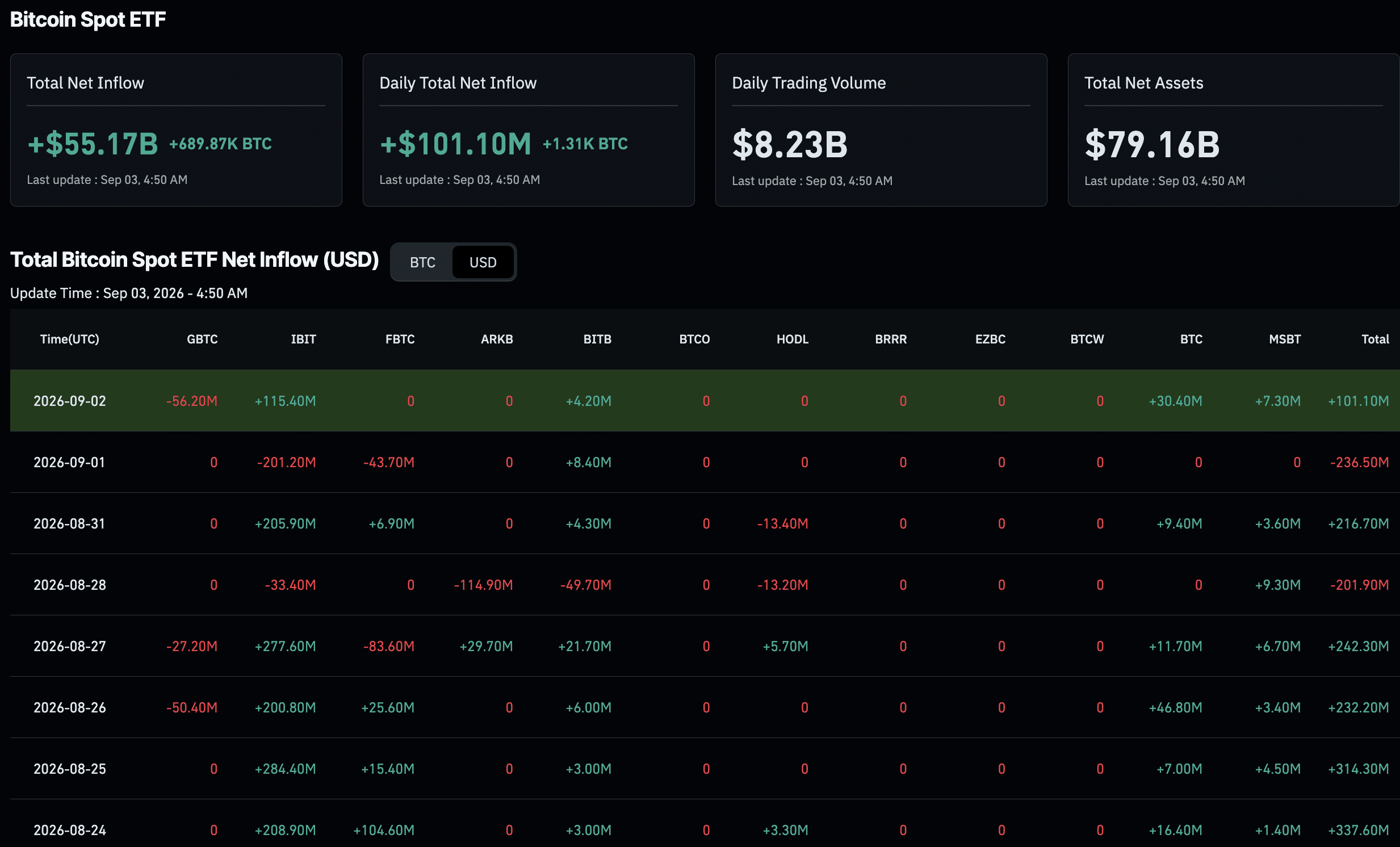
US spot Bitcoin ETFs recorded approximately $236.46 million in net outflows on September 1, wiping out the previous session's $216.70 million inflow in a single trading day. The reversal came just as BTC price briefly dipped below $77,000, having traded above $80,000 as recently as late August.
Because spot Bitcoin ETFs hold actual BTC rather than futures contracts, daily creations and redemptions translate fairly directly into purchases or sales of the underlying asset — which is why single-day flow prints like this one draw close attention from traders as a proxy for institutional positioning.
At the time this data was reported, BTC traded near $77,900.00, up +1.3% on the day — a sign the drop was not a rout but rather a pause after a bullish month in which Bitcoin rose +23%. August was the strongest month of 2026 for Bitcoin ETFs by a wide margin, yet September opened with the largest daily outflow since July 31. One number does not cancel the other, but it does raise the question of whether institutional demand is cooling or simply catching its breath.
What the August and September Flow Data Shows
August was not a fluke session — it was a month-long accumulation. According to SoSoValue data cited in the primary reporting, US spot Bitcoin ETFs pulled in roughly $3.52 billion in net inflows, dwarfing July's approximately $172 million. Bitcoin itself gained about +25% over the same stretch, its best monthly performance since November 2024.
The funds posted inflows in 16 of August's 21 trading sessions, anchored by a nine-day streak from August 17 through August 27, as detailed in coverage of that inflow streak.
August 27 alone brought in $242.3 million, and the accumulated demand cut 2026's year-to-date outflow total from roughly $5.29 billion at the end of July to $1.77 billion by the end of August — a 66% improvement.
September 1 broke that pattern, and the issuer breakdown shows where the pressure concentrated. According to Farside Investors' data, the roughly $236.5 million outflow was split into a $201.2 million redemption from BlackRock's IBIT, a $43.7 million redemption from Fidelity's FBTC, and an $8.4 million inflow into Bitwise's BITB — meaning the sell-side pressure was not evenly distributed across the complex.
IBIT's dominance cuts both ways: the same fund drove most of August 31's $216.7 million inflow, underscoring how concentrated recent Bitcoin ETF demand has been around BlackRock's product. That concentration has a mechanical implication for the flow data itself: when the largest fund in the complex sees a redemption, the aggregate daily figure swings disproportionately, so headline numbers can look more dramatic than the behavior across the broader ETF landscape.
(Source: CoinGlass)
What Does This Mean at Scale?
Zooming out from daily prints, August's scale becomes clearer. Total net assets across US spot Bitcoin ETFs climbed from $76.29 billion in July to approximately $99.61 billion by the end of August, while monthly trading volume rose nearly 49%, from $39.37 billion to $58.63 billion.
Ethereum and XRP ETFs told a similar story of recovering institutional demand. Ethereum ETFs flipped from roughly $1.12 billion in year-to-date outflows at the end of July to about $732 million in inflows by the end of August, and XRP ETF inflows rose from $343 million to approximately $502 million over the same window. The arrival of ETF wrappers for multiple assets beyond Bitcoin has given institutional allocators a common, regulated vehicle for comparing exposure across the largest crypto assets — one reason analysts watch cross-product flows side by side.
On September 1 itself, both product types continued to attract capital: ETH ETFs took in about $11 million and XRP ETFs about $14.4 million, even as Bitcoin ETFs bled money. That divergence hints at capital rotating within crypto rather than exiting outright, though the primary reporting frames it as a possibility rather than a confirmed pattern.
Bitcoin Price and ETF Flow Outlook
U.S. spot Bitcoin ETFs recorded $101 million in net inflows on Sept. 2, led by BlackRock's IBIT with $115 million. Spot Ether ETFs, meanwhile, posted $48.08 million in net outflows, even as BlackRock's Staked ETH ETF (ETHB) attracted $52.91 million. BlackRock is the world's… pic.twitter.com/s4ygLYqb2J
— Wu Blockchain (@WuBlockchain) September 3, 2026
That September 2 reading — a return to net inflows a single session after the outflow — is itself a data point for the debate: daily ETF flow figures have repeatedly whipsawed during 2026, and analysts generally caution against reading a trend from any one day's print.
In other Bitcoin ETF news, the flow reversal lines up with a rougher patch for BTC price. Bitcoin briefly dropped below $77,000 at the start of September after trading above $80,000 late in August, and the primary reporting flags rising Treasury yields and broader macroeconomic uncertainty as headwinds that could make a repeat of August's rally harder to achieve. ETF flows have historically been sensitive to this macro backdrop: risk assets broadly tend to face pressure when Treasury yields rise, since higher yields raise the opportunity cost of holding non-yielding assets like Bitcoin.
Three paths from here are worth tracking rather than predicting:
- Bull case: ETF inflows resume in the sessions following September 1, giving the rally fresh legs.
- Base case: Flows stay choppy while the market digests a 25% monthly gain; a single outflow day does not establish a trend on its own.
- Bear case: Outflows persist amid continued BTC price weakness near $77,000, adding selling pressure rather than absorbing it.
This article is based on reporting originally published by 99Bitcoins.

