Bitcoin Recovery Stays Fragile as US Spot ETF Outflows Hit Record $5.39 Billion in November
Key Takeaways
- •US spot Bitcoin ETFs recorded $453.12 million in net outflows on Wednesday, extending the withdrawal streak to seven consecutive trading days.
- •November's cumulative Bitcoin ETF outflows reached $5.39 billion, the largest monthly total since the products launched in January 2024.
- •October PCE inflation accelerated to 3.8% annually, with core PCE rising to 3.3%, reinforcing expectations of a Federal Reserve rate hike at the December policy meeting.
- •Bitcoin touched a yearly low of $55,130 last week and faces immediate resistance at $62,703, with a dense resistance zone between $71,569 and $74,961 overhead.
- •Renewed Middle East tensions, including Iran-backed Houthi attacks on Saudi Arabia and retaliatory strikes in Yemen, are adding to risk aversion and pressuring risk-sensitive assets.
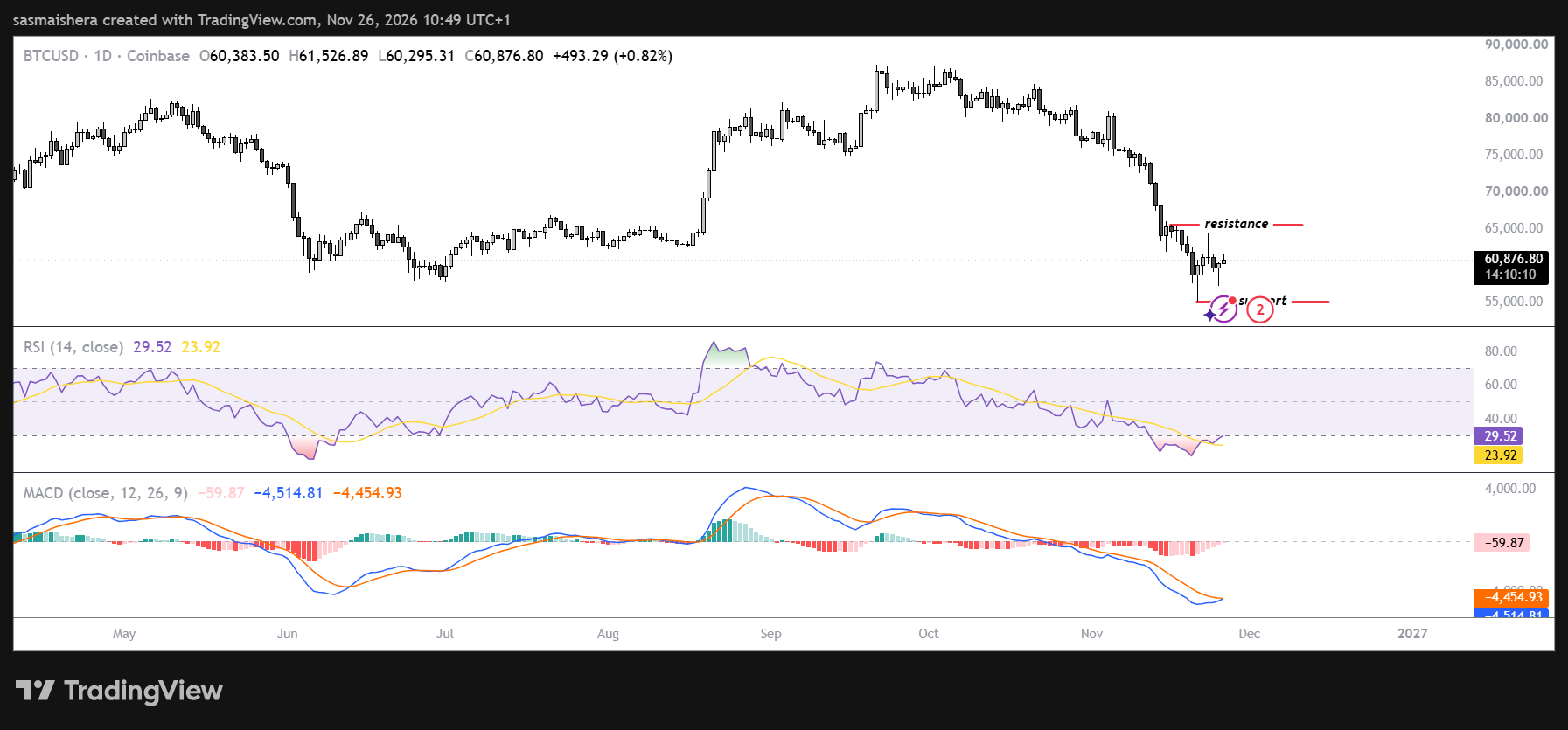
Bitcoin (BTC) extended its recovery on Thursday, climbing back above $60,800 and trading around $60,850 after posting modest gains in the previous session. The cryptocurrency, however, remains firmly within a broader downtrend, as persistent institutional withdrawals, inflation concerns, and escalating geopolitical tensions continue to weigh on investor sentiment. Record monthly outflows from US spot Bitcoin exchange-traded funds (ETFs) continue to undermine buying demand, while expectations of further Federal Reserve interest rate increases threaten to limit recovery attempts. Although technical indicators suggest that bearish momentum is gradually weakening, the cryptocurrency remains vulnerable to another significant correction while institutional selling persists.
Bitcoin ETF Outflows Reach Record $5.39 Billion in November
Institutional selling pressure continues to weigh heavily on Bitcoin, which has erased most of its third-quarter gains after reaching a yearly low of $55,130 last week.
According to SoSoValue data, US spot Bitcoin ETFs recorded $453.12 million in net outflows on Wednesday. The withdrawals extended the funds' streak to seven consecutive trading days, underscoring the persistence of institutional selling. Spot Bitcoin ETFs hold the cryptocurrency directly and trade like ordinary shares, which makes their daily flow figures a publicly available running tally of institutional buying and selling.
The November tally is even larger. Bitcoin ETFs have posted cumulative net outflows of $5.39 billion so far this month, their largest monthly total since the products launched in January 2024. If redemptions continue at the current pace, Bitcoin could struggle to establish a sustainable recovery, increasing the risk of another test of its yearly low.
Bitcoin's recovery prospects face additional challenges following the release of the latest US Personal Consumption Expenditures (PCE) Price Index. Headline PCE inflation increased by 0.3% in October, while the annual inflation rate accelerated to 3.8%, up from September's upwardly revised reading of 3.7%. Core PCE inflation, which excludes volatile food and energy prices, climbed to 3.3% annually from 3.1% in September, exceeding market expectations.
The stronger-than-expected inflation reading reinforced expectations that the Federal Reserve will raise interest rates at its December policy meeting — a prospect that could limit Bitcoin's recovery attempts.
Middle East Tensions Add to Risk Aversion
Renewed geopolitical tensions in the Middle East are adding another layer of uncertainty to global financial markets. Iran-backed Houthi forces claimed responsibility for attacks targeting Saudi Arabia, while the Saudi-led coalition reported retaliatory strikes against Houthi targets in Yemen.
The escalating conflict could heighten concerns about regional stability and energy supplies, potentially adding to existing inflationary pressures. Combined with expectations of tighter US monetary policy, these developments could strengthen demand for the US dollar and discourage exposure to risk-sensitive assets. As a result, Bitcoin's recent rebound could struggle to gain momentum as investors navigate an increasingly uncertain macroeconomic environment.
Technical Outlook: Recovery Attempts Could Attract Fresh Selling
Bitcoin traded around $60,880 on Thursday but remains significantly below its major daily exponential moving averages (EMAs). The 50-day EMA stands at $71,569, while the 100-day and 200-day EMAs are positioned at $73,703 and $74,726, respectively.
Momentum indicators continue to reflect bearish market conditions, although selling pressure appears to be moderating. The daily Relative Strength Index (RSI) stands near 29, indicating oversold conditions. Meanwhile, the Moving Average Convergence Divergence (MACD) remains negative, although its narrowing histogram suggests weakening downside momentum. These readings leave room for a short-term relief rally but do not confirm a broader bullish reversal.
Bitcoin faces immediate resistance at $62,703, a level corresponding to the 23.6% Fibonacci retracement of its recent decline. A successful breakout could expose the 38.2% and 50% Fibonacci retracement levels at $67,388 and $71,175, respectively. Beyond those thresholds, a dense resistance zone between $71,569 and $74,961 — comprising major moving averages, Fibonacci levels, and a previously broken trendline — could limit further upside.
On the downside, Bitcoin's next meaningful structural support remains its yearly low of $55,130 — the level it touched last week — where some bearish traders could begin taking profits.
For now, record ETF withdrawals, persistent inflation, and mounting geopolitical uncertainty continue to overshadow improving momentum indicators. In the sessions ahead, daily ETF flow reports and the Federal Reserve's December policy meeting stand as the nearest scheduled checkpoints for whether these pressures ease or intensify. Unless institutional demand recovers and Bitcoin reclaims key resistance levels, relief rallies could attract renewed selling pressure.
Source: CoinJournal

