Bitcoin ETFs Record $484.9 Million in Daily Outflows as BTC Price Tests $82,000 Support
Key Takeaways
- •U.S. spot Bitcoin ETFs recorded $484.9 million in net outflows on Oct. 7, the largest daily withdrawal since June 25, when funds lost $691.7 million.
- •Wednesday's redemptions flipped October's monthly flow balance to approximately $163.3 million in net outflows, undoing the roughly $321.6 million in inflows from the month's first four sessions.
- •BlackRock's iShares Bitcoin Trust led the withdrawals with $207.7 million, followed by Fidelity's FBTC at $105.1 million and ARK 21Shares' ARKB at $101.7 million, indicating broad-based redemptions across funds.
- •Bitcoin traded near $82,700 on Oct. 8 after falling below $83,000, with analysts flagging bearish Ichimoku Cloud signals and identifying $80,000 and $79,500 as key downside support levels.
- •Ether ETFs registered six consecutive sessions of negative flows through Tuesday, and preliminary Wednesday figures pointed to additional withdrawals.
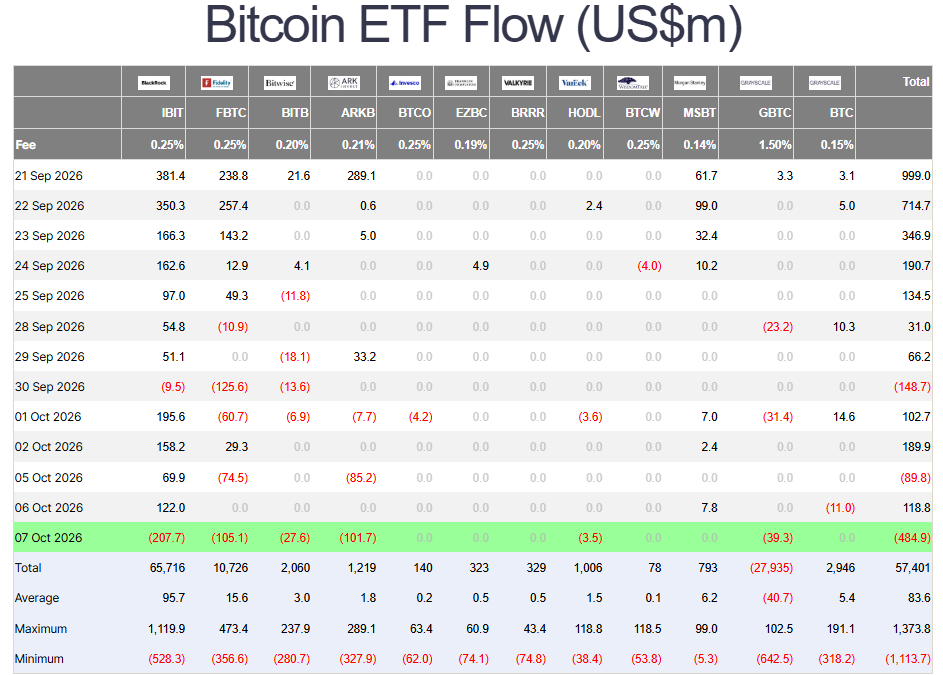
U.S. spot Bitcoin exchange-traded funds recorded $484.9 million in net outflows on Wednesday, Oct. 7, their largest single-day withdrawal since June, according to Farside Investors data. The redemptions reversed the prior session's inflows and erased the funds' earlier October gains, leaving monthly flows negative.
The outflows arrived as Bitcoin's price weakened, with the cryptocurrency slipping below $83,000. The reversal coincided with renewed selling pressure across crypto markets, although fund flows alone cannot establish causation.
Spot Bitcoin ETFs hold bitcoin directly and trade on U.S. exchanges like ordinary shares, offering exposure through standard brokerage accounts without requiring shareholders to manage custody. Data providers such as Farside Investors calculate each session's net figure by subtracting redemptions from new across the funds — a daily series widely tracked as an indicator of investor demand for bitcoin.
Bitcoin ETFs Record Largest Daily Withdrawals Since June
Farside Investors data showed Wednesday's $484.9 million outflow was the largest daily withdrawal since June 25, when funds lost $691.7 million. The redemptions followed $118.8 million in net subscriptions during the preceding trading session.
BlackRock's iShares Bitcoin Trust (IBIT) led the withdrawals, losing $207.7 million after attracting $122 million during Tuesday's session before investors reversed course. Fidelity's Wise Origin Bitcoin Fund (FBTC) followed with $105.1 million in outflows, while ARK 21Shares' ARKB lost $101.7 million. Bitwise's Bitcoin ETF recorded $27.6 million in redemptions, and Grayscale's GBTC lost $39.3 million.
The figures reflected broad withdrawals rather than selling concentrated in a single fund, though BlackRock accounted for the largest individual share of the day's negative flows.
October's first four trading sessions had generated approximately $321.6 million in net inflows. Wednesday's withdrawals pushed the monthly balance to roughly $163.3 million in net outflows, interrupting the recovery that began with October's opening sessions and placing renewed attention on institutional demand for U.S.-listed cryptocurrency investment products.
BlackRock describes IBIT as a fund providing Bitcoin exposure without direct custody requirements for shareholders. Its daily subscriptions and redemptions therefore offer one measure of investor demand through traditional brokerage accounts.
Bitcoin Price Falls Below $83,000 as ETFs Face Renewed Selling
CoinGecko market data showed Bitcoin trading around $82,700 on Thursday, Oct. 8, down from levels above $85,000 earlier in the week, a decline that weakened the cryptocurrency's short-term price structure. Bitcoin remained below a closely watched resistance area, and buyers struggled to recover the previous trading range after failing to sustain higher prices.
Crypto analyst Ella wrote on X that Bitcoin opened near $85,500 before losing the $84,000 level, with selling volume accompanying the drop below $83,000. Ella identified $83,000 as an important short-term level: a recovery above that area could support another attempt toward the $84,500–$85,000 resistance range, while sustained trading below the threshold could expose lower support levels, with the $81,800–$82,000 region the next potential area for buyers.
The analysis followed another unsuccessful attempt to overcome resistance near $87,000, a failure that left the short-term recovery dependent on buyers regaining previously lost price levels.
Outflows Coincide With Bearish Technical Signals
CryptoSavingExpert identified further technical weakness using Bitcoin's four-hour Ichimoku Cloud indicator — a charting tool that projects support, resistance, and trend-momentum zones on a price chart — writing on X that BTC had fallen below the cloud and its associated trend lines. The Tenkan-sen and Kijun-sen also remained above the market price, suggesting weakened short-term momentum.
The analyst identified the cloud between $84,300 and $84,700 as an immediate resistance region. A recovery through $84,000 followed by sustained trading above $85,000 could challenge the bearish setup, with $86,000–$87,000 a subsequent recovery target under that scenario. Conversely, a break below immediate support could increase pressure on the cryptocurrency, with $80,000 identified as an intermediate downside level and major support near $79,500.
These technical levels represent conditional trading scenarios rather than confirmed future movements, and price reactions around support and resistance would determine which scenario gains further evidence.
Ether ETFs Extend Withdrawal Streak
Ethereum investment funds also faced persistent withdrawals during the same period. Farside Investors recorded six consecutive sessions of negative Ether exchange-traded fund flows through Tuesday. Wednesday's preliminary figures showed additional withdrawals, although the dataset lacked complete figures for some funds, preventing a definitive comparison of the day's combined Ether fund redemptions.
The next U.S. trading session will offer another test of institutional demand. Traders will also monitor Bitcoin's reaction around $82,000, any recovery toward the $84,000 resistance area, and whether the downside levels flagged in the technical scenarios — $80,000 and $79,500 — hold. Ether fund flows will offer a further gauge of demand for crypto exchange-traded products.
This article is based on reporting originally published by The Market Periodical.

