U.S. Spot Bitcoin ETFs Post $201.9 Million Net Outflow, Ending Nine-Day Inflow Streak
Key Takeaways
- •U.S. spot Bitcoin ETFs recorded approximately $201.9 million in net outflows on Aug. 28, ending a nine-session inflow streak.
- •The nine-session streak began on Aug. 17 and added roughly $3.04 billion, with the prior session (Aug. 27) bringing in $242.3 million in net inflows.
- •Federal Reserve Chair Kevin Warsh's Jackson Hole remarks raised the possibility of additional interest-rate hikes, which can weigh on risk assets including cryptocurrencies.
- •Ethereum ETFs continued to see net inflows over the same period, while Bitcoin fell to $77,580 during the outflow session.
- •A single day of outflows cannot determine whether the move reflects macro conditions, profit-taking, or rebalancing; subsequent flow data will show whether it was an isolated pause.
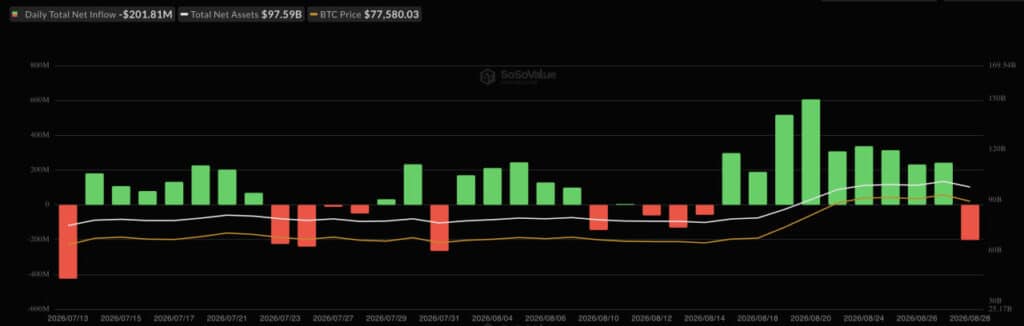
U.S. spot Bitcoin ETFs recorded approximately $201.9 million in net outflows on Aug. 28, bringing a nine-session inflow streak to an end. The reversal drew attention after nine consecutive sessions of positive flows, though the outflow remained small relative to the billions of dollars in cumulative net inflows the products have taken in since launching. Spot Bitcoin ETFs began trading in the United States in January 2024 after the SEC approved the products, and they have since become one of the main vehicles through which institutional and retail investors gain regulated exposure to Bitcoin without holding the asset directly.
A single day of net outflows does not by itself establish a broader shift in demand. Daily ETF activity can vary considerably, while the longer-term picture includes substantial capital committed to spot Bitcoin ETFs. Flow data are published each trading day by trackers such as SoSoValue and CryptoRank, making ETF creations and redemptions one of the most closely watched indicators of shifting positioning in digital assets.
Fund-level flow figures for the Aug. 28 session were reported for ARKB, BITB, IBIT and MSBT, alongside the overall net outflow. These tickers correspond to products from Ark 21Shares, Bitwise, BlackRock and Morgan Stanley-linked vehicles among the broader spot Bitcoin ETF lineup. For context, CryptoRank reported that the preceding Aug. 27 session brought in $242.3 million in net inflows. According to its report, the nine-session streak began on Aug. 17 and added approximately $3.04 billion to the funds, with Aug. 27 marking the ninth consecutive trading session of net inflows.
Bitcoin ETF Demand in the Bigger Picture
Since launch, spot Bitcoin ETFs have attracted billions of dollars in cumulative net inflows. The Aug. 28 withdrawal did not necessarily indicate a broad weakening of institutional sentiment toward Bitcoin. Ethereum ETFs continued to receive net inflows over the same period, a divergence that may reflect strategic rebalancing among institutional investors rather than a retreat from digital assets — although the available data do not establish the reason for the different flow patterns.
Coin Bureau highlighted the move on X:
BREAKING: $201,810,000 fled Bitcoin ETFs in a single day after Warsh's speech. US spot Bitcoin ETFs posted the outflow on Friday as Bitcoin dumped to $77,580, per SoSoValue. One day earlier, the same funds took in $242 MILLION. pic.twitter.com/IsLfy0SZX5 — Coin Bureau (@coinbureau) August 29, 2026
Federal Reserve Chair Kevin Warsh's Jackson Hole remarks raised the possibility of additional interest-rate hikes, adding to market caution. Jackson Hole, the Federal Reserve's annual economic policy symposium in Wyoming, is a venue where Fed chairs have historically signaled shifts in policy direction. According to the report, higher-rate expectations can strengthen the U.S. dollar and weigh on risk assets, including cryptocurrencies.
Whether the Aug. 28 outflow was tied to the macro backdrop, profit-taking, or portfolio rebalancing cannot be determined from a single day of flow data. Monitoring both ETF flows and central-bank policy signals can provide context for assessing changes in the digital-asset market. Subsequent sessions of flow data — particularly whether outflows persist or inflows resume — will indicate whether Aug. 28 was an isolated pause or the start of a longer trend.
The original article appeared first on 99Bitcoins.

