Bitcoin Nears $79,000 as Treasury Buyback Expansion Lifts Crypto Demand
Key Takeaways
- •Bitcoin gained 7.89% in 24 hours to $78,589.05, extending its weekly rise to nearly 20% and briefly trading above $79,000.
- •US spot Bitcoin ETFs recorded $606.29 million in inflows on August 20, their largest daily total since May 1, with BlackRock's IBIT alone taking in $502.99 million.
- •Treasury raised its maximum liquidity-support bond buyback from $2 billion to at least $4 billion per operation effective September 9, a move traders interpreted as a liquidity signal that weakened the dollar.
- •Nearly $709 million in Bitcoin short positions were liquidated in one 24-hour period, amplifying the rally, while an RSI 14 reading of 80.43 indicated overbought conditions.
- •The $75,000-$76,000 zone now serves as key technical support; losing it could expose $70,740 and the 38.2% retracement near $69,113.
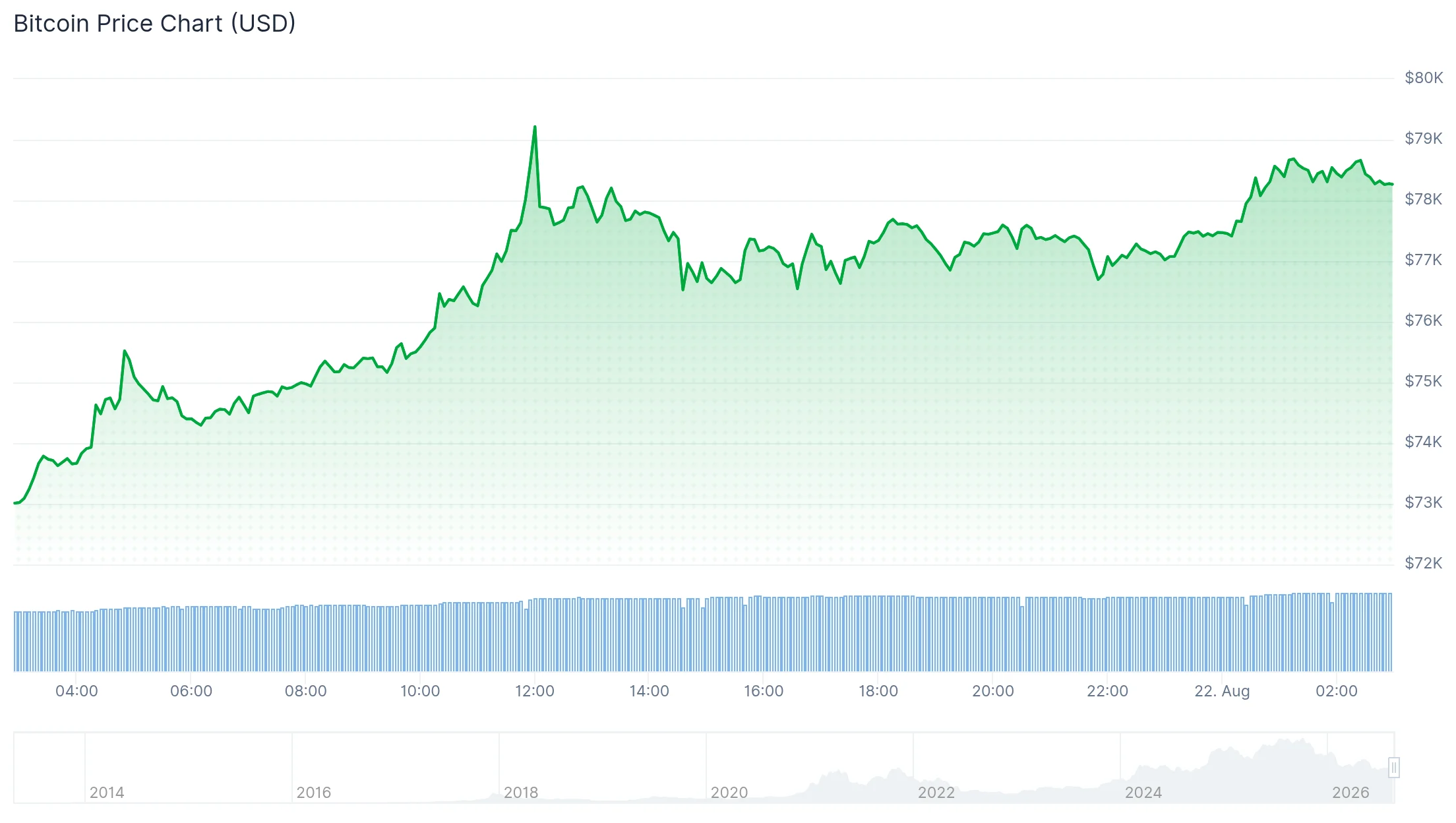
Bitcoin climbed 7.89% to $78,589.05 over 24 hours, leading gains across the cryptocurrency market and extending a weekly advance of nearly 20%. The move pushed BTC above the $75,000 breakout level and briefly above $79,000, with renewed institutional demand providing the clearest source of spot buying. US spot Bitcoin ETFs absorbed $606.29 million on August 20, their strongest daily intake since May 1.
The rally also followed a Treasury decision to expand buybacks of long-dated bonds. Traders treated the announcement as a liquidity signal, while falling dollar pressure lifted scarce assets. Bitcoin showed a 90% short-term correlation with gold during the macro-driven move, supporting the view that both assets followed the same macro trade.
ETF Inflows and the Treasury Trigger
Bitcoin ETF inflows extended to a fourth consecutive session, bringing the four-day total to roughly $1.61 billion. BlackRock's IBIT, the largest US spot Bitcoin ETF by assets, collected $502.99 million, more than four-fifths of the daily total, while Fidelity's FBTC followed with $64.74 million. Bitwise, ARK, and Invesco also reported additions. The products have operated since January 2024, when US regulators approved the first spot Bitcoin ETFs, and their daily flows are widely tracked as a signal of institutional demand.
That allocation pattern matters because ETF purchases create direct demand for Bitcoin held by regulated funds. The concentration in IBIT shows that the latest advance relied heavily on one vehicle. Sustained daily flows above $200 million would offer stronger evidence that fresh capital is replacing forced derivatives buying.
The Treasury provided the macro trigger. It raised the maximum liquidity-support buyback from $2 billion to at least $4 billion per operation, with the change beginning September 9 and covering 10-year through 30-year nominal coupon securities. Treasury has run regular buybacks since 2024, its first sustained program in more than two decades, and finances the purchases with additional bill issuance.
Bond buybacks do not equal Federal Reserve money creation. They can improve market functioning and signal concern about elevated long-term yields. The initial response lowered yields and weakened the dollar, conditions often favorable for Bitcoin and gold. Yet long yields later rebounded, limiting claims that the program changed the macro regime.
Bitcoin's gold correlation added another layer of context. Both assets rose amid inflation, fiscal stress, and currency debasement concerns. Bitcoin critic Peter Schiff acknowledged that investors were choosing between competing hedges, an observation that described behavior rather than an endorsement of Bitcoin's long-term value.
Short Squeeze Leaves Rally Facing a Crucial Support Test
A crypto short squeeze magnified the spot-led move. Data from Coinglass, a crypto derivatives data tracker, showed nearly $709 million in Bitcoin shorts liquidated during one 24-hour period, against about $139 million in longs. Across the broader market, short liquidations reached about $1.13 billion, compared with $290 million in long liquidations.
Forced closures require traders to buy back Bitcoin, accelerating price gains when liquidity is thin. That feedback loop helped carry the Bitcoin price through $75,000 and briefly above $79,000. RSI 14 reached 80.43, far above the 70 level that chart analysts treat as overbought, showing strong momentum in an overextended market. Once the short squeeze fades, new spot demand must carry the advance.
The technical structure now centers on the $75,000 to $76,000 zone. Holding that zone would preserve the breakout and keep the $80,256 Fibonacci extension within reach. A loss of support could expose $70,740, followed by the 38.2% retracement near $69,113. Falling Bitcoin ETF inflows would increase that downside risk.
Prediction traders appear less convinced about immediate follow-through. Contracts on Kalshi, a CFTC-regulated prediction market, place the Bitcoin price near $77,000 for year-end despite the powerful weekly recovery. Those contracts had indicated about $66,000 before Wednesday's surge, showing that expectations adjusted quickly without projecting another large rise.
Regulation and Upcoming Macro Tests
Regulation remains another catalyst. President Donald Trump urged Congress to advance the CLARITY Act, a market-structure bill that would split digital-asset oversight between the SEC and the CFTC, while CFTC Chairman Michael Selig directed staff to prepare market rules. Clearer oversight could support longer-term participation, though it does not guarantee token purchases.
Bitcoin has trimmed its 2026 loss from nearly 30% to 11.4% during the four-day rebound, and the crypto market's Fear and Greed Index jumped from 34 to 72, moving out of fear territory. Treasury auctions scheduled for August 25 through August 27 will test demand for government debt. Weak Bitcoin ETF inflows, rising yields, or profit-taking would challenge the breakout before $80,256.

