Bitcoin Tests $69,000 as ETF Inflows Contrast With Professional Trader Caution
Key Takeaways
- •Spot Bitcoin ETFs saw roughly $981.2 million in net inflows across seven trading days beginning July 14, according to Santiment.
- •Bitcoin briefly traded above $66,800 this week before retreating from its highest level in more than a month.
- •The Coinbase Premium Index has stayed negative for more than 900 cumulative hours, indicating weaker Coinbase demand relative to Binance.
- •Grayscale said Bitcoin may now be driven more by macro conditions than by its traditional four-year halving cycle.
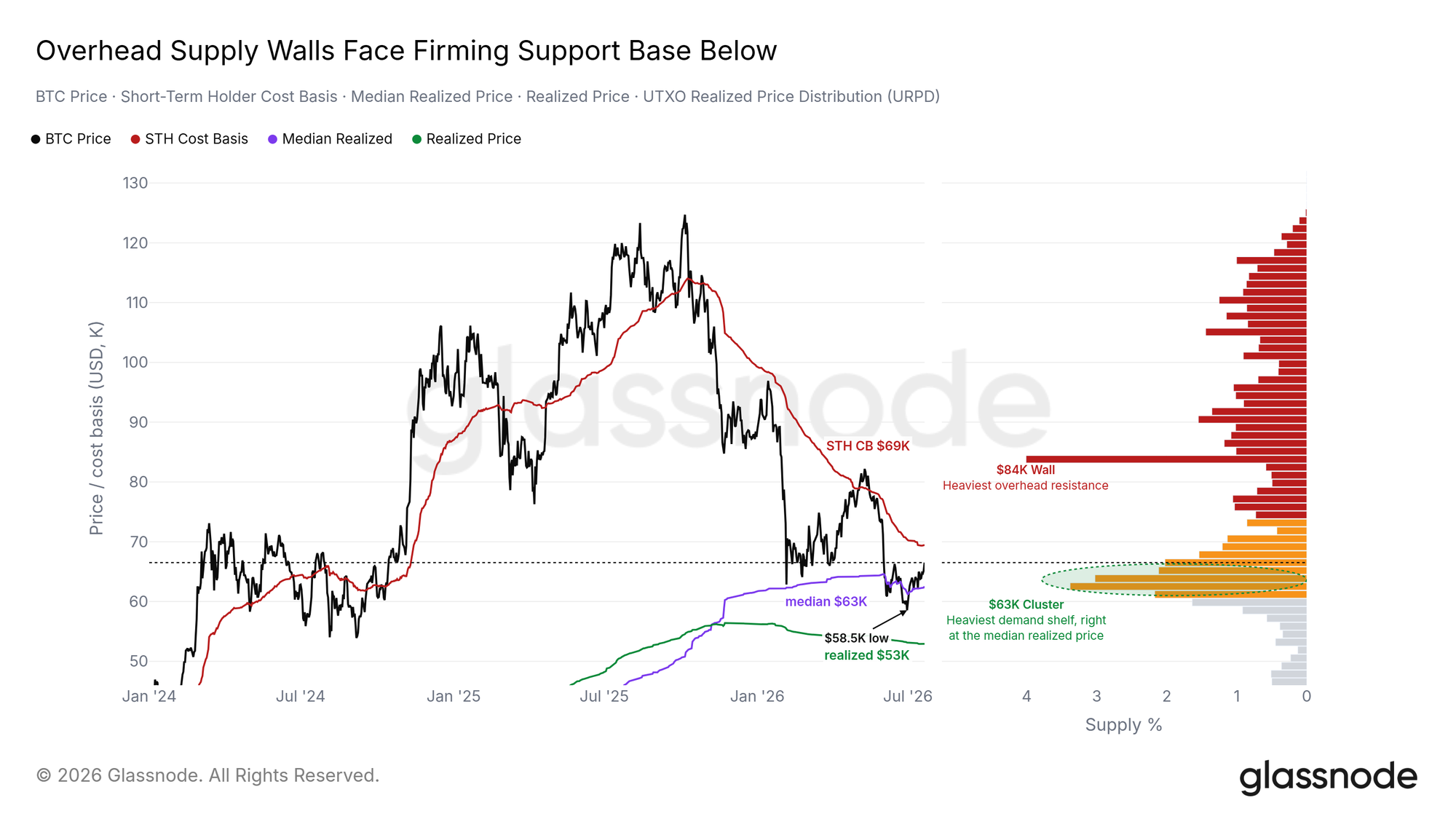
- •Glassnode identified the $69,000 Short-Term Holder Cost Basis as a key level, with a reclaim potentially opening a move toward $84,000.
Bitcoin (BTC) briefly climbed above $66,800 this week, reaching its highest level in more than a month before retreating. The move came as consecutive spot Bitcoin ETF inflows brought capital back into the market after a prolonged stretch of outflows.
The rebound has revived a recurring question for traders and analysts: whether Bitcoin has formed a low, or whether the latest advance is another bear-market rally that could fade. Because U.S. spot Bitcoin ETFs have become a major channel for regulated exposure to BTC, their daily flow data is now closely watched as a gauge of incremental demand, even when other parts of the market send mixed signals.
ETF Inflows Return After May and June Outflows
Bitcoin ETF flows weakened through May and June as investors withdrew funds. That pattern has now reversed. According to Santiment, roughly $981.2 million in net inflows returned across seven trading days beginning July 14.
A similar inflow streak last occurred before Bitcoin’s October 2025 rally, although previous patterns do not guarantee the same outcome.
💸 Bitcoin ETFs have now logged 7 straight trading days of inflows since July 14th, with Santiment tracking $981.2M net moving back in as $BTC pushed as high as $66.3K. After the heavy May and June outflow stretch, steady positive days are an encouraging sign that confidence is… pic.twitter.com/g0gvemNdwZ — Santiment Intelligence (@SantimentData) July 23, 2026
💸 Bitcoin ETFs have now logged 7 straight trading days of inflows since July 14th, with Santiment tracking $981.2M net moving back in as $BTC pushed as high as $66.3K. After the heavy May and June outflow stretch, steady positive days are an encouraging sign that confidence is… pic.twitter.com/g0gvemNdwZ
The recovery, however, also shows a widening divergence beneath the surface. While spot Bitcoin ETFs are again absorbing supply, other market indicators point to more cautious positioning among professional traders.
Coinbase Premium Signals Caution Among Professional Desks
The Coinbase Premium Index has remained negative for more than 900 cumulative hours, its longest such stretch in two years.
A negative premium indicates relatively weaker demand, or stronger selling pressure, on Coinbase compared with Binance. Because Coinbase is often used as a reference venue for U.S.-based institutional activity, the premium is commonly followed as one measure of whether professional spot demand is confirming price strength. In this case, the negative reading suggests continued caution among professional market participants.
Analyst Darkfost linked that caution to sticky inflation, rising oil prices, and a Federal Reserve that the analyst described as less transparent under its new chairman.
“This combination is what’s keeping institutional selling pressure going, as we’re still seeing today,” the analyst noted.
Taken together, the signals indicate that ETF inflows are helping support prices, but the recovery has not yet received confirmation from broader spot market demand. That leaves the rally exposed if ETF inflows begin to slow.
Grayscale Frames Debate Around Cycles and Macro Conditions
The divergence has fed a broader debate over what is currently driving Bitcoin. In a July 22 research note, Grayscale outlined two ways to view the bear market.
One view is based on Bitcoin’s four-year cycle, which is tied to halving events and points to further downside, with a possible bottom in September or October. Grayscale instead argued that Bitcoin has matured into a macro asset.
“The current bear market has also featured a major shift in Fed policy expectations and rising real interest rates. Naturally, if macro factors are in the driver’s seat, Bitcoin’s price could bottom when these macro factors turn around,” Zach Pandl, Grayscale Head of Research, said.
Glassnode, meanwhile, identified a key level for the near-term market structure.
“This is still a bear-market rally until the market proves otherwise, and the proof has an address,” the firm wrote.
Bitcoin is trading below the Short-Term Holder Cost Basis near $69,000, a closely tracked on-chain level that reflects the average acquisition price of more recent buyers. A reclaim of that level alongside steady inflows would open room toward $84,000, while rejection would send the price back toward the $63,000 demand shelf.
The next test is whether ETF buying continues and whether professional caution eases. Until Bitcoin reclaims $69,000, the burden of proof remains with the bulls.

