Bitcoin Consolidates as Spot ETF Inflows Reach $754 Million Ahead of US NFP Report
Key Takeaways
- •Spot Bitcoin ETFs recorded net inflows for four straight days, bringing weekly gains to $754 million, the strongest weekly performance since April.
- •Cumulative ETF inflows have surpassed $52 billion, with total assets under management reaching $78 billion, led by BlackRock's IBIT holding $48 billion.
- •Bitcoin balances on cryptocurrency exchanges have fallen to 2.49 million coins from a peak of 3.4 million, indicating investors are withdrawing and holding their assets.
- •Economists forecast approximately 85,000 new US jobs for July, with the NFP and upcoming CPI data expected to influence Federal Reserve interest rate decisions.
- •Bitcoin's daily chart displays a bearish double-top pattern at $66,933, with critical support at $60,000 and resistance at $65,674.
Bitcoin has traded sideways over the past several weeks, indicating that neither buyers nor sellers currently hold decisive control. This consolidation unfolds as American investors continue accumulating spot Bitcoin exchange-traded funds, with the cryptocurrency poised to react to the upcoming US nonfarm payrolls (NFP) release.
Spot Bitcoin ETF Inflows Climb
Signs of accumulation persist despite Bitcoin's range-bound price action. According to SoSoValue data, spot Bitcoin ETFs have registered net inflows for four consecutive days. The funds added $128 million on Thursday, bringing weekly gains to $754 million — the strongest weekly performance since April.
These inflows significantly exceed the $172 million recorded last month. Cumulative inflows now total over $52 billion, with the funds holding $78 billion in assets under management. BlackRock's IBIT alone accounts for $48 billion of that total. Since the SEC approved spot Bitcoin ETFs in January 2024, these vehicles have enabled institutional and retail investors to gain Bitcoin exposure through conventional brokerage accounts without directly holding the cryptocurrency.
This sustained accumulation likely explains the decline in Bitcoin held on cryptocurrency exchanges. Exchange balances currently stand at 2.49 million coins, down sharply from last year's high of 3.4 million. A decreasing exchange supply is generally interpreted as a signal that investors are withdrawing and holding their coins.
July NFP Report and Fed Rate Outlook
The next key macroeconomic catalyst for Bitcoin and the broader cryptocurrency market is the July NFP report, which measures the number of jobs created in the US economy during the previous month.
Economists' estimates compiled by Investing point to approximately 85,000 new jobs in July, following a revised 57,000 in June. Market participants will also scrutinize whether the Bureau of Labor Statistics (BLS) revises its June figure.
Earlier in the week, ADP reported that the private sector added 95,000 jobs, unchanged from the prior month's revised figure. The official NFP and ADP numbers frequently diverge, partly because the BLS report includes government employment while ADP covers only the private sector.
The jobs data arrives days before the US releases its latest consumer price index (CPI) report, which is expected to show that inflation remained elevated in July despite declining gasoline prices.
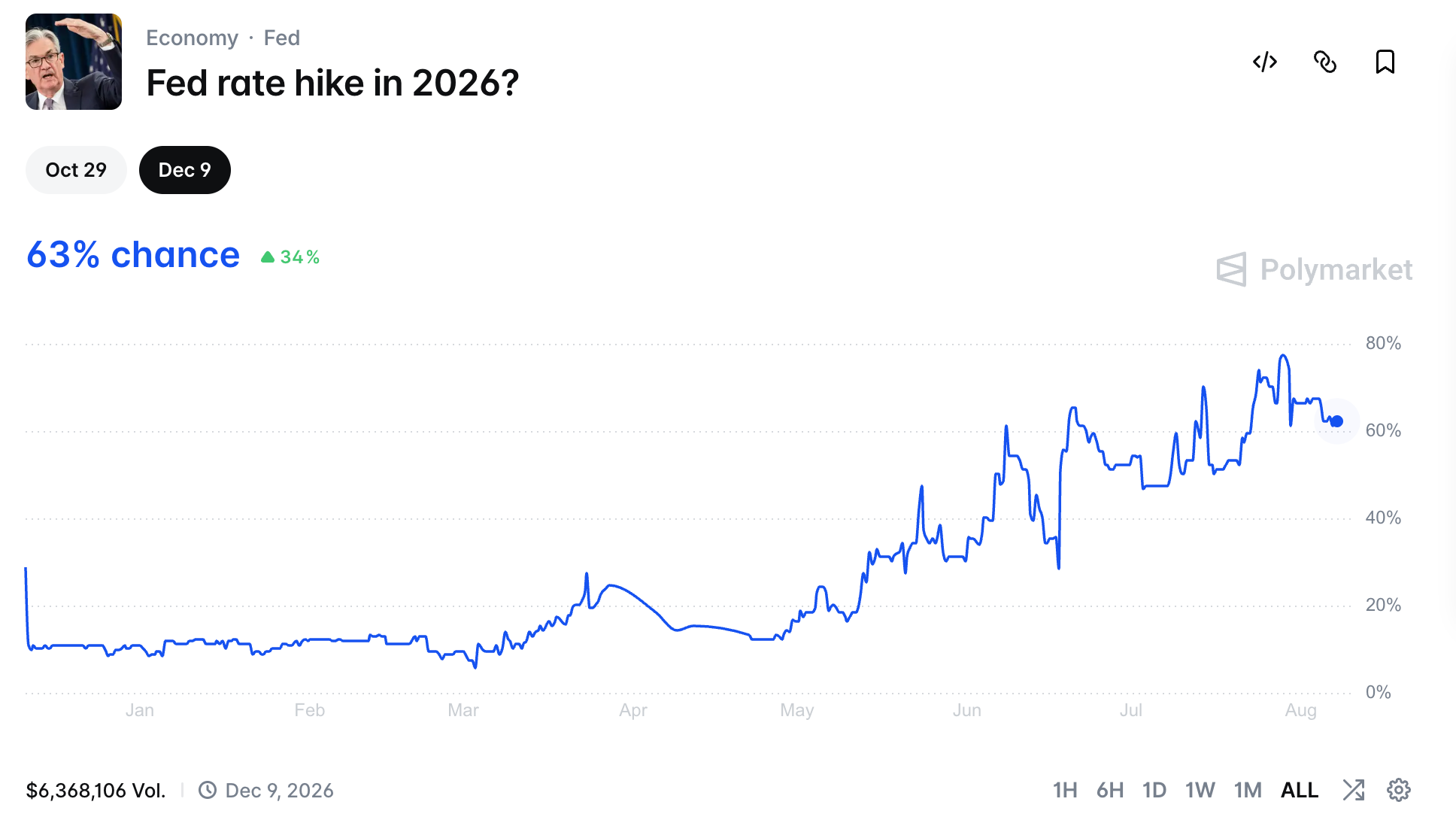
Both the NFP and CPI readings carry weight for the Federal Reserve's next interest rate decision. According to market pricing, the probability of a rate cut at the September meeting stood at 49%. The odds for October and December were 57% and 63%, respectively. Lower interest rates reduce the opportunity cost of holding non-yielding assets like Bitcoin, which is part of why crypto markets tend to respond to the Fed's policy trajectory.
Historically, Bitcoin and other cryptocurrencies have responded favorably when the Federal Reserve is either cutting rates or signaling future cuts. However, Bitcoin has remained muted even after recent major US economic events, including the Fed's latest policy decision, after which BTC was largely unchanged.
Technical Analysis
On the daily chart, BTC formed a double-top pattern at $66,933, with peaks on June 15 and July 22. This pattern is typically associated with a bearish reversal.
The price remains below both the 100-day Exponential Moving Average (EMA) and the descending trendline connecting the highest swing points since January.
A break below current levels could see Bitcoin test the key support at $60,000, a level that has repeatedly attracted buying interest throughout 2024. Conversely, a move above resistance at $65,674 would invalidate the bearish technical setup.

