Bitcoin ETF Inflow Streak Recovers 15% of June Losses Before $225M Outflow
Key Takeaways
- •Spot Bitcoin ETFs posted seven straight sessions of net inflows through July 22, totaling nearly $1 billion before a $225 million outflow ended the streak.
- •BlackRock’s IBIT accounted for $319.16 million of the week’s $499.05 million in inflows and represented nearly 79% of spot Bitcoin ETF trading volume on July 22.
- •Bitcoin traded above $66,000 during the two largest inflow days, which coincided with reports of progress on ethics rules tied to the CLARITY Act.
- •Grayscale’s GBTC has recorded $27.42 billion in cumulative outflows since converting to an ETF, reducing the net inflow total for the broader Bitcoin ETF market.
- •Total net inflows across all 13 U.S. spot Bitcoin ETFs stand at $51.85 billion since launch after accounting for GBTC redemptions.
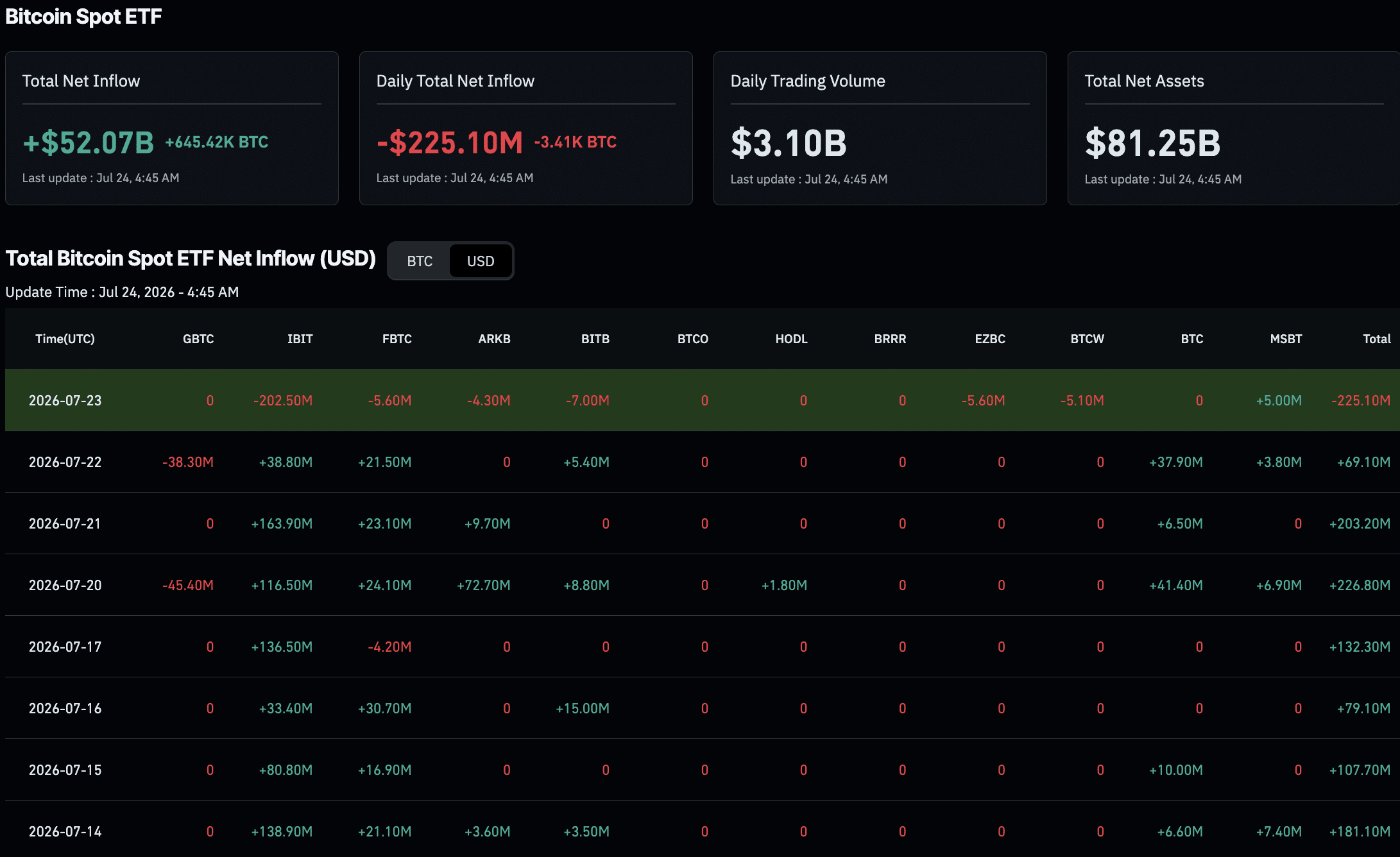
U.S. spot Bitcoin ETF funds, which began trading in January 2024 after years of SEC rejections and have since become a primary vehicle for institutional Bitcoin exposure, recorded nearly $1 billion in net inflows over seven consecutive trading sessions through July 22, 2026, marking their longest positive run in 11 weeks. BlackRock's iShares Bitcoin Trust, IBIT, accounted for $319.16 million of the $499.05 million added during the week alone.
The streak has since ended. The next reported session closed with -$225 million in outflows, even as Bitcoin held above $65,000 despite selling pressure linked to ETF flows.
Bitcoin moved above $66,000 during the two strongest sessions of the streak, July 20 and July 21, according to 247 Wall St. The reported catalyst was news that President Trump had agreed to ethics rules that had been holding up the CLARITY Act. The bipartisan digital-asset legislation is intended to establish clearer regulatory boundaries for crypto markets by defining how oversight responsibilities are divided between the Securities and Exchange Commission and the Commodity Futures Trading Commission, a jurisdictional ambiguity that has contributed to enforcement actions and institutional caution. The development coincided with a sharp increase in institutional demand.
Seven-Day Bitcoin ETF Inflow Streak Ends With -$225M Outflow
Source: CoinGlass
The previous outflow day was July 13, when investors withdrew $424.66 million, the largest single-day withdrawal of the month. After that, money returned to the funds in every session, although the pace was uneven.
According to CoinGlass data, flows reached $181.08 million on July 14, then slowed to $107.80 million on July 15 and $79.15 million on July 16. Inflows recovered to $132.30 million on July 17.
The two largest sessions came alongside the CLARITY Act headlines. July 20 brought in $226.92 million, and July 21 added $203.14 million as Bitcoin traded above $66,000.
By July 22, daily inflows had fallen to $68.99 million, the weakest session of the seven-day run. That slowdown was followed by -$225 million in outflows in the next session, bringing the streak to an end.
The last time institutional demand for Bitcoin through ETF vehicles showed similar multi-day consistency was in early October 2025, when Bitcoin was trading near its all-time high of approximately $126,000.
IBIT Leads Despite Not Being the Lowest-Fee Option
BREAKING: Bitcoin ETFs attracted +$900 million in inflows last week, the largest weekly inflow since early May. This marks a sharp acceleration from +$197 million in inflows in the prior week. The largest Bitcoin ETF, $IBIT , led the surge, attracting +$193 million last week,… pic.twitter.com/tr8lo363oX — The Kobeissi Letter (@KobeissiLetter) July 22, 2026
https://x.com/KobeissiLetter/status/2079962712356872220?ref_src=twsrc%5Etfw
Fees alone do not explain IBIT's lead. Fidelity's FBTC charges no management fee and holds $11.38 billion in assets under management, while IBIT charges an annual fee of 0.25% and has $48.86 billion in AUM. Over a 10-year period, that 0.25% annual fee can compound meaningfully for long-term investors.
247 Wall St. attributed IBIT's position to BlackRock's distribution advantages. BlackRock, the world's largest asset manager with over $10 trillion in assets under management, counts pension managers and registered investment advisers among its established client base, which can make IBIT easier to purchase through existing compliance and investment processes. In that context, the fee difference may be less important for some institutional allocators.
Trading activity also shows the concentration around IBIT. On July 22, IBIT accounted for nearly 79% of the $1.11 billion in total trading volume across all 13 spot Bitcoin ETFs. IBIT holds 3.70% of all Bitcoin, while the other 12 ETFs together hold 2.38%, indicating significant institutional activity in IBIT during the period.
Grayscale GBTC Remains a Structural Drag on Net ETF Flows
Grayscale's GBTC, the Grayscale Bitcoin Trust that converted from a closed-end fund into a spot ETF, remains the largest structural headwind to the net position of the Bitcoin ETF complex. GBTC was previously the only widely available vehicle for equity investors to gain Bitcoin exposure, often trading at steep discounts to its underlying holdings, and its conversion to ETF format allowed long-held positions to be redeemed for the first time. Since its conversion, GBTC has recorded $27.42 billion in cumulative outflows. On July 22 alone, another $38.30 million left the fund.
The fee gap is a central factor. Grayscale charges 1.50% annually, while IBIT charges 0.25%. For an investor holding $100,000 for five years, that 1.25 percentage-point difference compounds to roughly $6,500 in additional fees before accounting for any performance difference.
As a result, GBTC's cumulative outflows have offset a large portion of the demand visible in IBIT and, to a lesser extent, other competing spot Bitcoin ETFs. Total net inflows across all 13 Bitcoin ETF funds stand at $51.85 billion since launch, but that figure is calculated after subtracting GBTC's $27.42 billion in outflows. Without the GBTC outflows, the aggregate numbers for the ETF complex would be considerably higher.
$BTC — If we somehow deviate back and reclaim 65.5K on 4HR TF, we'll quickly see 70Ks! Else chop continues till 64K. I'm optimistic about upside movement due to the relative strength our orange coin had despite SPY weakness yesterday. 70K+ $BTC is programmed in the next few… pic.twitter.com/Ug9eGaGPUX — Friedrich (@FriedrichBtc) July 24, 2026
https://x.com/FriedrichBtc/status/2080489745755566209?ref_src=twsrc%5Etfw
CLARITY Act Headlines Coincide With Strongest Inflow Days
The CLARITY Act, formally the Digital Asset Market Clarity Act, had been stalled because of ethics-related disputes. Reports on July 20 that President Trump had agreed to the relevant ethics rules coincided with a notable increase in inflows.
Clearer regulation can reduce compliance risk for large institutions and may make it easier for investors such as pension funds and insurance companies to hold Bitcoin ETFs within their mandates. The legislation, if enacted, would represent one of the most significant pieces of federal crypto market structure legislation to date. The $226.92 million and $203.14 million inflow days on July 20 and July 21 came as market participants responded to the reported progress on the legislation.
However, the subsequent slowdown to $68.99 million on July 22 and the following -$225 million outflow showed that the seven-day inflow streak had not reversed the broader ETF pressure on its own. The seven sessions recovered only 15% of June's losses, while GBTC outflows and uneven demand across competing funds continued to shape the overall Bitcoin ETF flow picture.