Bitcoin Spot ETFs See $981M Seven-Day Inflow Streak as Institutions Rebuild Positions
Key Takeaways
- •Bitcoin spot ETFs attracted nearly $1 billion across seven consecutive trading days of net inflows starting July 14, marking the longest sustained inflow streak in months.
- •The current inflow pace runs at approximately one-fifth of the volume recorded during the October 2025 ETF streak, making direct comparisons between the two periods unreliable.
- •BlackRock's IBIT led daily inflows while Grayscale's GBTC continued net outflows, driven by GBTC's 1.5% expense ratio far exceeding competitor fees such as IBIT's 0.25% and ARKB's 0.21%.
- •A sustained move toward $70,000 is possible if ETF demand continues at a comparable pace, though macroeconomic conditions and derivatives positioning could offset fund flow dynamics.
- •Large single-day ETF inflow sessions have historically appeared near market cycle peaks rather than at the start of sustained advances, suggesting investors should watch for signs of overheating.
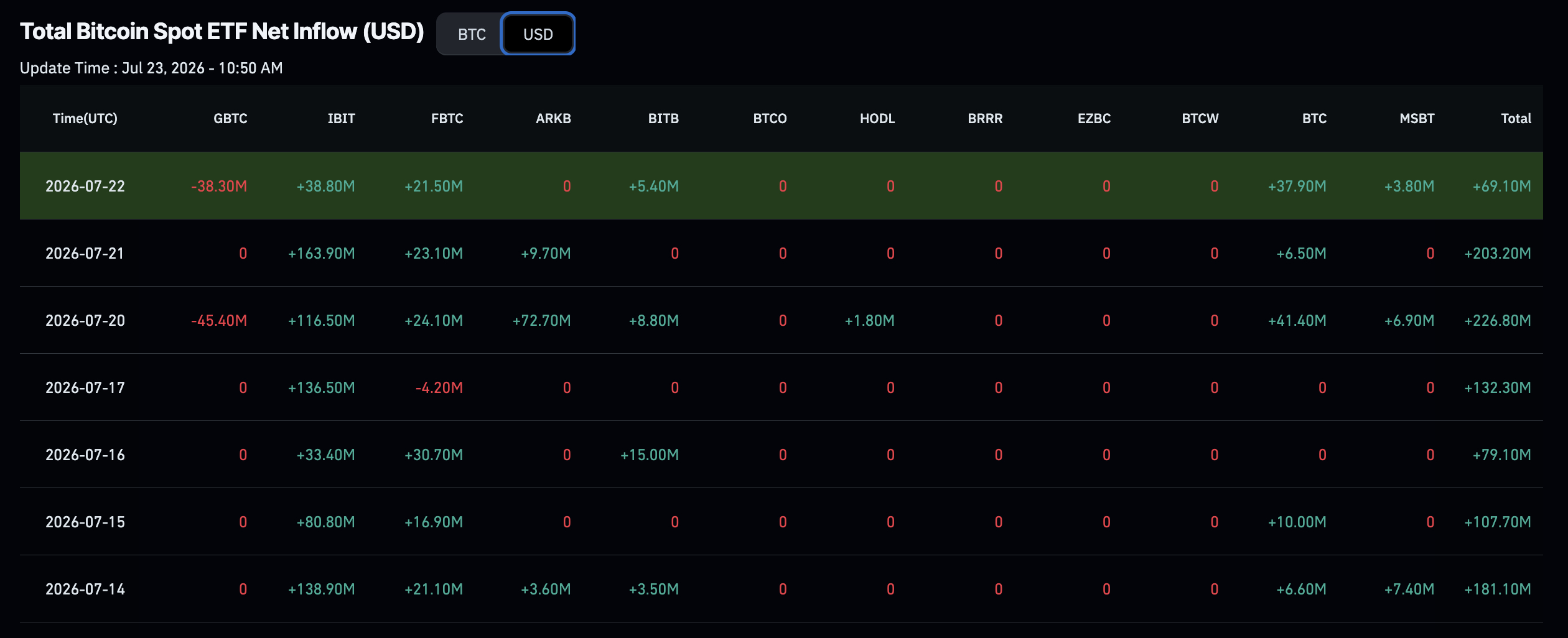
Bitcoin spot ETFs have recorded seven consecutive trading days of net inflows since July 14, attracting nearly $1 billion as Bitcoin traded around $65,500. The streak marks the longest sustained inflow period in months and signals what may be a renewed phase of institutional interest following heavy selling earlier in the summer. Since receiving SEC approval in January 2024, US spot Bitcoin ETFs have opened regulated access to investors — including registered investment advisors, wealth platforms, and retirement-focused accounts — who previously had limited ability to hold Bitcoin through conventional fund structures.
The inflow streak follows a challenging period that pushed Bitcoin below $58,000 before buyers re-entered the market. Notably, the inflows have not been driven by a single large allocation but have instead arrived at a steady daily pace — a pattern that typically reflects sustained demand rather than a short-lived burst of market enthusiasm.
The October 2025 Comparison: Context and Limitations
Some analysts have drawn comparisons between the current streak and October 2025, when persistent ETF demand preceded Bitcoin's rally toward its all-time high. The comparison, however, has clear limitations. During that earlier run, ETFs attracted well over $5 billion across seven trading days — roughly five times the volume of the current streak. That scale difference makes a direct comparison unreliable.
Today's inflows are running at approximately one-fifth of the October 2025 pace. Even so, a slower accumulation pattern can still provide price support without generating the same speculative conditions. Rather than signaling another explosive rally, the current data is more consistent with gradual institutional positioning at a time when leverage across the broader market remains relatively restrained.
Issuer-Level Breakdown
Issuer-level data reveals where capital is concentrated. BlackRock's IBIT continued to lead daily inflows, while ARK's ARKB and Fidelity's FBTC also attracted fresh capital. Grayscale's GBTC, meanwhile, continued to record net outflows — extending a trend that has persisted since spot Bitcoin ETFs first launched. GBTC's 1.5% expense ratio stands well above competitor fees — IBIT charges 0.25% and ARKB charges 0.21% — and that structural cost gap helps explain the ongoing rotation, as investors continue to favor lower-fee products over legacy funds.
The $70,000 Question: Sustained Demand Required
A move toward $70,000 remains technically possible if ETF demand continues at a comparable pace. However, no historical relationship guarantees that outcome. While ETF inflows have frequently supported Bitcoin's price, macroeconomic conditions, derivatives positioning, and profit-taking activity can all rapidly outweigh fund flow dynamics.
The recent recovery also requires broader context. It follows weeks of persistent ETF outflows that pressured Bitcoin below $58,000. Seven consecutive positive sessions have improved sentiment, but they do not by themselves confirm a lasting uptrend. Buyers will need to defend current price levels before the market can mount a credible challenge at $70,000 resistance.
One historical observation is relevant. During healthy rallies, inflows tend to build through consistent daily sessions rather than through one extraordinary buying event. At previous market peaks, the largest single-day ETF inflow sessions appeared near the top of the cycle rather than at the start of sustained advances — a pattern that suggests investors should monitor for signs of overheating.
For now, the current inflow pattern appears more measured than euphoric. If ETF inflows remain distributed across multiple sessions, Bitcoin could continue its gradual move toward $70,000. Conversely, a sudden spike concentrated in a single exceptionally large inflow day could indicate rising speculation rather than strengthening fundamentals. With Bitcoin's supply increasingly mediated through regulated vehicles, ETF flow data has become one of the more closely watched indicators of institutional positioning — though it remains one signal among many, including on-chain activity, stablecoin issuance trends, and derivatives open interest.
Source: Cryptonews | ETF data: CoinGlass