Crypto ETFs Split: Bitcoin Funds Add $23 Million as Ethereum Outflows Stretch to Fifth Session
Key Takeaways
- •U.S. spot Bitcoin ETFs attracted $23.16 million in net inflows on October 20, following $526.60 million the prior session, marked the largest daily intake of the month.
- •BlackRock's Bitcoin fund added $29.87 million on October 20, while the rest of the Bitcoin ETF group recorded a combined net outflow of roughly $6.7 million.
- •Ethereum ETFs extended their losing streak to five consecutive sessions on October 20 with a $26.13 million outflow, bringing five-day withdrawals to about $388.8 million.
- •Ethereum ETF net assets fell to $14.98 billion from $17.71 billion on October 1, with the funds posting outflows in each of the last four weeks and monthly losses exceeding $1 billion.
- •Bitcoin rose roughly 2% on October 21 to close near $84,696 with an intraday high around $84,863, approaching the $85,000 resistance level as its recovery from the $60,000–$65,000 zone continued.
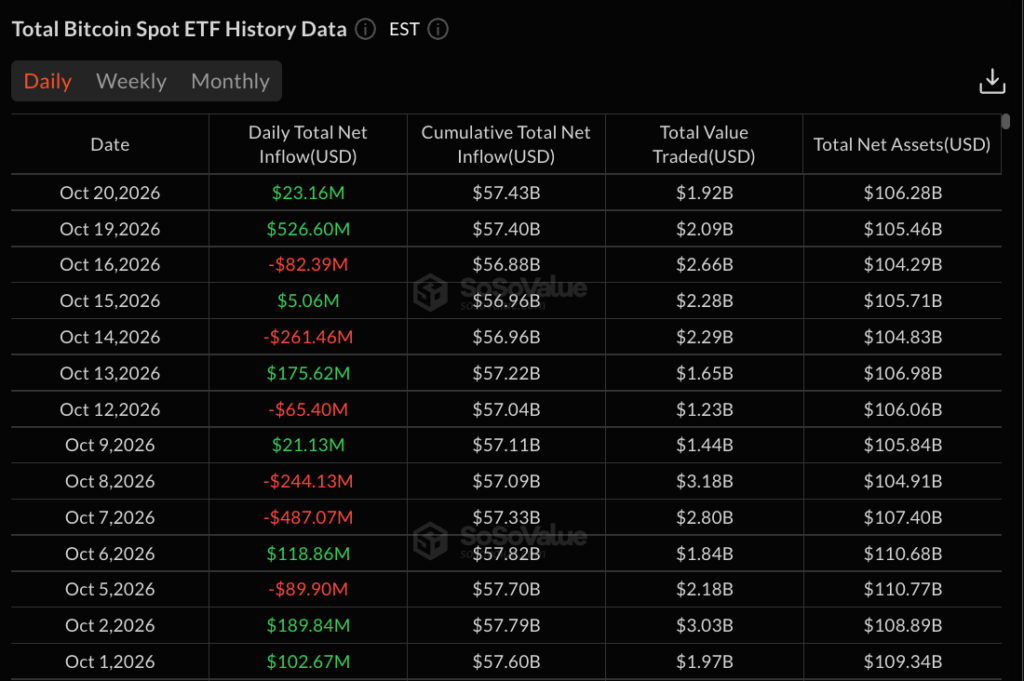
U.S. spot crypto exchange-traded funds (ETFs) split along asset lines on October 20, as Bitcoin funds attracted $23.16 million in net inflows while Ethereum funds lost $26.13 million, extending their withdrawal streak to five consecutive sessions.
According to data from SoSoValue, Bitcoin ETF inflows totaled $549.76 million across October 19–20. Ethereum funds, however, had already shed approximately $1.08 billion since the beginning of October. The divergence followed two weeks of substantial withdrawals across both markets, and Bitcoin subsequently approached $85,000 on October 21, renewing attention on its recovery. Spot ETFs hold the underlying cryptocurrencies directly, so daily net-flow totals are widely tracked as a gauge of direct investor demand rather than leveraged or derivatives-based exposure.
BlackRock Leads Bitcoin Inflows
The October 20 figure appears modest next to the preceding session. On October 19, Bitcoin ETFs took in $526.60 million, their largest daily intake of the month. Tuesday's follow-through was considerably lighter, but it kept the run positive and lifted weekly inflows to $549.76 million after just two trading days.
BlackRock once again did the heavy lifting. Its fund added $29.87 million on the day, which means the rest of the Bitcoin ETF group posted a combined net outflow of roughly $6. million.
Cumulative net inflows for spot Bitcoin ETFs now stand at $57.43 billion, with total net assets of $106.28 billion.
Ethereum ETFs Extend Outflow Streak to Five Sessions
Ethereum ETFs posted a $26.13 million net outflow on October 20, their fifth straight losing session. Across those five days, investors pulled about $388.8 million from the products.
Ethereum has been the weakest corner of the U.S. crypto ETF market this month. The funds have recorded outflows in each of the last four weeks, including $542.07 million in the week ending October 9 and $319.97 million in the week ending October 16.
Total net assets dropped to $14.98 billion, down from $17.71 billion on October 1. Cumulative net inflows slipped to $12.81 billion, and trading value stood at $624.58 million on the day. Part of the gap between the two products' cumulative totals reflects launch timing: U.S. spot Bitcoin ETFs began trading in January 2024, while spot Ethereum ETFs followed in July of that year.
Bitcoin Price Analysis: Can ETF Inflows Extend the Recovery?
Bitcoin trades near $83,454 on the weekly chart after bouncing from the $60,000–$65,000 zone. The recovery has pushed the price back above $80,000, but BTC still sits well below its 2025 peak near $126,200.
The nearest hurdle is the $85,000–$90,000 range, with a tighter band between $83,400 and $84,400 acting as first resistance. On the downside, buyers need to hold $78,000–$80,000. A break below that area could bring $75,000 — and then the $60,000–$65,000 swing lows — back into play.
Weekly Relative Strength Index (RSI) readings sit at 64.07, 60.27 and 53.36, pointing to improving buying strength without reaching the overbought level of 70. The Moving Average Convergence Divergence (MACD) line is above its signal line, and the histogram is positive.
This is where crypto ETF flows matter. Steady spot demand from these funds would give the rally a firmer base than futures-driven bets.
Bitcoin Nears $85,000 as Recovery Extends
Bitcoin advanced during October 21 trading as buyers extended the recovery. Investing.com recorded a closing price near $84,696, up approximately 2% for the session. The cryptocurrency reached an intraday high near $84,863, approaching psychological resistance at $85,000 — a level that also sits near recent October trading highs.
Bitcoin previously traded above $85,500 on October 7 before retreating. A sustained recovery beyond $85,000–$85,500 could bring $90,000 into focus, though the price would first have to establish support above the resistance region.
On the downside, the $83,000 area provides an initial reference following recent trading. Further weakness could expose $80,000, near the October 15 intraday low. The original weekly RSI and MACD readings remain unverified without the underlying Coinank chart.
Can ETF Flows Support Bitcoin's Next Move?
The recent divergence in crypto ETF flows highlights differing investor demand for Bitcoin and Ethereum products. However, two positive Bitcoin sessions do not establish a sustained accumulation trend. October's cumulative Bitcoin ETF flows remained negative through October 20 despite the latest weekly recovery, while Ethereum funds faced deeper monthly withdrawals exceeding $1 billion.
Further Bitcoin ETF inflows could strengthen the recovery alongside sustained spot-market buying. A weekly close above $85,500 would reinforce the case for testing $90,000. Conversely, weaker fund demand and a decline below $80,000 could expose $78,000, and further downside would require additional confirmation before lower price targets become relevant.
The next completed ETF sessions will clarify whether Bitcoin's renewed demand persists.
This article is for informational purposes only and does not constitute financial advice. Cryptocurrency prices are highly volatile, and investors face potential capital losses. Readers should conduct independent research before making investment decisions.

