BlackRock's IBIT Captured 81% of U.S. Bitcoin ETF Inflows in August Surge
Key Takeaways
- •U.S. spot Bitcoin ETFs attracted $853.54 million in net inflows during the week ended August 7, the strongest weekly showing since mid-April and a reversal from $8.26 billion in outflows over the prior eight weeks.
- •BlackRock's iShares Bitcoin Trust accounted for approximately $693 million of weekly inflows, meaning roughly 81 cents of every dollar entering the category went to a single fund.
- •The Coldcard exploit that began July 30 resulted in over $116 million stolen from more than 5,200 self-custody wallet addresses, potentially motivating some investors to consider regulated ETF alternatives.
- •Ethereum ETFs gained $244.9 million during the same week, and no direct evidence links drained Coldcard wallets to specific Bitcoin ETF purchases.
- •Total net assets across spot Bitcoin ETFs stand at $79.50 billion, representing approximately 6.10% of Bitcoin's total market capitalization.
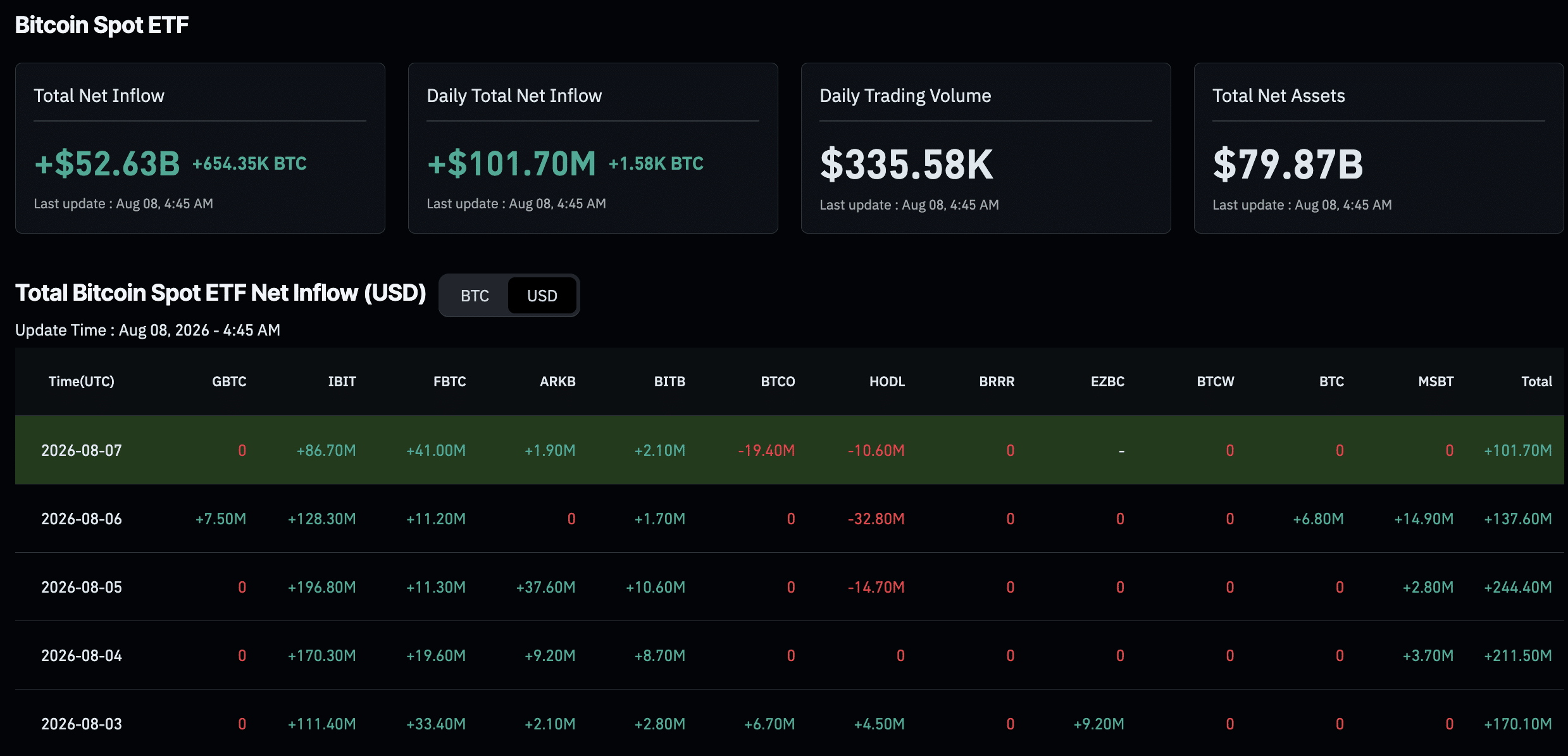
U.S.-listed spot Bitcoin exchange-traded funds attracted $853.54 million in net inflows during the week ended August 7, marking the strongest weekly performance since mid-April, according to CoinGlass data. BlackRock's iShares Bitcoin Trust (IBIT) alone accounted for approximately $693 million of that total, meaning roughly $0.81 of every dollar entering the category went to a single fund. Since the SEC approved the first wave of spot Bitcoin ETFs in January 2024, IBIT has consistently dominated category flows, reflecting BlackRock's position as the world's largest asset manager and its institutional distribution advantage over smaller issuers like Fidelity, Ark Invest, and Bitwise.
Bitcoin's price pushed through $65,000 to touch $65,340 early in the week and finished up approximately 3%, even though four of the five positive ETF inflow days occurred before the rally began.
Bloomberg Intelligence senior ETF analyst Eric Balchunas noted the trend on X:
$IBIT, $FBTC, $BITC, $ARKB, $MSBT have all seen inflows every single day (and growing each day) since the Coldcard Hack this wknd for a total of $620m. I'm not saying it's connected, we just don't know, altho long-term I can't imagine there aren't some who migrate over, but it's… pic.twitter.com/Y63ZUKsVJD
— Eric Balchunas (@EricBalchunas) August 6, 2026
Five Days, $1.03 Billion, and a Concentration Problem
The August rebound followed a prolonged stretch of outflows. Investors withdrew $8.26 billion from U.S. spot Bitcoin ETFs over the eight weeks through early July, with June alone seeing $4.51 billion in outflows — the worst month of the year, according to CoinGlass. July's recovery was negligible, with only $172.43 million in net inflows.
August reversed that trend with five consecutive positive sessions. From August 3 to 7, spot Bitcoin ETFs accumulated $1.03 billion in net inflows, led by the strongest single day on August 5 at $244.4 million. For context, the previous notable inflow week occurred in April, when the category pulled in $996.38 million.
Total net assets across spot Bitcoin ETFs now stand at $79.50 billion, representing approximately 6.10% of Bitcoin's total market capitalization, per CoinGlass. That ratio has become a closely watched metric for assessing how much of Bitcoin's float is locked in regulated vehicles rather than held in self-custody or on exchanges.
The Coldcard Exploit and the Custody Theory
Two events coincided with the recent Bitcoin rebound. The first is the Coldcard exploit, which began on July 30 when attackers targeted self-custody wallets using weakly generated seed phrases. TRM Labs reported that more than $116 million was stolen from over 5,200 addresses, while Galaxy Research estimated the total could approach $130 million — making it one of the largest cryptocurrency thefts of 2026.
Balchunas suggested that ETFs could serve as an alternative for security-conscious investors, since ETF holders do not manage seed phrases directly and thus avoid that specific risk. The trade-off is that ETF investors rely on institutional custodians like Coinbase Custody, trading self-custody risk for counterparty and custody-concentration risk.
On-chain data appears to partially support this interpretation. Following the exploit, long-term holders moved approximately 210,000 BTC, with more coins transferred to exchanges than leaving them — a reversal of a two-year trend.
The second event was the July jobs report, released on August 7, which showed a decline in payrolls and made another Federal Reserve rate hike less likely. However, $754.69 million of the $853.54 million in weekly Bitcoin ETF inflows occurred before the report was published. The largest single-day influx tied to the jobs report, on Friday, produced only $98.85M — coinciding with Bitcoin's price rally.
Ethereum ETFs Also Gained, Complicating the Narrative
Two data points complicate the theory that Coldcard-affected holders migrated en masse to Bitcoin ETFs. First, IBIT accounted for 81% of the week's inflows, concentrating demand in a single product. Second, Ethereum ETFs gained $244.9 million over the same period, according to CoinGlass — funds with no direct connection to a Bitcoin hardware wallet exploit.
Before the hack, Ethereum ETFs had outperformed Bitcoin ETFs for three consecutive weeks, attracting $103.9 million compared to Bitcoin's $33.79 million during the week of July 20. The post-exploit reversal in which Bitcoin ETFs regained the lead lends circumstantial support to the custody theory, though no evidence directly links drained Coldcard wallets to specific ETF purchases. QCP Capital separately noted limited concern in options markets regarding the exploit's broader impact.
With 81 cents of every new dollar flowing to a single fund, the category's near-term health remains heavily dependent on one issuer's positioning and the decisions of its institutional client base.
Limited Recovery in Context
The $853.54 million weekly inflow recovers only about a tenth of the $8.26 billion that left the category over the prior eight weeks. Whether the August surge represents a durable shift toward regulated Bitcoin exposure or a transient reaction to a security incident and favorable macro data remains an open question.
If Bitcoin ETF inflows continue to outpace Ethereum ETF inflows through late August — after the Coldcard exploit fades from headlines — the custody re-rating argument would gain credibility. If Ethereum ETFs resume out-raising Bitcoin ETFs as they did for three weeks in July, the more probable explanation is that this was a strong macro week for risk assets that coincidentally followed a major hack.
Either interpretation requires more than five days of data to confirm. Upcoming signals to watch include the next set of Form 13F filings, which will disclose institutional ETF holdings as of the end of the quarter, and any regulatory developments from the SEC regarding additional crypto-linked ETF products.

