Bitcoin Falls Below $65,000 as US-Iran Tensions Lift Oil and Yields
Key Takeaways
- •Bitcoin fell to around $64,799 on Bitstamp, its lowest level in three days, as broader risk markets came under pressure.
- •The S&P 500 declined 1.2% and the Nasdaq lost 2.2%, while Brent crude rose above $100 per barrel amid heightened geopolitical concerns.
- •CME FedWatch data showed the probability of a 0.25% Federal Reserve rate increase rising to nearly 40% from about 12% a week earlier.
- •Analysts are watching support near the 21-week simple moving average around $64,073 and resistance near $68,000 for Bitcoin’s next directional signal.
- •Michaël van de Poppe outlined a potential target near $73,000 if Bitcoin breaks above the $68,000 resistance area.
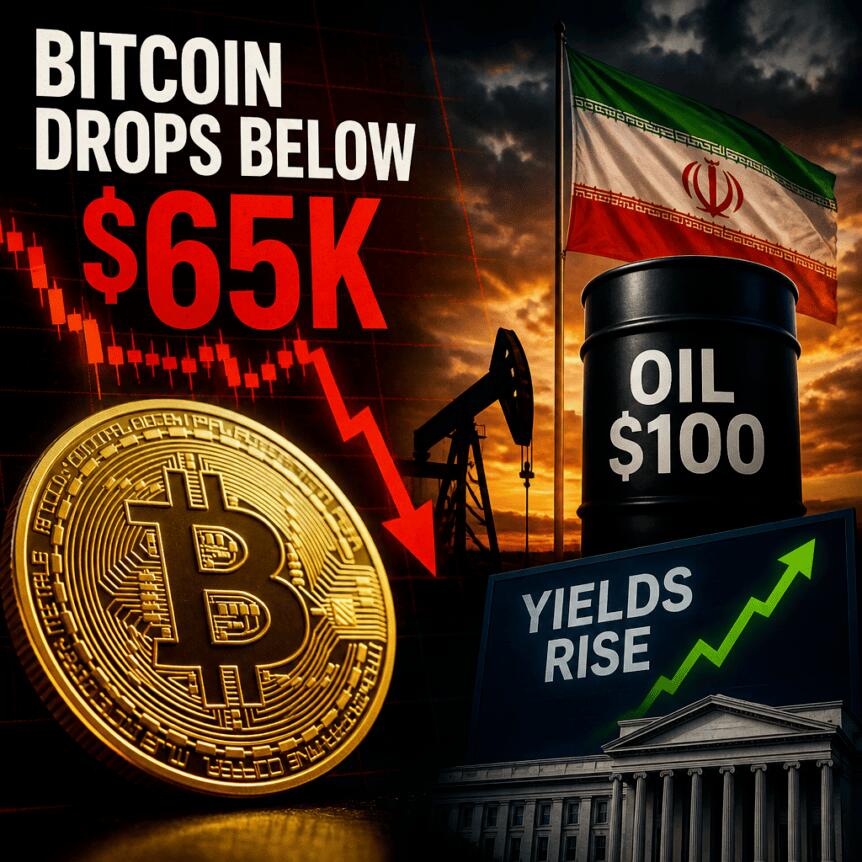
Bitcoin fell below $65,000 on Thursday, reaching a three-day low near $64,799 on Bitstamp as broader risk markets weakened amid renewed tensions between the United States and Iran. The decline coincided with losses in U.S. equities, a sharp rise in oil prices and growing expectations that U.S. interest rates could remain elevated for longer.
Market attention has shifted to nearby technical levels as traders remain divided over whether Bitcoin’s recent relief move can continue or has begun to fade. A widely watched moving-average area and resistance around $68,000 are now among the levels being monitored for signs of the next directional move.
Geopolitical pressure weighs on risk assets
According to TradingView data cited in the report, BTC/USD dropped to three-day lows of $64,799 on Bitstamp. The move came as equities and other high-beta assets were under pressure, a backdrop that often coincides with weakness in cryptocurrency markets.
U.S. market pressure increased after President Donald Trump warned that he would blame Iran for recent Houthi strikes on Saudi commercial vessels. In a post on Truth Social, Trump said he was “very disappointed” in the Houthis and referred to attacks on U.S. ships from 2025.
By the close of New York trading, the S&P 500 was down 1.2%, while the Nasdaq had fallen 2.2%. Oil prices also rose sharply, with Brent crude climbing to its highest level since early June and moving above $100 per barrel. For macro-sensitive assets, the oil move matters because higher energy costs can complicate the inflation outlook that investors are already tracking through Federal Reserve expectations and Treasury yields.
The combination of weaker equities, higher energy prices and tighter financial conditions added pressure to speculative assets. The Kobeissi Letter noted on X that inflation expectations and interest rates were rising again, highlighting renewed macroeconomic pressure on risk-taking.
Fed expectations move toward a possible 0.25% hike
Changes in Federal Reserve rate expectations remain a key input for crypto traders assessing near-term risk appetite. The report pointed to CME Group’s FedWatch Tool, which showed a higher probability of a 0.25% rate increase ahead of the Federal Reserve’s next policy decision.
The odds approached 40% on Thursday, compared with about 12% one week earlier. Expectations for additional rate increases have historically weighed on assets that tend to perform better when financial conditions are easier.
The Kobeissi Letter also cited 18-month highs in U.S. 10-year Treasury yields, describing the move as a sign of renewed economic stress. Higher yields can reduce liquidity and raise discount rates, conditions that often create challenges for speculative markets and leveraged positioning. That makes the bond market an important reference point for Bitcoin traders, even when the immediate price action is being discussed through crypto-specific support and resistance levels.
Traders split over Bitcoin’s next move
As Bitcoin weakened, traders expressed differing views on whether the recent rebound could continue or whether the rally was nearing a turning point. The report described a divided market, with some traders focusing on downside risk below $65,000 and others emphasizing the potential for another attempt higher.
One commentator, Exitpump, argued on X that the “July rally” could end by late July and said traders should prepare for downside if price breaks below $65,000. The view, posted late Wednesday, framed the $65,000 area as a key level for long positions, with caution warranted if that zone gave way.
Other market participants took a more constructive view. Crypto trader Jelle said BTC was “still making progress,” describing a scenario in which clearing a nearby area could open a path toward the $70,000 region and potentially establish a new trading range.
The difference between those views is important for positioning because it affects whether traders interpret the decline as a continuation of bearish momentum or as consolidation before another attempt to move higher.
Moving averages and the $68,000 zone in focus
In addition to macroeconomic and geopolitical catalysts, technical levels are shaping short-term trading decisions. The report highlighted crypto analyst Michaël van de Poppe’s view that the 21-week simple moving average, or SMA, near $64,073 represents important support.
Van de Poppe said in an X post dated Thursday that as long as BTC remains above the 21-Day MA, there should be room for a higher valuation in the near term. In the same post, he identified the $68,000 resistance zone as the “final hurdle” for a larger breakout, noting that it had already been tested once and would now face a second attempt.
He also outlined a bullish target near $73,000 if Bitcoin can break through that resistance area. The setup provides traders with a conditional roadmap: holding support around the moving averages keeps the higher-valuation scenario intact, while a sustained move below key averages would weaken the breakout case.
For now, the market remains focused on both macro signals and technical price levels. Fed expectations, bond yields and geopolitical headlines remain central factors, while Bitcoin’s ability to hold the $64,000 moving-average area and retest the $68,000 zone continues to define the immediate technical picture.

