Bitcoin Defends $80,000 as Asian Equity Sell-Off Weighs on Altcoins
Key Takeaways
- •Bitcoin buyers stepped in just above $80,000, keeping the $80,000–$80,300 band as the week's key reference zone after a second test in a little over a week.
- •Crypto futures liquidations surged to nearly $1 billion over 24 hours following a hotter-than-expected U.S. inflation report, up from about $136 million the prior day.
- •Odds of an October Federal Reserve rate increase spiked to nearly 47% on CME FedWatch after the inflation data before easing back to roughly 26%.
- •Lower-market-cap tokens bore the steepest losses, with Pump.fun dropping 9.4%, the worst performance in the CD100, while ether fell 2%.
- •Rising futures volume paired with flat open interest and negative cumulative volume deltas suggests fresh positions skew short, even as positive funding rates show longs still paying to hold.
Bitcoin (BTC) was changing hands at $81,200, down roughly 0.5% from midnight UTC, after trimming an earlier 1% decline. Buyers stepped in just above the $80,000 mark at around 02:30 UTC — a level close to the Oct. 8 low of about $80,300 — with the token last quoted at $80,972.85. That puts the $80,000–$80,300 band back in focus as the week's reference zone, having now been tested twice in just over a week.
Asian equities set a risk-off tone for the session. South Korea's Kospi plunged 8%, triggering circuit breakers — automatic trading halts that pause trading when indexes fall past preset thresholds — while Nasdaq 100 index futures slid about 1%, extending Wednesday's 1.9% drop in the Nasdaq Composite. Crypto has no such brakes: markets trade around the clock, so price discovery continues uninterrupted through risk-off phases.
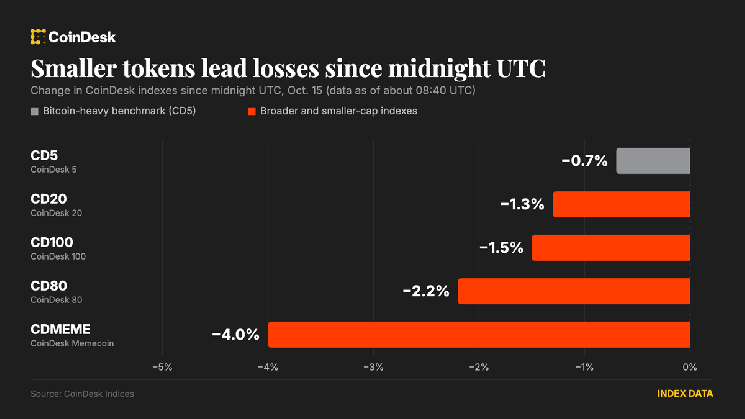
Altcoins absorbed the heavier losses. Ether (ETH), quoted at $2,363.49, fell 2.0% to trade near $2,370. The CoinDesk 80 (CD80) index slid 2.2%, while the bitcoin-heavy CoinDesk 5 (CD5), which tracks the five largest digital assets, lost around 0.7%.
The damage was most visible across lower-market-cap tokens. Pump.fun (PUMP), quoted at $0.004259, dropped 9.4%, and the CoinDesk Memecoin Index lost 4.0%, leaving all but six members of the CD100 in the red.
Macro expectations also shifted sharply. The odds of an October Federal Reserve interest-rate increase spiked to nearly 47% on CME's FedWatch — a tool that derives rate probabilities from fed funds futures pricing — after Wednesday's hotter-than-expected inflation report, up from about 22% beforehand, before easing back to roughly 26%. The swing is a reminder of how quickly a single inflation print can reprice the policy path that risk assets trade against. Treasury yields and rate-hike pricing remain the key signals heading into the U.S. open, with bitcoin's defense of the $80,000 area the chart level to watch alongside them.
Derivatives Positioning
Liquidations surged to nearly $1 billion following the hot inflation print. Close to $1 billion in crypto futures bets were wiped out over 24 hours as the market wilted after Wednesday's hotter-than-expected U.S. inflation report, up from about $136 million a day earlier. Liquidations are the forced closure of leveraged positions whose margin no longer covers losses, which is why flushes of this size tend to mark where leverage was most crowded. The spike highlights how crowded positioning was heading into the data release.
Ether took a harder hit than bitcoin. Longs worth $200 million were liquidated in ETH, significantly more than the $115 million in BTC — a gap that points to heavier long leverage in the ether market.
Silver outpaced a leading privacy coin liquidations. XAG (silver) perpetual futures have seen more liquidations than zcash (ZEC), one of the top privacy coins, in a sign of the growing popularity of TradFi assets on crypto trading platforms.
Trading surged while open interest held steady. 24-hour crypto futures volume stands at $252 billion, up 61% over the period, while open interest (OI) — the total notional value of outstanding futures contracts — is largely unchanged at $139.6 billion. That means the activity was mostly existing positions being closed or churned, not a major build-up of new leverage. The taker long/short volume ratio is again skewed bearish, with shorts accounting for 51.67% of the flow, little changed from 52% a day earlier.
Traders are adding to bitcoin positions as the price falls. BTC's spot price is down over 2% in 24 hours, yet notional futures OI is up 1.6%. Because OI is measured in dollars, that implies the number of contracts rose by roughly 3.7%, meaning net new capital is entering during the drop. The 24-hour OI-adjusted cumulative volume delta (CVD) is negative, alongside negative readings for most coins, so the new money looks more like shorts. OI does not show direction on its own, however, and BTC's perpetual funding rate is still positive, so longs are still paying to hold their positions. Funding is the recurring payment exchanged between perpetual futures traders that keeps contract prices tethered to spot.
Ether and solana show a similar setup. ETH and SOL futures OI have held largely steady despite bigger spot price drops than bitcoin. Flat dollar OI amid falling prices implies the number of contracts rose by about the size of the price decline — another sign of fresh positions. Both markets also posted negative CVDs and still-positive funding rates.
DOGE and NEAR are being de-risked. Their OI declines are far bigger than their spot price drops, which means traders are closing positions outright and capital is leaving, rather than positions simply being marked down.
Bitcoin's implied volatility is holding above 40%. The BVIV index — a measure of expected bitcoin price swings priced into the options market — has sat just above 40% for a second straight day, up from recent lows near 34%. The increase reflects renewed demand for options, though levels remain well short of the panic highs seen in February and June. Ether's volatility index shows a similar pattern.
Options flow is two-way in bitcoin and defensive in ether. On Deribit, BTC calls at the $90K and $86K strikes top the 24-hour options volume rankings, while the other three among the top five are puts. Calls above the market point to bets on a rebound, while the puts indicate hedging. In ETH's case, puts dominate the leaderboard.
Token Talk
Pump.fun (PUMP), quoted at $0.004259, the token of the Solana memecoin launchpad of the same name — a platform that lets users spin up new tokens on Solana — fell 9.4%, the steepest loss in the CD100, as the broader Solana ecosystem also came under pressure. Jito (JTO), quoted at $0.4551, lost 6.2% and Jupiter (JUP) fell 6.1%, while Solana (SOL) itself slipped only 1.1% to about $103.
Pyth Network (PYTH), quoted at $0.08541, an oracle token — oracles pipe real-world market data such as prices onto blockchains — rose 2.8%, extending a rally that began Oct. 8 after its DAO voted to direct all product revenue into monthly buybacks. CoinMarketCap shows about $96 million of PYTH volume over 24 hours, a 67% increase on the previous 24-hour period.
Starknet (STRK), quoted at $0.07692, gained 11%, rebounding after a 17% slide on Oct. 13. The token remains 278% higher than its yearly low of $0.021 set on Aug. 16.
Canton (CC), quoted at $0.1067, the institutional blockchain token, fell 7.3%, Optimism (OP), quoted at $0.1288, lost 7.0%, and Aerodrome (AERO) dropped 6.4%, as a lack of altcoin liquidity continues to weigh on the sector — in thin order books, even modest selling flow translates into outsized percentage moves.
Larger names held up relatively better, with Tron (TRX), quoted at $0.3318, little changed, Monero (XMR) down 0.55%, and Hyperliquid (HYPE) down 0.96% to about $80.

