Bitcoin Decouples from S&P 500 and Nasdaq, but $83K–$86K Zone Is the Litmus Test
Key Takeaways
- •Bitcoin's rolling 30-session correlation with the S&P 500 fell toward zero during the recent rally, approaching its lowest level in nearly two years, according to Glassnode.
- •Grayscale data shows Bitcoin's 90-day correlation with the Nasdaq has declined while its correlation with gold has strengthened.
- •An August 19 short squeeze lifted BTC above $80,000, but the rally stalled below the $83,000-$86,000 long-term holder supply zone before retreating toward $76,000.
- •Glassnode identified $62,000-$65,000 as key support and $83,000-$86,000 as the main resistance zone, with the share of supply in profit rising to 68% near $78,000.
- •Charles Schwab said a sustained hold above $80,000 could position Bitcoin for a year-end rally, noting October through December are historically strong months.
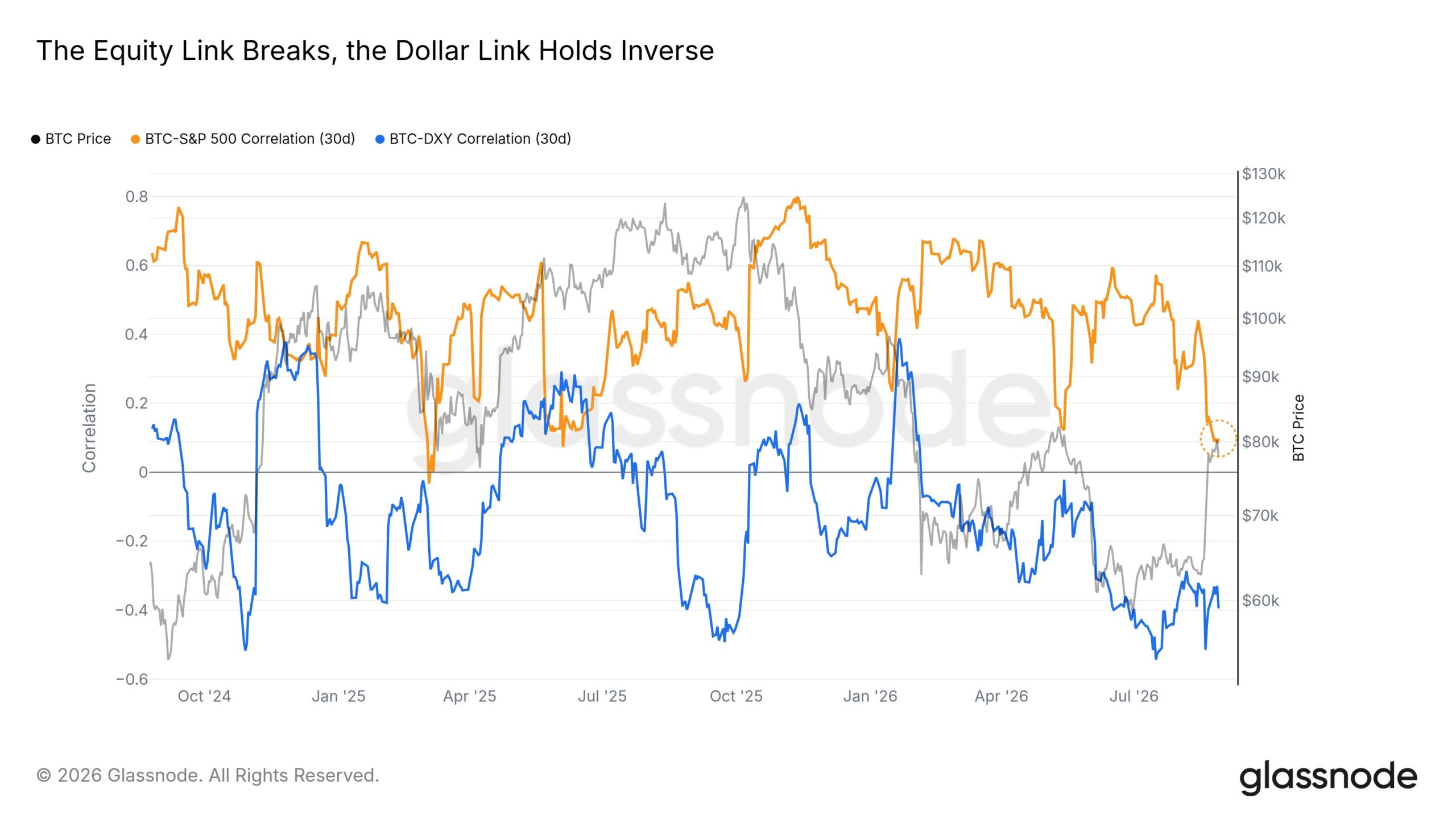
Bitcoin has shown an unusual shift in its relationship with traditional markets following its sharp August recovery. Glassnode reported that Bitcoin's rolling 30-session correlation with the S&P 500 fell toward zero during the recent rally, while Grayscale separately found that BTC's 90-day correlation with the Nasdaq declined as its relationship with gold strengthened.
The move has renewed debate over whether Bitcoin is now trading more like a scarce macro asset than a high-beta technology investment — a distinction that matters for how investors weigh Bitcoin in diversified portfolios, since a lower correlation with equities reduces the tendency of BTC to sell off alongside stocks during risk-off episodes. Glassnode cautioned, however, that similar decorrelation episodes during sovereign bond selloffs have historically proven temporary rather than permanent structural shifts.
Bitcoin Decouples from S&P 500 and Nasdaq, Follows Gold
Bitcoin is increasingly decoupling from equities, with its correlation with the S&P 500 approaching its lowest level in nearly two years. According to data from Glassnode (X post, Market Pulse Week 36), the close relationship between Bitcoin and equities that defined much of the recent downtrend is now fading.
At the same time, data from Grayscale (X post) shows Bitcoin displaying a stronger correlation with gold. "Rising debt, persistent deficits, and higher yields are pushing investors toward alternatives like Bitcoin and gold," Grayscale reported. Grayscale, which operates spot Bitcoin ETFs among its product lineup, is one of several institutional asset managers that have increasingly framed Bitcoin as a store-of-value asset in research publications since U.S. spot Bitcoin ETFs launched in January 2024.
Bitcoin Establishes a Weak Link With Equities
Bloomberg's ETF strategist Eric Balchunas reported that Bitcoin's correlation with U.S. equities has weakened significantly over the past six months. According to him, BTC's relationship with U.S. stocks has fallen below that of gold, small-cap stocks, emerging markets, and Treasuries.
Balchunas noted that Bitcoin's correlation with equities has historically remained around 0.40, while gold and Treasuries have become more closely correlated with the cryptocurrency in recent months. The shift challenges the view that Bitcoin's recent market behavior has been driven primarily by its correlation with the Nasdaq-100 — a framing that had gained traction as spot Bitcoin ETF flows drew the asset closer to traditional-finance trading channels.
BTC Price Faces Supply Pressure at $83K–$86K
Blockchain analytics firm Glassnode reported that an August 19 short squeeze pushed BTC above $80,000. However, the rally stalled below the $83,000–$86,000 long-term holder supply zone before retreating toward $76,000. In on-chain analysis, such supply zones mark price ranges where coins acquired by long-term holders are near their cost basis, often creating selling interest as those holders seek to exit at breakeven.
When BTC traded near $78,000, the share of supply in profit had risen to 68%, up from 65% in May, pointing to a greater likelihood of sell-side pressure. Glassnode identified $62,000–$65,000 as the key support zone, while $83,000–$86,000 remains the main resistance area — meaning the zone serves as a test of whether the recovery can extend or whether profit-taking caps the move.
In the options market, the 7-day 25-delta skew rose sharply during the short squeeze, showing that traders were chasing upside calls before the skew moved back toward neutral. Meanwhile, the 180-day skew remained stable, suggesting that short-term bullish sentiment has cooled.
Charles Schwab, on the other hand, noted that a sustained move above $80,000 could set Bitcoin up for a year-end rally. The firm observed that holding above that level would bring the average BTC investor back into profit, and it highlighted October through December as historically strong months for the cryptocurrency.
Source: The Market Periodical

