Bitcoin Faces December Reckoning as Analysts Warn of More Losses
Key Takeaways
- •U.S. spot bitcoin ETFs suffered their worst month on record in November with net outflows of $5.4 billion to $5.8 billion, including roughly $3.4 billion across an eight-session redemption streak in which BlackRock's IBIT figured prominently.
- •Bitcoin trades more than 50% below its October 2025 all-time high and underperformed equities, with its daily RSI hovering between 25 and 26 while the price sits below both its 50-day and 200-day moving averages.
- •Investors who purchased bitcoin within the past one to three months carry an average unrealized loss of 25.8% against an $81,900 cost basis, and futures funding rates have remained positive for 186 consecutive days, signaling leveraged long positioning has yet to fully unwind.
- •Cryptoquant analyst Shayan Markets identified overheated futures activity clustered around $59,000 to $61,000 and cautioned against treating it as confirmation of a bottom, citing demand near $55,000 to $57,000 and resistance at $64,000 to $66,000.
- •Benjamin Cowen suggested bitcoin could bottom around mid-December as monetary policy reaches peak hawkishness, while Kyle du Plessis warned that deteriorating demand may instead usher in a bearish supercycle defined by macro lower lows and lower highs.
Bitcoin Faces December Reckoning as Analysts Warn of More Losses
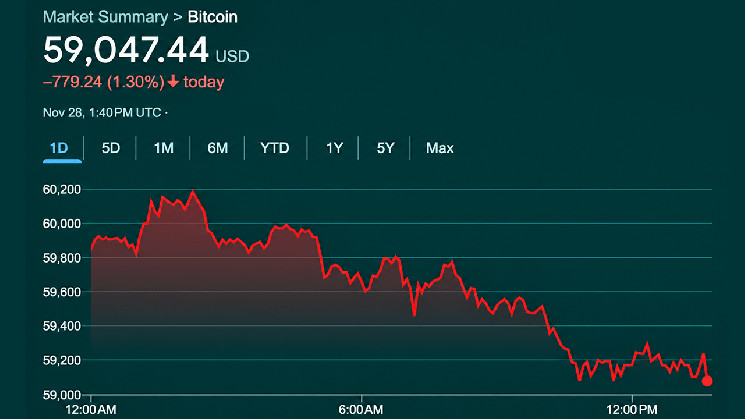
Bitcoin is entering the final month of 2026 with investors navigating a particularly unforgiving market, and several analysts are warning that further losses may lie ahead despite Wall Street's recent recovery. The leading cryptocurrency ($BTC) fell roughly 3.5% to 3.8% over the past 24 hours as of Saturday morning, giving back ground after recently climbing above $64,000.
Although the asset remains modestly higher on a seven-day basis, its rebound from around $55,000 on Nov. 21 has struggled to gain conviction. Bitcoin trades more than 50% below its October 2025 all-time high, even as traditional equities posted a comparatively strong Thanksgiving-shortened trading week. Kyle du Plessis, an analyst at Crypto Banter, said that divergence deserves close attention.
“And the fact that you have the Nasdaq pushing towards the upside into its weekly close and you have bitcoin coming down, that's a sign of weakness, right? It's not relative strength, that's relative weakness for bitcoin,” du Plessis explained in a recent analysis. His comments reflect a broader concern among market watchers that bitcoin's underperformance stems from fragile underlying demand rather than mere profit-taking.
Demand Indicators Flash Warning Signs
Du Plessis also expressed concern about diminishing exchange activity, weakening investor participation and unfavorable flows into exchange-traded funds (ETFs). “And right now, the money is not flowing into bitcoin … And we can see that in terms of the daily exchange volume, right, which has mostly just been going down,” the Crypto Banter analyst added.
U.S. spot bitcoin ETFs — funds that hold bitcoin directly and whose flows many analysts treat as a proxy for institutional demand — have experienced their worst month on record, with November net outflows estimated at $5.4 billion to $5.8 billion. An eight-session streak of net redemptions accounted for roughly $3.4 billion of that total, with BlackRock's IBIT responsible for much of the withdrawal activity.
Macro conditions compound those difficulties. Investors anticipate another 25-basis-point interest rate increase at the Federal Reserve's Dec. 8-9 policy meeting, and elevated rates make yield-bearing instruments comparatively more attractive, presenting another obstacle for speculative assets.
Has Bitcoin's Price Reached a Market Bottom?
From a technical standpoint, bitcoin's price remains below both its 50-day and 200-day moving averages — trend-tracking lines many traders use to judge whether an asset retains medium- and long-term momentum — while its daily relative strength index (RSI), a momentum gauge on which readings below 30 are traditionally considered oversold, has hovered between 25 and 26, indicating deeply oversold conditions. Such readings can accommodate substantial relief rallies without necessarily reversing the prevailing bearish trend.
Shayan Markets, a community analyst at Cryptoquant, identified a separate development in bitcoin's derivatives markets that could complicate the recovery process. “The Futures Volume Bubble Map shows a fresh cluster of overheating readings around $59K–$61K following bitcoin's steep decline,” the analyst wrote.
In his view, bitcoin could face an extended period of sideways trading, with demand concentrated between $55,000 and $57,000 and resistance sitting between $64,000 and $66,000. “Overheating therefore should not be treated as confirmation of a bottom,” the Cryptoquant contributor cautioned.
Fellow Cryptoquant community analyst Woominkyu, meanwhile, identified considerable financial distress among investors who purchased bitcoin within the past one to three months. “Bitcoin's 1–3 month holders, the cohort that best reflects active short-term traders, are now sitting on an average unrealized loss of 25.8%,” Woominkyu disclosed on Saturday.
That cohort's average acquisition cost stands at $81,900 per coin. According to the community market strategist, comparable periods of investor distress in December 2025, February 2026 and June 2026 preceded recoveries of 12%, 28% and 48%, respectively.
However, futures funding rates — periodic payments between leveraged traders that help keep perpetual contracts aligned with spot prices — have remained positive for 186 consecutive days, a configuration in which long traders pay short traders and one that is generally read as a sign that leveraged long positioning has yet to fully unwind, while heightened movement among older coins suggests that broader market capitulation remains incomplete. Woominkyu concluded: “Short-term holder pain is already in the zone where previous bottoms formed. Whether this becomes a bottom likely depends on leverage and long-held supply following the same reset.”
Cowen Eyes December Bottom as Du Plessis Warns of Bearish Supercycle
Market analyst Benjamin Cowen maintains that bitcoin's price behavior remains broadly consistent with historical midterm-year market cycles, despite widespread anxiety surrounding its performance. “And what I would argue yet again is that this was always the most likely pattern for this year. The February low, the summer low, and now we're in route to the Q4 low,” Cowen remarked on Friday.
Cowen has previously suggested that a peak-to-trough decline of 67% to 74% would fall within his expectations for the current bear market. Nevertheless, he believes the market could be approaching a meaningful turning point, particularly as monetary policy reaches peak hawkishness.
“What if it bottoms on peak hawkishness? That's what I'm looking at. And I think that's coming to a theater near you, you know, sometime around mid-December,” Cowen emphasized.
Du Plessis entertains a considerably darker possibility. Beyond the immediate threat of another December decline, the Crypto Banter analyst believes deteriorating demand could foreshadow a multiyear reversal of bitcoin's historical appreciation pattern. In his video, du Plessis argued: “Not the super cycle to the upside, but the super cycle towards the downside, right? Putting in macro lower lows and lower highs is most likely going to be the case, right?”
Cowen, for his part, remains receptive to a more constructive longer-term outcome. “I'd be looking for a more durable low to form and to sort of build off that low, sometime relatively soon,” he stated in his video.
Bitcoin's December Outlook
As 2026 enters its closing stretch, bitcoin faces a series of consequential tests: November's monthly close, the Federal Reserve's December decision, persistent ETF redemptions, and the durability of support between $55,000 and $58,000. Reclaiming the $62,000 to $66,000 range would improve the immediate technical picture, although a sustainable recovery would likely require renewed demand that is simply not visible right now.
Whether December delivers the final chapter of a conventional bear market or introduces a more enduring period of weakness remains unsettled. For now, bitcoin's greatest challenge is demonstrating that exhausted sellers can finally give way to committed buyers.
This article was first published by Bitcoin.com News and syndicated by CryptoNewsNet.

