Crypto Crash Risk Rises as Bond Yields Reach Multi-Year Highs
Key Takeaways
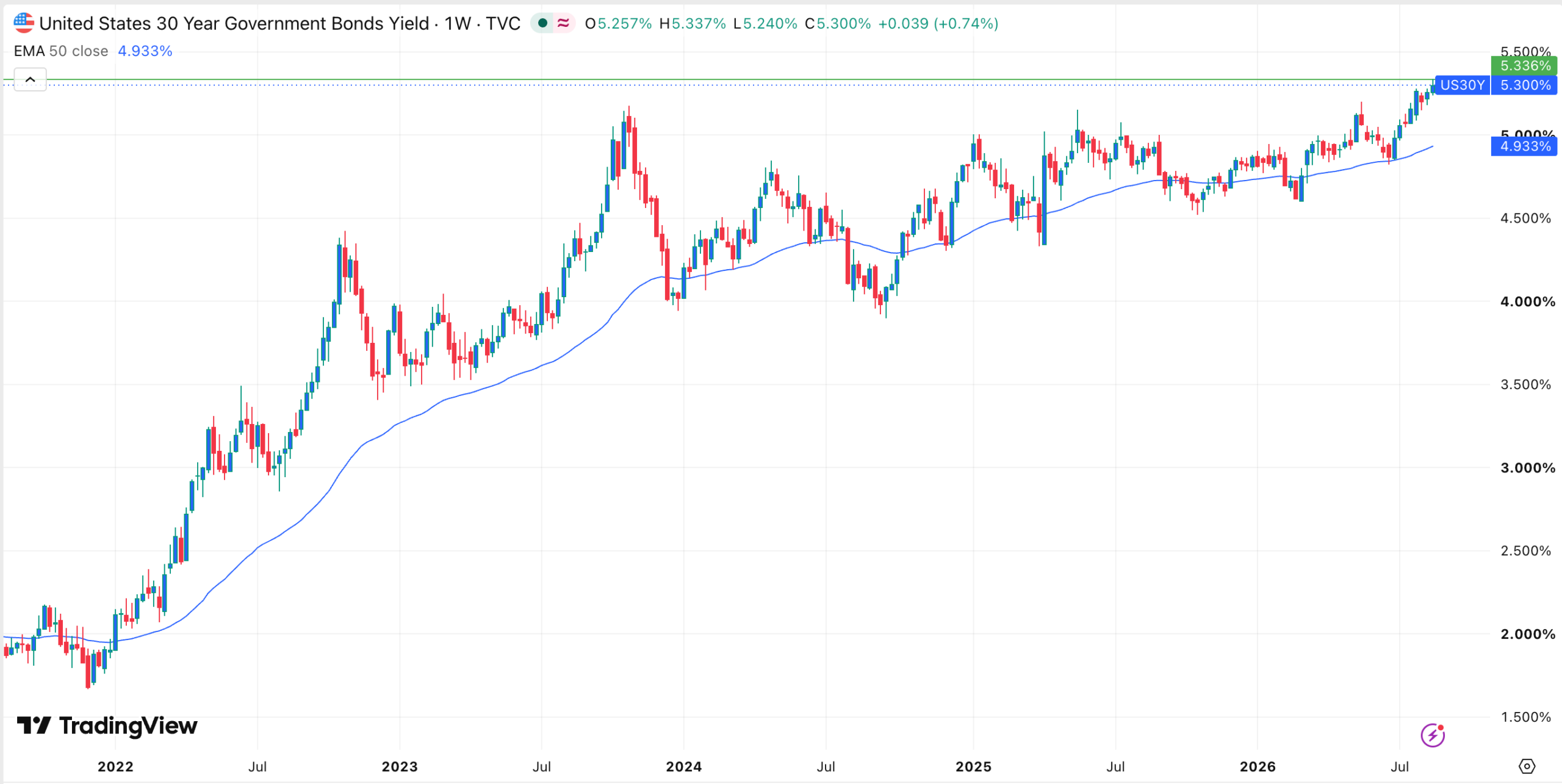
- •The US 30-year Treasury yield rose to 5.33%, its highest level in more than two decades, while German and UK 30-year yields climbed to 3.76% and 5.8%, respectively.
- •The Federal Reserve held interest rates at 3.50%-3.75%, with three hawkish officials voting for a 25-basis-point increase, and minutes from the July 28-29 meeting are due Wednesday.
- •Recent US data showed the economy lost 23,000 jobs in July and retail sales posted their biggest drop in months, contributing to a decline in Polymarket odds of a rate hike.
- •Bitcoin ETFs added $297 million on Monday but have lost assets over recent weeks, and other altcoin ETFs have recorded outflows or no inflows at all.
- •Bitcoin has slipped below its 50% Fibonacci retracement level and the 50-week and 100-week moving averages, a pattern suggesting potential downside toward $50,000.
A crypto crash risk remained in focus as long-term government bond yields climbed across major markets. Bitcoin traded around $64,800 on Tuesday, while Ethereum held near $1,915.
Global market pressure also intensified as oil remained above $90 per barrel. Rising yields, weaker risk appetite, and uncertainty around Federal Reserve policy added pressure to crypto assets. Crypto also trades around the clock, unlike bond and stock markets, so shifts in rates and risk sentiment tend to show up in Bitcoin and Ethereum prices quickly.
Global Bond Yields Are Rising This Week
Signs are mounting that bond vigilantes are pushing yields to their highest levels in years. The phrase, popularized by economist Ed Yardeni in the 1980s, describes bond investors who sell government debt to push back against fiscal policy they consider inflationary.
In the US, the 30-year Treasury yield jumped to 5.33%, its highest level in more than two decades. The same trend is visible elsewhere. In Germany, the 30-year yield soared to 3.76%, while in the UK it climbed to 5.8%. All of these bond yields had been trading at less than 1%.
The rise in yields is unfolding as investors push back against higher spending by major governments. In the United States, public debt has jumped and is nearing the $40 trillion milestone. Similar pressures are appearing in other countries as they increase defense spending. Moves in long-term yields matter beyond the bond market, because they feed into borrowing costs for mortgages, corporate loans, and other credit, tightening financial conditions even when the central bank's policy rate is unchanged.
Yields are also moving higher because of developments in energy markets, where crude oil continues to rise. Brent, the global benchmark, has moved above $90, and West Texas Intermediate is reaching $84. These gains may continue after President Donald Trump said there were no talks between the US and Iran. The WSJ reported that Iran was seeking to escalate because it believes it has the upper hand.
These developments could affect the crypto market because of their influence on the Federal Reserve, which has kept interest rates elevated for some time. They may also increase volatility in the stock and crypto markets as fear spreads. The pattern has a recent precedent: Bitcoin lost roughly 65% of its value in 2022 while yields surged and technology-heavy stock indexes fell into a bear market during the Fed's rapid tightening cycle.
FOMC Minutes Are Due
Traders are also watching the upcoming Federal Reserve minutes, which are set to be released on Wednesday. The minutes are one of the Fed's main communication tools, alongside press conferences and officials' speeches, and markets parse them for clues about the rate path. They will provide more detail on what Fed officials discussed during the July 28–29 meeting.
Officials decided to keep interest rates unchanged at 3.50% to 3.75%. Three hawkish officials voted for a 25-basis-point increase, saying inflation has remained above 2% for years. Hawkish minutes would pose a risk for Bitcoin and the broader crypto market.
On the other hand, recent macroeconomic data have been relatively weak. The economy lost 23,000 jobs in July, inflation has eased slightly, and retail sales recorded their biggest drop in months. That helps explain why the odds of a Fed rate hike have declined on Polymarket.
Crypto ETF Outflows Have Continued
Another factor that could contribute to a crypto crash is continued ETF selling. US regulators approved spot Bitcoin ETFs in January 2024, and their daily flow figures have since become one of the most closely watched barometers of institutional crypto demand. While Bitcoin ETFs added $297 million on Monday, they have lost assets over the past few weeks.
Other altcoin ETFs have either recorded outflows in recent months or seen no inflows at all. That suggests demand from institutional investors remains weak, possibly as some investors rotate into the strong stock market, where the S&P 500 and Nasdaq 100 are sitting at all-time highs. Because ETF flows are published daily, they are among the fastest available data points for signaling whether crypto demand is stabilizing or weakening further.
Bitcoin Technicals Point to More Downside
Technical indicators also suggest that BTC could fall further over the longer term. On the weekly chart, Bitcoin has slipped below the 50% Fibonacci retracement level. It has also remained below the 50-week and 100-week moving averages, thresholds commonly used to separate long-term uptrends from downtrends. That pattern indicates that downward momentum remains intact.
As a result, Bitcoin could continue lower in the near term, potentially toward $50,000. Such a move would likely add pressure to other cryptocurrencies as well. For now, the near-term checkpoints are Wednesday's FOMC minutes, the next round of jobs and inflation data, and the daily ETF flow numbers.
Disclaimer: This article is for informational purposes only and does not constitute financial advice. Cryptocurrency markets can experience sharp price movements. Readers should conduct independent research before making financial decisions.

