Bitcoin Breaks Above $66,000 Resistance as Traders Eye $70,000 Target
Key Takeaways
- •Bitcoin surpassed the $65,000 resistance level and traded above $66,000, marking the latest phase of its recovery from the correction that followed its March all-time highs above $73,000.
- •Approximately $200 million in cryptocurrency liquidations occurred over the 24-hour period preceding publication, with short-position closures representing a significant share as rising prices forced bearish traders to cover.
- •The $67,500–$68,000 range serves as the primary technical confirmation zone, and a sustained daily close above it could open a path toward the $70,000–$72,000 region.
- •Bitcoin's NUPL metric stands near 0.18, indicating moderate unrealized investor gains that remain well below levels historically associated with overheated market conditions.
- •Analysts caution that despite improved short-term technical structure, stronger spot-market participation is necessary to sustain the advance once leveraged positions unwind.
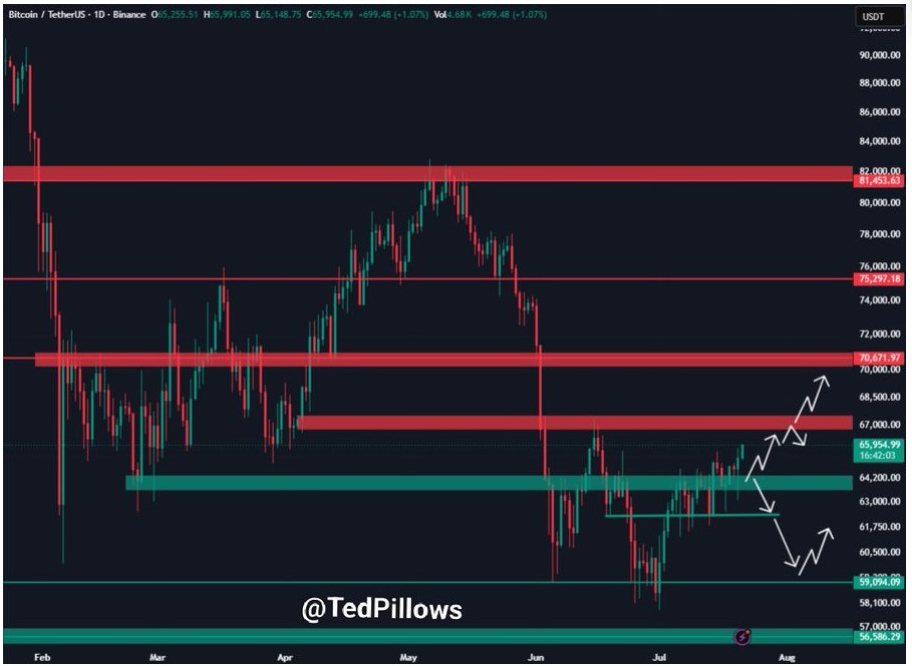
Bitcoin traded above $66,000 on Tuesday after decisively breaking through the $65,000 resistance area, shifting market attention toward the $67,500–$68,000 zone as the next key technical hurdle. The move marks the latest phase of Bitcoin's recovery from a multi-week correction that began after the cryptocurrency reached record highs above $73,000 in March. Some traders have identified $70,000 as a plausible near-term target if buyers can sustain the breakout momentum. However, analysts caution that Bitcoin still requires a confirmed daily close above nearby resistance and stronger participation from spot-market buyers.
Liquidations Surge as Short Positions Unwind
Data from CoinGlass showed approximately $200 million in cryptocurrency liquidations over the 24 hours preceding publication. The total figure includes both short and long liquidations, though short-position closures accounted for a significant portion as the upward move forced bearish traders to cover.
The immediate technical test lies between $67,500 and $68,000. Trader Ted Pillows noted that Bitcoin could gain another 5% to 6% rapidly if buyers reclaim that area, a move that would place the price near $71,000 to $72,000 and strengthen the case for a run toward the upper boundary of the previous trading range. (X/Twitter)
Descending Channel Upper Boundary in Focus
Bitcoin is now trading near the upper boundary of a descending channel that has guided price action since early June. This same area overlaps with a supply zone spanning $66,000 to $67,000, a region sellers may actively defend after the market previously fell through it during the earlier decline.
A daily close above both the channel and the supply area would improve the current market structure. Bitcoin has already established higher lows following its rebound from the $57,000–$60,000 support region. A breakout could open a path toward $70,000, where the 100-day moving average currently sits. The 200-day moving average near $73,000 presents an additional barrier beyond that level, placing it in close proximity to Bitcoin's March all-time high.
On the four-hour chart, short-term conditions appear more constructive. Bitcoin has moved above earlier resistance levels near $58,000 and $61,000, while buyers continue to defend higher support zones. The relative strength index has approached 70, indicating firm buying pressure but also raising the likelihood of a brief consolidation.
Derivatives Market Positions for Further Upside
QCP Capital reported demand for month-end Bitcoin upside options and noted that dealers were short upside gamma heading into the Federal Reserve's July 28–29 meeting. Short-gamma positioning can amplify price moves because dealers may need to purchase Bitcoin as prices rise, although the magnitude of this effect depends on the size, strike prices, and persistence of the options exposure.
The upcoming Federal Reserve meeting is expected to shape short-term risk appetite. Current market pricing indicates no rate change at the July meeting, while traders continue to monitor the September outlook closely. Bitcoin has exhibited sensitivity to monetary policy expectations throughout 2024, often moving in step with broader risk assets during periods of shifting rate forecasts. Shifts in interest rate expectations, oil prices, or geopolitical tensions around the Strait of Hormuz could influence Bitcoin and other risk assets during the final days of July.
Some market participants remain cautious about the durability of spot demand. Market commentator Exitpump observed that short covering contributed to the rally and questioned the extent of genuine fresh buying. Bitcoin may therefore need stronger spot volume to maintain its position above resistance once leveraged positions unwind from the market. U.S. spot Bitcoin ETF flows, which have been a closely watched barometer of institutional demand since the products launched in January, remain a key variable for whether spot participation can underpin the current move.
On-Chain Metrics Suggest Room Before Overheating
Bitcoin's Net Unrealized Profit and Loss (NUPL) metric stands near 0.18, according to CoinGlass data. This reading indicates that investors hold moderate unrealized gains, well below levels typically associated with overheated market conditions. The metric has recovered from lower readings as Bitcoin moved away from its June bottom, but it has not yet reached a zone that historically triggers heavy profit-taking.
Key Levels to Monitor
Bitcoin's break above $65,000 improved the short-term technical structure, but the $67,500–$68,000 region remains the primary confirmation zone. A sustained close above that range could bring $70,000–$72,000 into focus, while a drop back below $65,000 would weaken the breakout thesis. Liquidations and options positioning may amplify short-term volatility, but analysts broadly agree that stronger spot demand remains essential for a sustained advance.
This article is for informational purposes only and does not constitute financial or investment advice.

