Bitcoin Capitulation Signal Flashes as Realized Losses Reach Levels Last Seen in 2023
Key Takeaways
- •Bitcoin's drop to $62,000 on November 15 pushed realized losses to levels recorded only near past cycle lows, a capitulation pattern last matched in early 2023 and similar to spikes in 2018, 2020, and 2022.
- •The selling has come mainly from recent buyers, whose short-term holder cost basis stands at $74,100, and a coin block between $62,000 and $66,000 grew by roughly 66,000 Bitcoin during the two heaviest selling days.
- •A daily close below $62,000 would leave August buyers at a loss, with the June low at $58,500 and the realized price at $53,700 representing the next downside levels.
- •Demand outside the price low remains thin, with US spot ETFs logging $2.6 billion in net outflows over ten trading days, stablecoin supply shrinking 4.2% over 90 days, and miners MARA and Riot selling about 28,000 Bitcoin this month.
- •Deribit options pricing implies roughly a one-third probability that Bitcoin settles below the $53,700 realized price by September 2027.
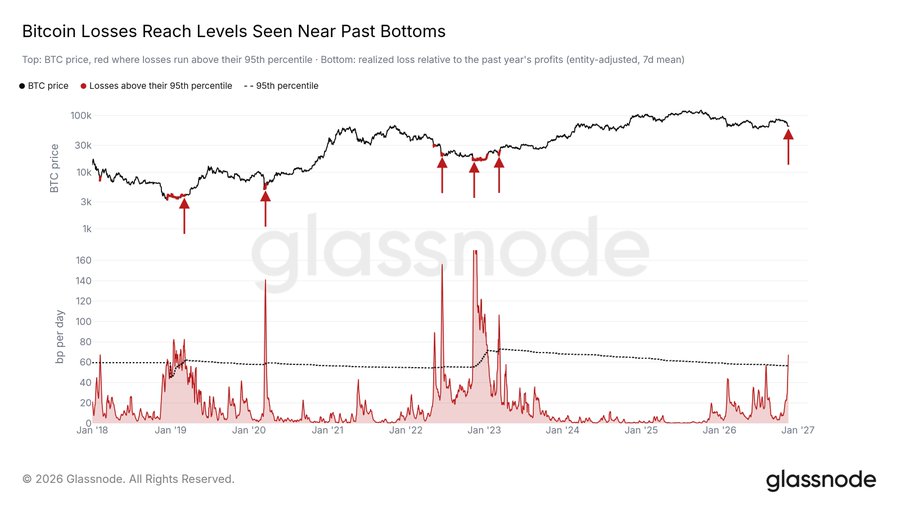
Bitcoin's slide to $62,000 on November 15 pushed realized losses to levels last recorded near previous cycle lows, according to on-chain analytics firm Glassnode, producing one of the clearest capitulation readings since early 2023.
Realized losses tally the losses locked in when coins are sold below their purchase price. Glassnode flagged the reading in its latest Week On-chain report, which it said contains twelve additional analyses, including the August support block, the liquidation map, and stablecoin supply.
"Bitcoin crashed to $62K this week, and realized losses reached levels seen only near past cycle lows. Our latest Week On-chain report contains twelve more analyses, including the August support block, the liquidation map, stablecoin supply and much more. " — glassnode (@glassnode) November 17, 2026, via X
Comparable spikes in realized losses appeared in 2018, 2020, 2022 and early 2023. Each marked capitulation — episodes in which buyers who purchased at higher prices give up and sell, passing their coins to new owners at lower prices and resetting where the market's cost basis sits.
Recent Buyers Carry the Losses
The current selling has come largely from recent buyers. Holders of coins less than six months old took profits during the September and October rally and are now selling at a loss again, with the price sitting below what recent buyers paid on average. Their break-even point — the short-term holder cost basis — stands at $74,100.
A block of coins accumulated between $62,000 and $66,000 holds about a fifth of recent buyers' supply and grew by roughly 66,000 Bitcoin during the two days of heaviest selling. Few coins were bought below $62,000, and the largest cluster of long liquidations sits just under that level. A daily close below $62,000 would put August buyers at a loss, with the next levels being the June low at $58,500 and the realized price at $53,700, an on-chain estimate of the average cost basis across all coins.
Leverage was also flushed out. November 13 and 14 brought some of the largest long liquidations since 2023 when measured against open interest, the total value of outstanding derivative positions. Resting bids on Binance and Coinbase within 5% of the price now outweigh asks by about 2.3 times, and the largest single bid on Binance since August sits near $60,000.
The Coinbase Premium — the spread between bitcoin's price on Coinbase and on other major exchanges — turned positive over the weekend of the low as United States buyers paid up, having been negative almost every hour since late October. Meanwhile, only 6% of the 100 largest altcoins trade above their 50-day average. In each year since 2023, the deepest altcoin washout came within four days of a local Bitcoin low.
Demand Stays Thin Outside the Low
Stablecoin supply — dollar-pegged tokens widely used to settle trades between cryptocurrencies — has shrunk 4.2% over the past 90 days, a period in which the three-month Treasury bill yield rose about 45 basis points. Mining companies MARA and Riot reported selling about 28,000 Bitcoin this month to help fund a move into AI data centers, while Strategy kept buying. United States spot ETFs, which hold bitcoin directly and trade on American exchanges, recorded $2.6 billion in net outflows over the ten trading days to November 13.
Elsewhere in digital assets, tokenized products that place stocks, funds and other real-world assets on blockchains grew from 428 to about 6,200 between January and early November, a span in which Bitcoin fell 15%. Perpetual futures on stocks, commodities and currencies grew from about 190 to more than 3,200, with open interest rising from about $0.35 billion to roughly $15 billion across eight exchanges.
Gate climbed from fifth to second by number of listings, with 490 today, and holds about $2.1 billion of open interest — third behind Binance and Hyperliquid. Gate says its cold storage and independent custodian holdings would cover 104.58% of user assets, and an independent audit is under way.
Options pricing on Deribit, a leading crypto options exchange, implies about a one-third probability that Bitcoin settles below $53,700 by September 2027.
Among upcoming catalysts, Anthropic is expected to begin trading on Nasdaq on November 19, and NVIDIA is due to report quarterly results. The Federal Reserve sets rates on December 9, a day before the November CPI print.
This article is based on reporting by CoinCentral.

