Bitcoin Trades Near $65,000 as BTCPay Exploit, BIP-110 Fork Debate, and $1B ETF Inflows Dominate the Week
Key Takeaways
- •Attackers exploited a BTCPay Server vulnerability to steal Lightning Network node credentials, and the project urged immediate updates to version 2.4.2.
- •The proposed BIP-110 fork has received only around 2.6% miner signalling, well below the 55% threshold, but could still trigger a minority chain split that poses replay-attack risks for users.
- •US spot Bitcoin ETFs attracted approximately $1 billion in net inflows during the week, marking their best performance since April.
- •Bitcoin network growth reached 2.27 million new wallets last week, the highest in a year, with analytics firm Santiment partially attributing the surge to security concerns following the Coldcard hack.
- •Hardware wallet maker Foundation and publication Citadel21 both confirmed losses from compromised Lightning nodes connected to the BTCPay flaw.
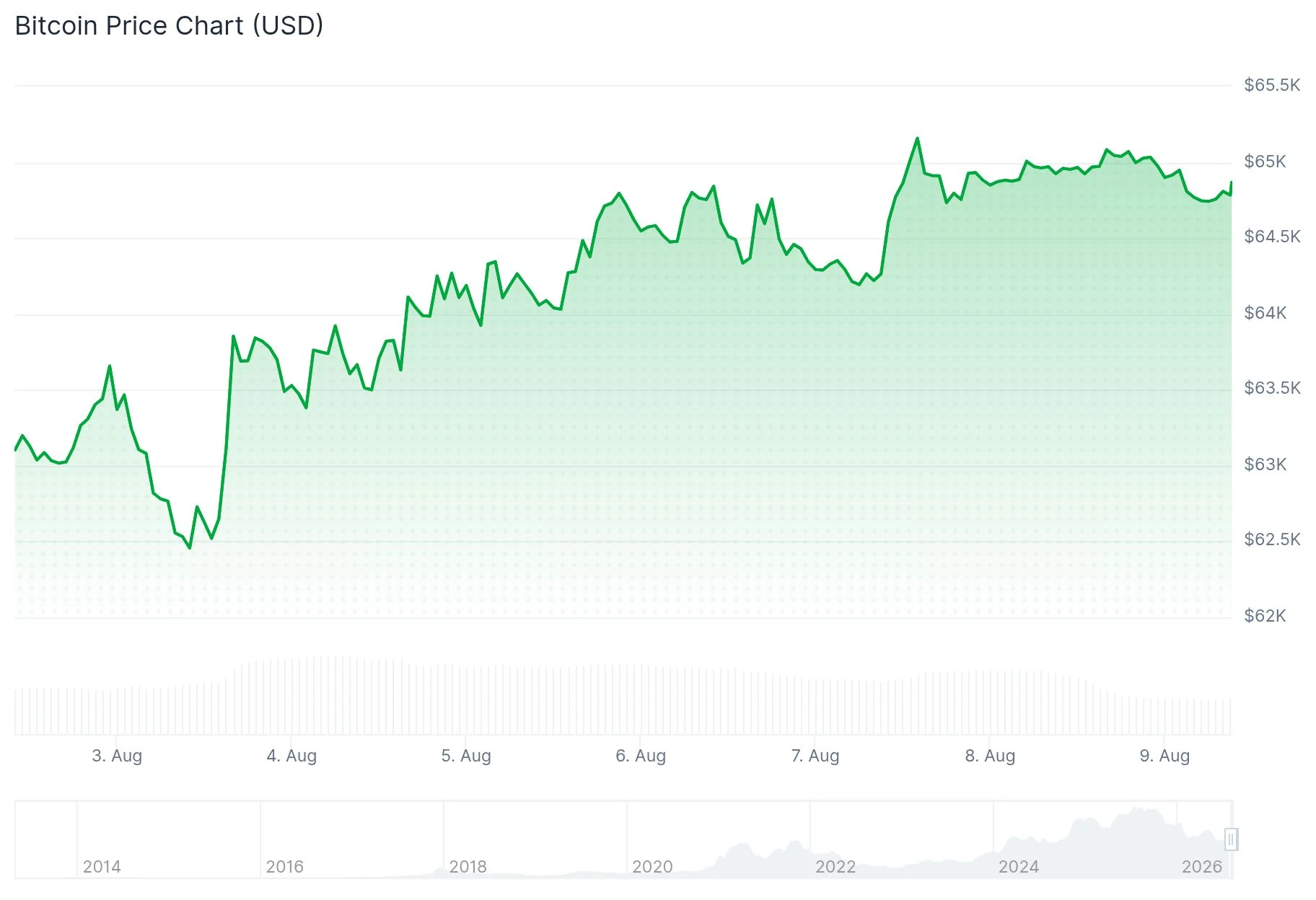
Bitcoin traded just below $65,000 on Saturday, rising 0.61% to $64,986, as a series of security and network developments drew attention across the ecosystem. For a market that often tracks macro headlines and ETF flows, this week’s focus has instead been on operational risk, protocol governance, and how users respond when those risks surface.
Late Friday, attackers exploited a vulnerability in BTCPay Server and stole credentials used to control Lightning nodes running LND software. The flaw allowed unauthenticated attackers to access “macaroon” files, which can control Lightning wallets, close payment channels, and move funds.
BTCPay confirmed that funds were stolen and urged operators to update to version 2.4.2 immediately or take their servers offline. The project has not disclosed how many victims were affected or the total amount of Bitcoin lost.
⚠️ALERT: An actively exploited BTCPay Server flaw is draining merchant Lightning nodes. Attackers can remotely grab credential files from BTCPay deployments running LND and empty the node, with hardware wallet maker Foundation among the confirmed victims, per CoinDesk. BTCPay… pic.twitter.com/558xdhTbjm — Coin Bureau (@coinbureau) August 8, 2026
Hardware wallet maker Foundation confirmed that its BTCPay Lightning node was drained, though its on-chain hot wallet was not accessed. Bitcoin publication Citadel21 also reported losing funds from a Lightning node. Standard on-chain wallets within BTCPay were not affected, although funds in LND node on-chain wallets may still be at risk.
A separate issue centered on the proposed BIP-110 fork, which could activate around block 961,632 this weekend. The proposal would limit non-payment data stored in Bitcoin transactions.
BIP-110 Minority Fork Falls 18 Blocks Behind Bitcoin Main Chain A minority fork backed by BIP-110 supporters emerged after Bitcoin block height 961,632. The BIP-110-supporting pool Roughnecks had produced only blocks 961,632 and 961,633, while the Bitcoin chain had advanced to… pic.twitter.com/higWmYqZRn — Wu Blockchain (@WuBlockchain) August 9, 2026
Miner signalling was near 2.6% on Friday, well below the 55% threshold required. Even so, nodes running BIP-110 software will reject non-signalling blocks once the activation height is reached, which could create a minority chain. That kind of split matters operationally because it can force node operators, miners, and traders to pay close attention to which chain their software follows and whether any forked assets need to be handled separately.
If a chain split occurs, holders would have equal balances on both chains. Developer Kevin Loaec warned that selling forked coins without separating balances first could expose real BTC to replay attacks.
Meanwhile, Bloomberg ETF analyst Eric Balchunas reported that US spot Bitcoin ETFs took in roughly $1 billion in net inflows this week, marking their strongest week since April and their third-best week since October 2025.
Balchunas also suggested that the Coldcard hardware wallet hack, which resulted in roughly $116 million in Bitcoin being stolen due to a firmware flaw in key generation, may have pushed some investors toward ETFs. He said, “long-term I can’t imagine there aren’t some who migrate over,” while noting that the connection has not been proven.
On-chain analytics firm Santiment said Bitcoin network growth reached 2.27 million new wallets last week, the highest level in a year. Santiment linked the increase partly to the Coldcard incident, saying security shocks often prompt users to move funds, change custody setups, and create fresh wallets, which can drive activity sharply higher. The firm also noted that larger Bitcoin holders have historically used periods of rising retail activity to accumulate more aggressively.
🔐 Bitcoin has just posted a huge on-chain week. Network growth reached 2.27M new wallets, the highest level of the past year, while 751K active wallets marked the strongest reading in 10 months. 📈 The biggest catalyst is the Coldcard wallet chaos. Security shocks pressure… pic.twitter.com/fBEGeSPbNO — Santiment Intelligence (@SantimentData) August 7, 2026
Bitcoin last traded at $64,933, down $74 on the day.

