Why Did BTC Suddenly Jump Above $68K? Treasury Buybacks, Crypto Policy, and Whale Accumulation
Key Takeaways
- •Bitcoin gained about 6% on August 19, 2026, trading near $68,406 at 4 p.m. ET after briefly touching $70,000 during the session.
- •U.S. Treasury buybacks of longer-term government debt reduced bond-yield stress and supported risk appetite for higher-duration assets such as Bitcoin.
- •The White House hosted discussions between industry leaders and regulators while the CLARITY Act moved toward another Senate vote, improving crypto policy sentiment.
- •Bloomberg-cited data showed large Bitcoin holders accumulated roughly 43,000 BTC, valued around $2.75 billion, over the preceding 60 days.
- •Traders identify $68,000 as the first retest zone, with further upside dependent on ETF inflows, exchange outflows, and controlled perpetual funding rates.
Quick Answer
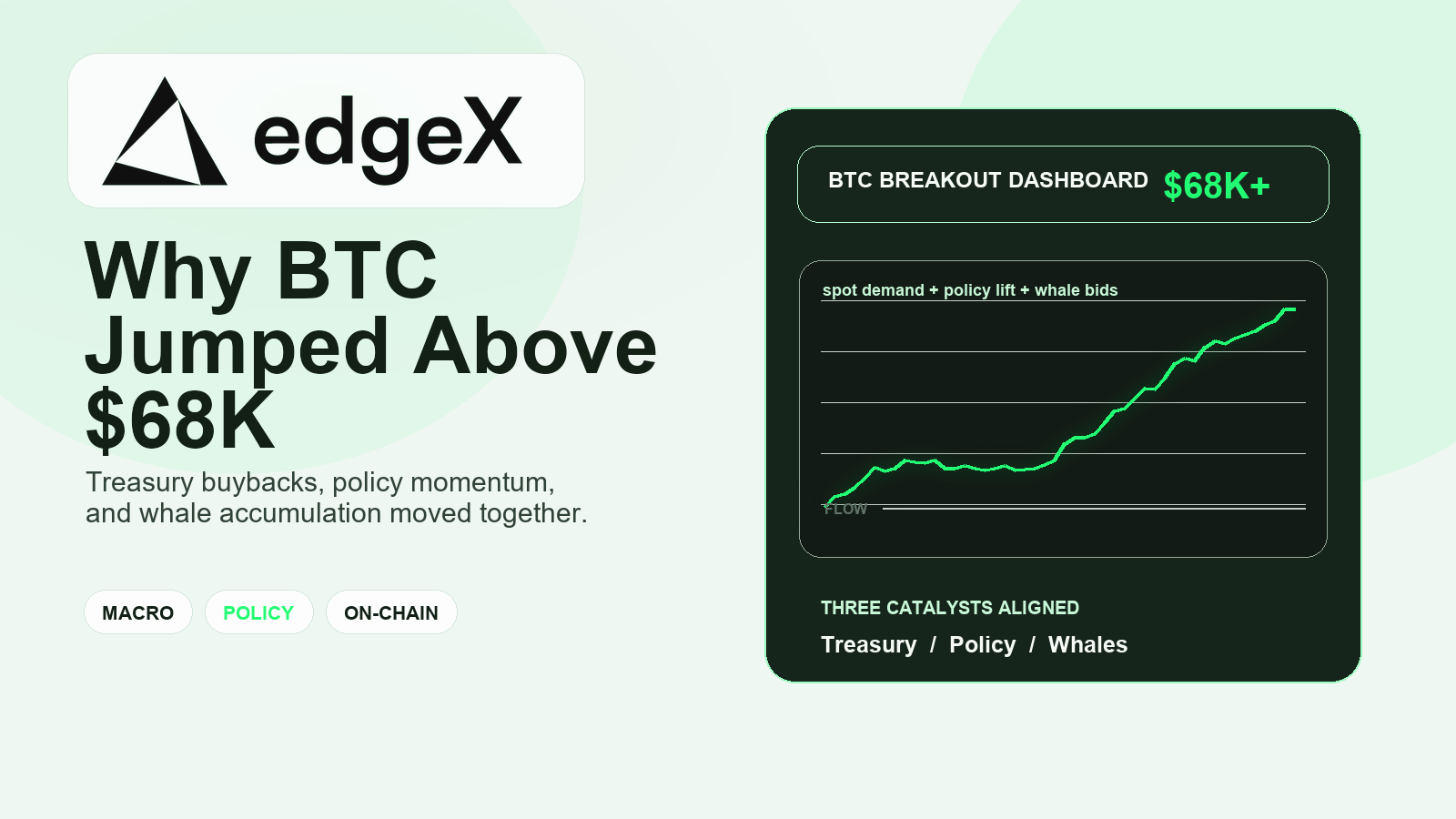
On August 19, 2026, BTC jumped above $68K because several market signals aligned at once. Treasury buybacks of longer-term debt helped calm bond-yield pressure, which supported risk appetite. Crypto regulation headlines improved sentiment as the White House hosted industry and regulatory discussions while the CLARITY Act moved toward another Senate vote. At the same time, data cited by Bloomberg showed that large Bitcoin holders had accumulated around 43,000 BTC over the previous 60 days, giving traders a Bitcoin-specific demand signal. BTC gained about 6% to trade near $68,406 at 4 p.m. ET and briefly touched $70,000 during the session.
Bitcoin Broke $68K Because the Macro Tape Turned Friendlier
Bitcoin's move above $68,000 did not arrive from a quiet market. The rally came as traders were already watching Treasury yields, U.S. policy signals, crypto regulation, and large-wallet behavior. The move looked sudden on the chart, but the setup had several layers underneath it.
The first layer came from rates. The U.S. Treasury expanded its buyback activity in longer-term government debt, a move that helped reduce stress in the part of the bond market that often matters most for risk assets. When longer-term yields rise too quickly, high-duration assets, equities, crypto, and speculative trades usually feel pressure. When long-yield pressure cools, traders have more room to add risk.
Bitcoin is not a Treasury bond, but it trades inside the same liquidity environment. A calmer rates backdrop can lower the hurdle for buyers who were waiting for confirmation that macro pressure was not about to overwhelm crypto-specific demand.
Why Lower Yields Can Trigger a Fast Repricing
The yield channel is especially important after a period when crypto traders had been forced to watch macro indicators as closely as exchange data. Higher long-term yields can lift discount rates, tighten financial conditions, support the dollar, and reduce the appeal of assets that depend on future liquidity growth. Bitcoin can still rally during a high-yield environment, but the burden on spot demand becomes heavier. A Treasury action that softens the long end therefore changes the near-term risk calculation even before it changes any Bitcoin-specific metric.
There is also a duration effect inside crypto positioning. Traders who buy BTC on momentum often look for a market in which rates, equities, and the dollar are not fighting the trade at the same time. When Treasury buyback news reduces the sense of bond-market stress, the same price level can suddenly look less risky. That can turn a slow range into a fast breakout because sidelined buyers move together.
Bitcoin often reacts more sharply than traditional assets when macro pressure eases. The reason is positioning. If traders were cautious because yields were rising, a softer bond-market tone can quickly push them back toward higher-beta assets. BTC then becomes one of the cleanest ways to express renewed risk appetite.
That does not mean Treasury buybacks alone caused the rally. It means the buyback news improved the conditions around the trade. Bitcoin was already sitting near a technical and psychological zone where momentum accounts could respond quickly. Once the market saw a less hostile bond backdrop, buyers had fewer reasons to wait.
Crypto Policy Headlines Added a Second Tailwind
The second catalyst came from Washington. Crypto regulation moved back into focus as industry leaders and regulators met at the White House, while the CLARITY Act continued toward another Senate vote. For Bitcoin traders, the details matter less than the direction of travel: the market wants evidence that U.S. digital-asset rules are moving from enforcement uncertainty toward a clearer market-structure framework.
Policy clarity can affect Bitcoin sentiment even when the bill is not Bitcoin-specific. Clearer rules can support exchanges, custodians, market makers, tokenized-asset venues, stablecoin rails, and the broader crypto infrastructure layer. Bitcoin sits at the center of that market. When policy risk falls, liquidity providers can become more willing to quote, investors can become more willing to allocate, and institutions can become more willing to treat crypto as a regulated market rather than a headline hazard.
The CLARITY Act also matters because it has become a symbol for market-structure reform. Traders do not need the bill to be completed in one day for it to matter. Momentum toward a vote can reduce the perceived probability of a stalled or hostile policy path.
Why the Policy Timing Mattered to the Breakout
The White House focus added a timing component. A meeting between industry leaders and regulators tells the market that crypto policy is not sitting entirely outside the political agenda. The reaction does not require every participant to agree on every rule. Markets often move when the probability distribution improves. A lower chance of policy paralysis can be enough to lift risk appetite when price is already pressing against resistance.
Bitcoin benefits indirectly from that shift. BTC has the strongest brand, the deepest liquidity, and the clearest institutional access among crypto assets, but it still depends on the health of the broader market structure. If exchanges, market makers, stablecoin rails, custody platforms, and derivatives venues face less uncertainty, Bitcoin liquidity can improve along with the rest of the sector. That is why regulatory momentum can appear in BTC first even when the policy conversation covers the entire digital-asset market.
Crypto markets do not automatically rally on regulation. Restrictive rules can hurt activity. Ambiguous rules can freeze investment. Clearer rules, however, can support market depth because participants know where the boundaries sit.
That is why BTC's move above $68K should be read as a policy-sentiment move as much as a macro move. Traders saw a rates backdrop that was less threatening and a regulatory tape that looked more constructive. That combination made short-term upside easier to price.
Whale Accumulation Turned Sentiment Into a Bitcoin-Specific Trade
The third catalyst was the most Bitcoin-specific. Large holders reportedly added around 43,000 BTC over 60 days, worth roughly $2.75 billion. The accumulation did not occur in a single session, but its disclosure reinforced the demand narrative as BTC broke higher. Whale accumulation can change the tone of a rally because it suggests the move is not only a derivatives squeeze or a macro beta trade.
When large wallets add supply, the market can interpret the behavior as balance-sheet conviction. That does not guarantee a durable advance, and whale data can vary by provider and wallet-classification method. But the direction of the signal matters. A major accumulation figure arriving at the same time as macro and policy support creates a stronger rally narrative than any one factor would create alone.
Whale buying also affects market psychology. If traders believe larger holders are absorbing supply, dips can feel more dangerous to short. Momentum buyers become more willing to chase. Short sellers become quicker to cover. That can turn a clean push through resistance into a faster breakout.
The scale also changes the interpretation. At roughly 43,000 BTC, the reported accumulation figure is large enough to be discussed as a market-structure input rather than background noise. At an estimated value near $2.75 billion, it points to demand from wallets that can absorb meaningful supply. The figure should still be handled carefully because whale labels depend on address clustering and provider methodology. Even with that caveat, reported accumulation near a breakout level can tighten the float that active traders are trying to buy.
The strongest version of this signal would show whales accumulating while coins leave exchanges. That pairing would imply that large holders are adding and available sell-side inventory is falling. The weaker version would show whale accumulation alongside rising exchange inflows, which could mean some holders are preparing to sell into strength. Without a fresh CryptoQuant or Coinglass export, the cleaner editorial stance is to treat the 43,000 BTC figure as supportive but not conclusive.
The Three-Catalyst Stack Behind the $68K Break
| Catalyst | Why It Helped BTC | Confirmation to Watch |
|---|---|---|
| Treasury long-debt buybacks | Eased pressure on longer-term yields and improved risk appetite | Softer 10-year and 30-year yields, stronger equity breadth, stable dollar |
| White House crypto policy focus | Reduced fear that U.S. regulation would remain stuck in uncertainty | CLARITY Act progress, market-structure comments, clearer agency roles |
| Whale accumulation | Gave the rally a Bitcoin-specific demand signal | Continued large-holder accumulation, exchange outflows, stable ETF demand |
| Technical breakout above $68K | Forced momentum buyers and short-covering flows to respond | BTC holding $68K on retests and building volume above the level |
The table shows why the rally moved quickly. Macro conditions helped, policy sentiment improved, and large-holder behavior gave Bitcoin a direct demand story. A technical break above $68K then converted those signals into price action.
The timing of the break also matters. A level such as $68,000 is not only a round number. It can sit near stop orders, breakout triggers, and discretionary trader thresholds. Once BTC crossed that area, systematic momentum strategies and short-covering flows could amplify the move. That feedback loop often makes a breakout look more abrupt than the underlying catalyst sequence. The market may spend days building pressure and then express the repricing in a few hours.
The Breakout Still Needs Follow-Through
The $68K move improved the chart, but it did not finish the argument. Bitcoin rallies often begin with a catalyst stack and then need confirmation from flows. ETF demand, spot volume, exchange netflow, funding rates, and liquidation maps will decide whether this was the start of a broader range expansion or a fast relief move.
Spot Flows Must Confirm the Headline Move
ETF demand matters because it remains one of the cleanest institutional channels. If spot Bitcoin ETFs attract new inflows after the breakout, the rally gains a more durable buyer base. If ETFs stay flat or see outflows, the move depends more on momentum and whale behavior.
Exchange netflow matters because coins moving back to exchanges can signal potential sell pressure. A stronger bull case would show exchange outflows alongside whale accumulation. That combination would suggest supply is being pulled away from venues while large holders accumulate.
Funding and liquidation data also deserve attention. A breakout funded by moderate leverage can extend. A breakout driven by crowded long positioning can become unstable. If funding overheats while spot confirmation stays weak, BTC can be vulnerable to a sharp reset even after a strong headline move.
Spot market behavior will carry the most weight during the next retest. If spot buyers absorb dips above $68K while perpetual funding stays controlled, the rally can mature from headline reaction into a healthier trend. If the move becomes mostly a derivatives chase, liquidity can cut both ways. A sudden reversal through the breakout level could force late longs out of the market and return BTC to the prior range.
That is why volume and venue mix deserve attention. A breakout supported by broad spot volume, ETF inflows, and exchange outflows usually has a stronger base than a move led by perpetuals alone. A perpetual-led breakout can still run, especially if shorts are trapped, but it tends to require careful confirmation because leverage can unwind faster than spot demand.
$68K Becomes the First Retest Zone
After a fast breakout, the former resistance zone often becomes the first test of demand. If BTC holds above $68,000 during pullbacks, traders can treat the move as a constructive regime shift. If price loses the level quickly, the rally starts to look more like headline-driven short covering.
The next upside test sits around the upper-$60,000s to low-$70,000s, where psychological resistance and liquidity clusters can attract both profit-taking and breakout orders. A clean move into that area would require the same three supports to remain intact: calmer yields, constructive policy momentum, and continued evidence that large holders are not distributing into strength.
Failure would look different. A quick move back below $68K, especially if it comes with rising yields, weaker equity risk appetite, or signs of whale distribution, would reduce confidence in the breakout. That would not erase the bullish catalysts, but it would show that the market had already priced them too aggressively. Bitcoin rallies are strongest when the chart, flows, and macro backdrop confirm each other. They become fragile when price runs ahead of confirmation.
What the Breakout Changes for Bitcoin Traders
The jump above $68K changed the immediate Bitcoin setup from range defense to breakout evaluation. Before the move, traders were focused on whether BTC could hold support and whether spot demand was too fragile. After the move, the question shifted to whether buyers can defend the breakout.
That shift is important because the rally did not depend on only one input. Macro liquidity, policy expectations, and whale behavior all lined up. Multi-catalyst rallies can travel further because they attract different buyer groups: macro traders, policy-sensitive crypto investors, momentum accounts, and on-chain analysts. They can also reverse quickly if one of the supports disappears.
The cleanest bullish follow-through would be a close above $68K, stable or positive ETF flows, exchange outflows, and whale accumulation that continues rather than stalls. The bearish warning would be a failed retest, rising exchange inflows, overheated funding, or policy headlines losing momentum after the initial excitement.
Bitcoin now has a better upside story than it had before the breakout. The market still needs proof that the story has buyers behind it.
The next confirmation window should focus on behavior, not slogans. Treasury buybacks can support the macro backdrop, while the CLARITY Act and whale accumulation can keep sentiment and demand aligned. If those conditions hold together, the $68K break can become the start of a more durable push.
Trade Bitcoin With Leverage - Without Giving Up Custody
Decentralized perpetual exchanges have moved well past niche status. According to CoinGecko's 2025 Annual Crypto Report, DEX perpetual trading volume surged 346% last year, reaching $6.7 trillion, while centralized exchange open interest fell 20.8% over the same period. Traders are committing serious capital to on-chain derivatives, and the reasons are straightforward: counterparty risk is real, custodial failures happen, and censorship resistance matters.
edgeX is a decentralized perpetual futures exchange built for traders who want market access without sacrificing control. Here's what sets it apart:
- No KYC, no barriers. Connect a wallet and start trading. No identity verification, no account approvals. Onboarding is fast regardless of where you're based.
- True self-custody. edgeX combines off-chain order matching with verifiable on-chain settlement secured by Ethereum. Forced-withdrawal mechanisms keep your funds recoverable directly from the blockchain, even if the operator goes dark.
- Deep liquidity, tight spreads. edgeX maintains $10 million of market depth within a one-basis-point spread, with sub-0.1-basis-point slippage on trades exceeding $100,000. When Bitcoin moves fast, that precision matters.
- Up to 100x leverage. Scale positions to match your conviction, whether you're hedging exposure or trading momentum.
- 140% trading fee rewards. Active traders can earn back more than they pay in fees, reducing the net cost of high-frequency strategies over time.
- Institutional-grade infrastructure. edgeX processes up to 200,000 orders per second with matching latency below 10 milliseconds, delivering performance on par with major centralized exchanges without the custody trade-offs.
Start trading BTC/USDC perpetual futures on edgeX and put your market view to work.
Frequently Asked Questions
Why did BTC jump above $68K?
BTC jumped above $68K because macro, policy, and on-chain signals aligned. Treasury buybacks helped ease long-yield pressure, U.S. crypto regulation headlines improved sentiment, and whales reportedly added around 43,000 BTC.
Did Treasury buybacks directly cause Bitcoin to rally?
No single Treasury action directly controls Bitcoin. The buybacks helped improve the rates backdrop by easing pressure on longer-term government debt, which can support risk assets when traders are sensitive to yields.
Why does the CLARITY Act matter for Bitcoin?
The CLARITY Act matters because it points toward clearer U.S. crypto market-structure rules. Bitcoin can benefit when regulatory uncertainty falls and institutions gain more confidence in crypto infrastructure.
Is whale accumulation enough to confirm a new Bitcoin bull leg?
Not by itself. Whale accumulation is constructive, but confirmation should also come from ETF flows, spot volume, exchange outflows, and healthier derivatives positioning.
What level should traders watch after the breakout?
The first level is $68,000. Holding that zone on pullbacks would support the breakout case. Losing it quickly would make the move look more like headline-driven short covering.

