Bitcoin Pulls Back as Iran Risk Grows: What Traders Are Watching
Key Takeaways
- •Bitcoin's climb above $84,000 lost momentum after Iran kept conditions attached to its proposed temporary reopening of the Strait of Hormuz and President Trump rejected the offer while not ruling out further U.S. strikes.
- •Brent crude briefly rose above $106 as the talks stalled, a move that matters to risk assets because the strait carries roughly a fifth of the world's oil.
- •Nasdaq futures weakened alongside Bitcoin, signaling a wider reassessment of risk rather than a crypto-specific event.
- •The $81,200–$81,400 area, which acted as resistance during the late-August and early-September advance before the rally toward $87,000, is now the key support, with the rising 50-day SMA near $76,500 as the next level if it fails.
- •Three U.S. releases this week — the August PCE report on September 30, the ISM manufacturing survey on Thursday and the September jobs report on Friday — could determine whether oil-driven inflation concerns intensify or ease.
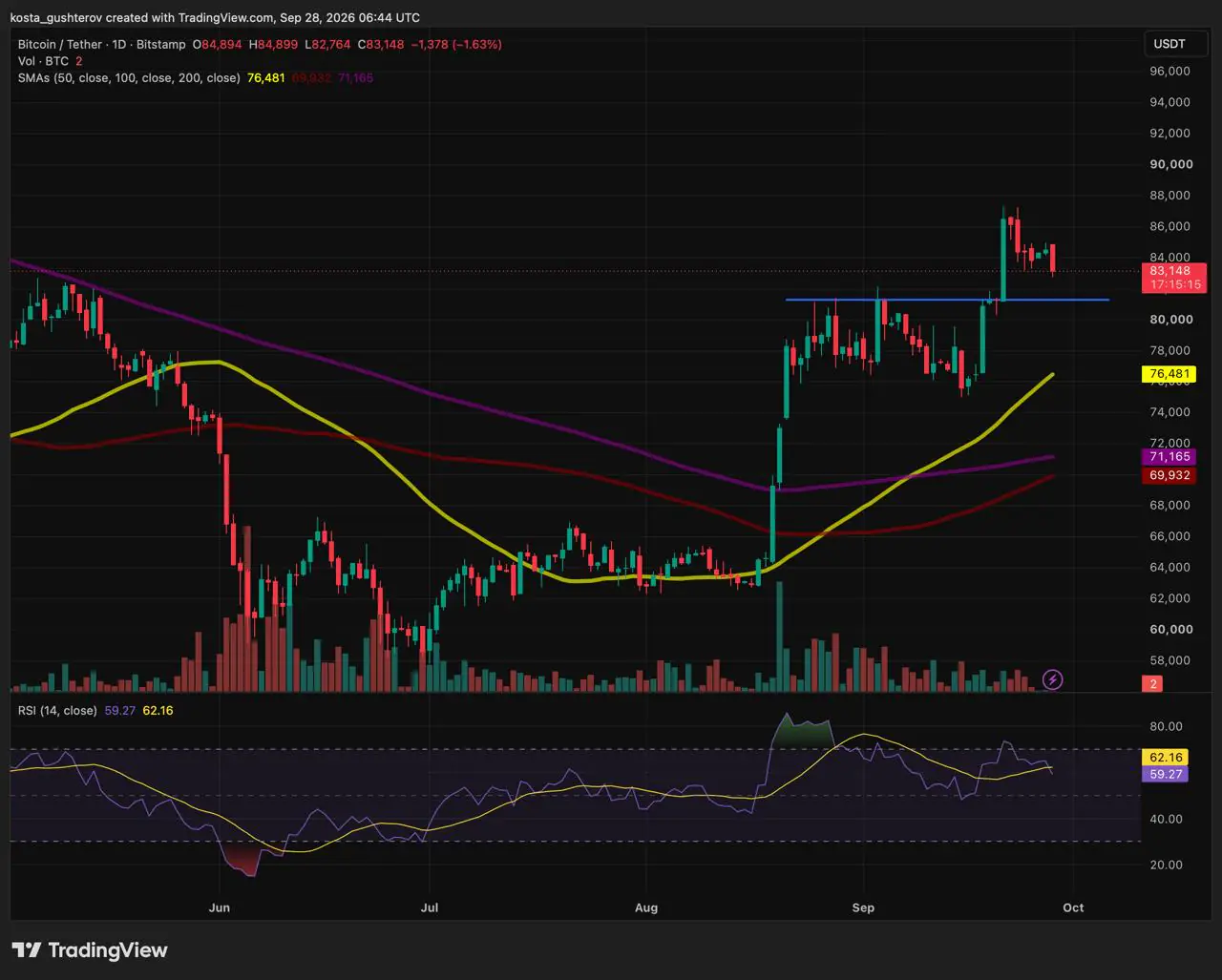
Bitcoin is pulling back as hopes for a swift resolution around the Strait of Hormuz fade, and traders are weighing whether the retreat is a short reaction to renewed headlines or the start of a broader repricing of energy and inflation risk. The nearest chart reference sits near $81,300 — an area Bitcoin previously struggled with before breaking higher — making it the closest meaningful support zone below the market rather than a precise price that must hold to the dollar.
The market's Hormuz optimism has faded
The decline followed a more optimistic stretch for the market. Earlier reports of U.S.-Iran discussions over a phased reopening of the Strait of Hormuz had helped BTC climb back above $84,000, a rebound covered by Coindoo when the prospect of reduced disruption was still lifting sentiment.
That reassurance has since worn off. Iran has maintained the conditions attached to its proposed temporary reopening of the waterway, while President Donald Trump rejected the offer. According to CoinDesk's report on the latest comments, Trump has said negotiations could continue but has not ruled out further U.S. strikes.
A route to talks still exists, but there is no accepted framework for reopening Hormuz. Traders who had treated the earlier diplomacy as a reason to reduce geopolitical exposure must now consider the possibility of a longer disruption.
Oil turns diplomacy into a macro risk
Brent crude briefly climbed above $106 as Iran held to its proposed terms and Trump rejected the offer. Reuters report described the move as a response to stalled talks and continued pressure around the Strait. The waterway is one of the world's most important energy chokepoints, carrying roughly a fifth of the world's oil, which is why uncertainty around access feeds so directly into crude prices.
Bitcoin does not mechanically follow oil. The concern, however, is that prolonged energy disruption could lift inflation expectations, push yields higher and leave investors less willing to hold volatile assets.
Nasdaq futures also weakened alongside Bitcoin during the latest move — a sign of a wider reassessment of risk rather than a crypto-specific event.
Bitcoin's rebound from roughly $82,760 shows that buyers stepped in after the initial sell-off. It does not yet establish that markets have absorbed the risk created by the stalled negotiations or restored the confidence that carried BTC above $84,000.
The chart puts $81,300 under the spotlight
The nearest support sits around the $81,200–$81,400 area. This zone acted as a visible horizontal barrier during the late-August and early-September advance, and Bitcoin eventually broke through it before rallying toward the recent high around $87,000.
That history gives the area a clear role in the present decline. A former ceiling can provide support after a breakout, though only a sustained hold would confirm that buyers remain in control.
A daily close above the support area would preserve the view that the pullback is merely testing former resistance. Continued trading beneath it would bring deeper moving-average supports into view, including the rising 50-day SMA near $76,500 — a widely watched medium-term trend gauge.
What could move Bitcoin this week
Neither a single diplomatic comment nor a single red daily candle resolves the current market question. Traders are watching whether the conflict disrupts energy flows for longer, whether higher oil prices feed into inflation expectations, and whether risk assets can absorb both pressures. The chart shows where buyers may respond; the developments below could shape that response.
A real diplomatic change around Hormuz
Markets need more than competing statements from Tehran and Washington. Traders will look for a mutually accepted reopening mechanism, evidence that shipping can resume safely, and signs that physical flows are improving.
Whether oil keeps adding to inflation fears
A short oil spike and a sustained rise carry different implications. If Brent stays elevated while yields rise and Nasdaq futures remain weak, pressure on Bitcoin could persist even without a fresh escalation.
This week's U.S. data calendar
Three scheduled releases could shape the macro backdrop for Bitcoin this week. The August PCE report — the inflation measure watched most closely by the Federal Reserve — arrives Wednesday, September 30, per the BEA release schedule; ISM publishes its September manufacturing survey on Thursday, per its PMI reports page; and the September jobs report follows on Friday, per the BLS release schedule.
PCE will show whether inflation pressure is easing or persisting. ISM can provide an early reading on factory activity, supply conditions and input costs. Payrolls will shape expectations for growth, wages and interest rates. With oil already lifting inflation concerns, traders will be watching whether the data reinforce that pressure or give markets room to look past it.
Bitcoin is testing how much uncertainty the market can absorb
The next phase depends on evidence rather than another round of competing statements. A workable Hormuz agreement would reduce the energy-risk premium, while a prolonged impasse would leave markets focused on oil, yields and incoming U.S. data.
For Bitcoin, the prior breakout zone is the immediate test. A sustained hold would show that buyers are still defending the area despite renewed geopolitical pressure. A loss of it would suggest the earlier advance needs more time to rebuild.
This article is provided for informational purposes only and does not constitute financial or investment advice. Cryptocurrency markets are volatile, and technical levels can change quickly.

