Bitcoin Rises Above $64,000 as Strait of Hormuz Negotiations Pressure Oil Markets
Key Takeaways
- •President Donald Trump said the Strait of Hormuz could reopen soon, but negotiators have not reached a final agreement.
- •Reports say the proposed interim framework would create separate shipping routes and include a mine-clearing provision within 30 days.
- •Bitcoin traded around $64,400 after briefly reaching $64,700, while trading volume fell about 15%.
- •Oil prices fell below $75 a barrel and have dropped more than 13% over the past week as supply fears eased.
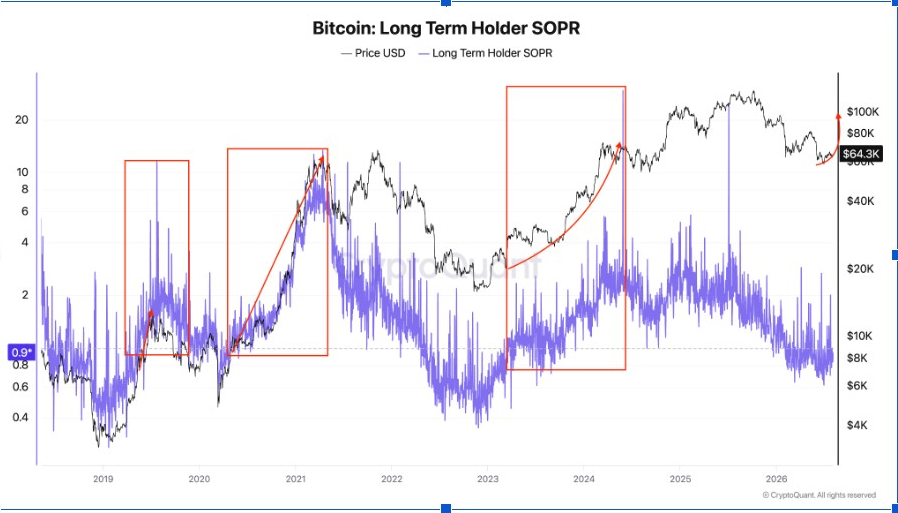
- •Long-term holders added about 380,000 BTC in the past month, and spot Bitcoin ETFs recorded roughly $381.4 million in net inflows over five sessions.
Bitcoin climbed above $64,000 on Wednesday as traders evaluated potential progress toward reopening the Strait of Hormuz, a development that simultaneously pressured crude oil prices lower.
The Strait of Hormuz narrow shipping lane handles roughly one-fifth of global oil consumption, making any disruption there a flashpoint for energy markets and, by extension, inflation expectations worldwide. President Donald Trump indicated that an agreement involving Iran and Oman could materialize soon. His remarks alleviated some supply concerns across energy markets and lent support to risk assets. West Texas Intermediate traded near $75.22, while Brent crude stood around $79.45 on August 5.
Bitcoin advanced roughly 2% over the latest 24-hour period. Market participants also monitored U.S. economic data releases, institutional demand patterns, and higher-timeframe technical indicators.
Trump Signals Progress on Hormuz Negotiations
Trump stated that the Strait of Hormuz could reopen soon as negotiators continued discussions over an interim arrangement. https://x.com/DonaldTrumpNat/status/2084907965304262768?s=20
The proposed agreement centers on Iran and Oman, with the United States participating indirectly in the broader negotiations. Iran acknowledged making progress toward an arrangement with Oman but denied engaging in direct talks with Washington.
Reports indicated that negotiators were discussing an initial 60-day framework. The arrangement would establish separate shipping routes for vessels entering and leaving the Gulf while longer-term negotiations continued. The draft also referenced a provision requiring both parties to clear naval mines within 30 days.
No final agreement had been signed, meaning the terms remained subject to change. Several contentious issues persisted. Washington opposed cargo fees, while Iran sought the right to collect payments from ships transiting routes under its control. Oman reportedly proposed a reduced fee as a compromise. Iran additionally demanded an end to the U.S. blockade of its ports — a condition Washington had not publicly accepted.
The negotiations represented meaningful progress rather than a confirmed reopening. Past ceasefire and shipping arrangements in the region have faced implementation delays, and previous diplomatic breakthroughs have unraveled before taking effect.
Bitcoin Strengthens as Oil Extends Decline
Bitcoin traded near $64,400 after touching an intraday high of $64,700. The cryptocurrency dipped to $63,397 earlier in the session before buyers stepped in. Trading volume declined approximately 15%, indicating reduced participation during the advance. Investors awaited further U.S. labor reports for signals on the Federal Reserve's policy direction, as labor market strength directly influences the central bank's appetite for rate adjustments that shape liquidity conditions across risk asset markets.
Oil prices slipped below $75 per barrel as traders factored in the potential reopening of the critical shipping route. Crude extended its slide for a third consecutive session, losing more than 13% over the past week. The retreat in energy prices eased some inflation concerns linked to the conflict, bolstering risk assets including Bitcoin and major U.S. stock indexes. Lower energy costs feed into headline inflation metrics that the Federal Reserve watches closely, and disinflationary signals from commodities can strengthen the case for accommodative monetary policy — a tailwind for scarce, non-yielding assets like Bitcoin. Market participants also tracked shipping insurance costs and tanker traffic across the Gulf. A confirmed agreement could further diminish near-term supply fears.
Long-Term Holders Accumulate
On-chain data showed that long-term holders added approximately 380,000 BTC over the past month, representing an estimated $24.3 billion at current market prices. These holders accumulated while Bitcoin traded largely between $60,000 and $65,000. The increase constituted nearly 2% of Bitcoin's total supply.
The long-term holder spent output profit ratio moved above one, indicating that older holders had resumed profit-taking even as demand absorbed available supply.
Spot Bitcoin exchange-traded funds recorded approximately $381.4 million in net inflows across five trading sessions, providing an additional demand source during the recent consolidation across major trading venues. Since their launch in January 2024, these ETFs have become a structural demand channel, allowing traditional finance participants to gain Bitcoin exposure without holding the asset directly. Buyer interest persisted despite short-term price action remaining within a relatively narrow band.
Technical Levels in Focus
EGRAG Crypto identified a bullish divergence on Bitcoin's three-day chart, where price formed a lower or similar low while the relative strength index produced a higher low. The analyst suggested momentum could strengthen if the RSI reclaims its moving average, with a move above $83,000 providing the first major confirmation. https://x.com/egragcrypto/status/2084972317977772330?s=20
The analyst placed the next structural resistance near $102,000, with a firm three-day close above that level potentially opening targets toward $126,000 and $171,000. A further extension toward $200,000 was noted under stronger momentum conditions. However, a break below the rising yellow trend line could undermine the divergence setup.
Separately, other analysts continued to monitor a falling wedge pattern on Bitcoin's higher-timeframe chart, where a daily close above $70,000 could confirm the formation and point toward $120,000.

