Bitcoin Faces Rejection at Key Resistance – Is $58,000 the Next Stop?
Key Takeaways
- •Bitcoin remains confined within a bearish descending channel after failing to secure a daily close above the $63,300 to $63,600 resistance band.
- •The overhead resistance is strengthened by a confluence of the 50-day Simple Moving Average and a Fibonacci retracement level.
- •Immediate downside protection is located at $62,100, with limited established support visible before the $58,000 region.
- •Short-term holders transferred over 32,000 Bitcoin to exchanges at a loss on August 1, reflecting financial strain among recent buyers.
- •Analysts emphasize that while these loss-related inflows indicate seller stress, they do not independently confirm a market bottom without accompanying price stability.
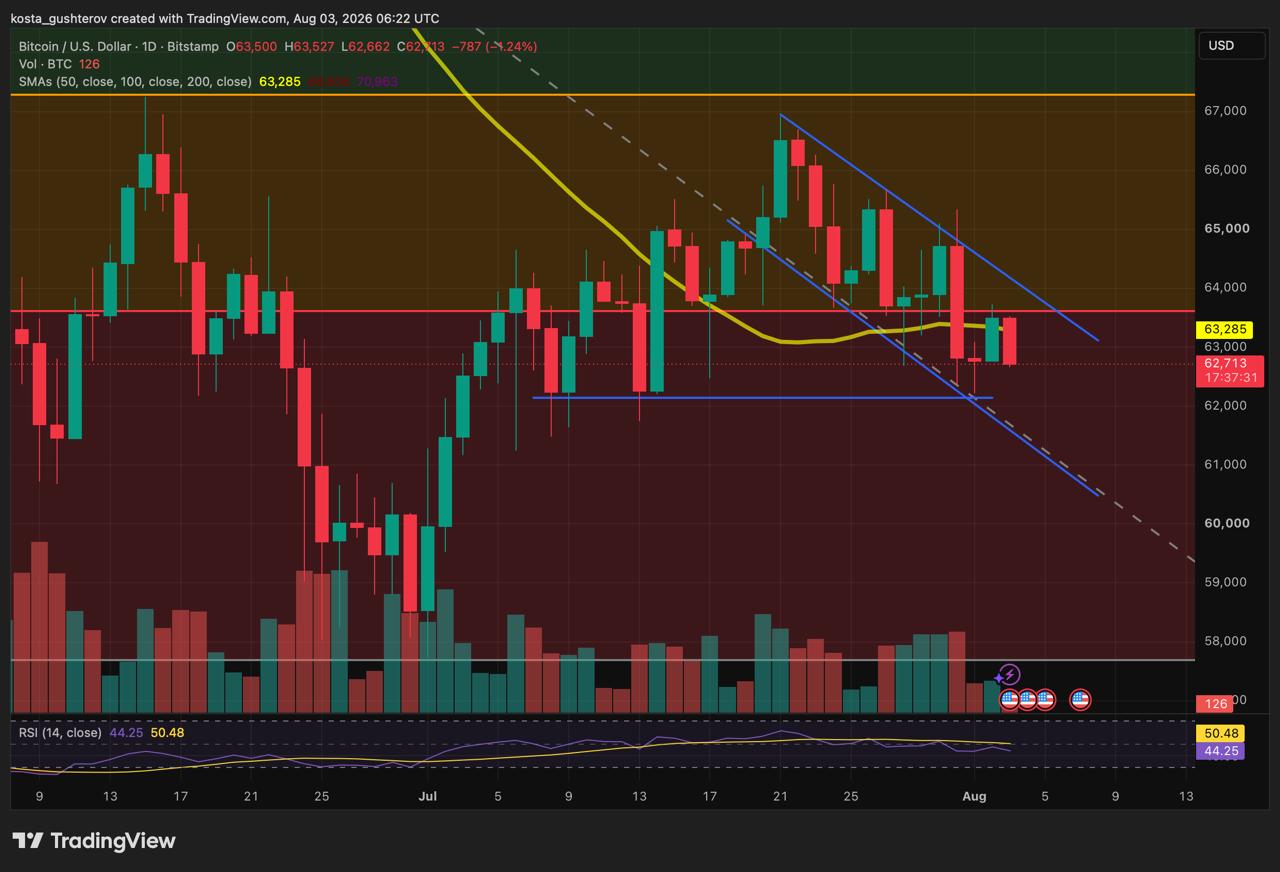
Bitcoin's price approached a critical resistance zone but failed to secure a daily close above it, leaving the cryptocurrency within a descending channel that has generated lower highs since July 21. Descending channels are widely recognized in technical analysis as bearish continuation patterns, though both upside breakouts and downside breakdowns from such formations can signal a shift in trend direction.
The $63,300–$63,600 Resistance Band Holds Firm
The 50-day SMA and the Fibonacci retracement level sit in close proximity, forming a consolidated resistance band rather than two distinct price levels. Confluence zones—where multiple technical indicators cluster near a single price area—tend to draw heightened attention from traders because a move above or below them can carry more analytical weight than a breach of any single indicator.
Bitcoin had previously traded above this area before surrendering it during the most recent correction. Reclaiming only the lower boundary would still leave both the Fibonacci level and the descending channel overhead as obstacles.
A daily close above the full $63,300–$63,600 range would partially repair the recent technical deterioration. However, the upper channel boundary would still need to be broken and successfully retested before the pattern of lower highs could be considered broken.
$62,100 Serves as the Nearest Horizontal Support
Horizontal support is located near $62,100, aligning closely with the lower boundary of the descending channel. This area has already halted multiple declines throughout the current correction phase.
A daily close below $62,100 would eliminate the nearest horizontal floor and subject the channel boundary to increased pressure. Should both levels give way, the chart reveals limited established support before the broader zone around $58,000.
That $58,000 area previously arrested the late-June sell-off, though its past performance does not ensure that buyers will mount a similar defense this time.
Short-Term Holders Transferred 32,000 BTC at a Loss
The recent price weakness coincided with a notable surge in exchange deposits from recent Bitcoin purchasers.
CryptoQuant analyst Darkfost reported on X that short-term holders moved more than 32,000 BTC to exchanges at a loss on August 1. The transfer ranked among the largest such movements documented over the preceding 30 days.
Short-term holders are those who acquired their coins more recently than long-term investors. Their behavior is closely tracked in on-chain analysis because this cohort is statistically more likely to react to price volatility, having held positions through a limited portion of Bitcoin's market cycles. Sending Bitcoin to an exchange at a price below the acquisition cost signals that some of those positions had come under financial strain.
An exchange deposit does not necessarily mean every coin was sold. It does, however, place the Bitcoin in a venue where it can be traded readily, expanding available supply at a time when price is already struggling beneath resistance.
The inflow occurred around the same time as Bitcoin's failed recovery attempt near $63,600. While the timing does not establish causation, it demonstrates that recent buyers were relocating underwater positions toward trading platforms during the same window.
Loss-Related Inflow Alone Does Not Signal a Market Bottom
Large loss-related exchange deposits can emerge during capitulation events, but the movement by itself does not indicate that selling pressure has concluded.
The transferred coins may sit on exchanges indefinitely, change hands among other short-term traders, or continue circulating within speculative accounts. The data also does not reveal which market participants absorbed any Bitcoin that was sold.
A more favorable signal would require the loss-related inflows to decelerate while price finds stability and spot demand absorbs the excess supply. On-chain analysts commonly cross-reference exchange inflow data with metrics such as the Spent Output Profit Ratio (SOPR) and stablecoin reserve levels on exchanges to build a fuller picture of whether seller exhaustion is materializing. Until such conditions materialize, the 32,000 BTC transfer stands as evidence of stress among recent buyers rather than confirmation that the correction has run its course.
Bitcoin continues to trade within the descending channel, with $62,100 shielding the downside and the former support band overhead. A daily close beyond either boundary would offer more definitive technical information than another intraday fluctuation within the current range.
Disclaimer: This article is for informational purposes only and does not constitute financial or investment advice. Technical indicators and on-chain data do not guarantee future price performance.
Methodology: The analysis references the BTC/USD daily Bitstamp chart dated August 3, 2026, incorporating the 50-day SMA, the 0.236 Fibonacci retracement, horizontal support levels, and a descending channel. Short-term holder data is sourced from CryptoQuant analyst Darkfost's August 3 assessment of Bitcoin transferred to exchanges at a loss.

