Bitcoin's 5-Year Return Is Nearly Zero as Grand Narratives Fade, Leaving the Fed in Focus
Key Takeaways
- •Bitcoin's rolling five-year return has fallen to roughly zero, with a $1 purchase on Nov. 18, 2021 worth about $1.10 today, and briefly turned negative for the first time since December 2022.
- •Each bitcoin cycle peak has been smaller than the previous one, shrinking from about 42 times the prior peak in 2013 to 1.8 times in 2025, while cycle lows have also risen more slowly.
- •Bitcoin peaked at a record above $126,000 on Oct. 6, 2025 and now trades about 49% below that level, near $61,500.
- •Because bitcoin pays no yield and produces no cash, purchases have near-zero investment multiplier effect, making governments carrying heavy fiscal debt unlikely to hold it as a reserve asset.
- •Analysts and investors such as Maelstrom Fund's Arthur Hayes now point to Federal Reserve rate decisions and the reception of Anthropic's $1.5 trillion IPO as the main near-term factors for bitcoin's price.
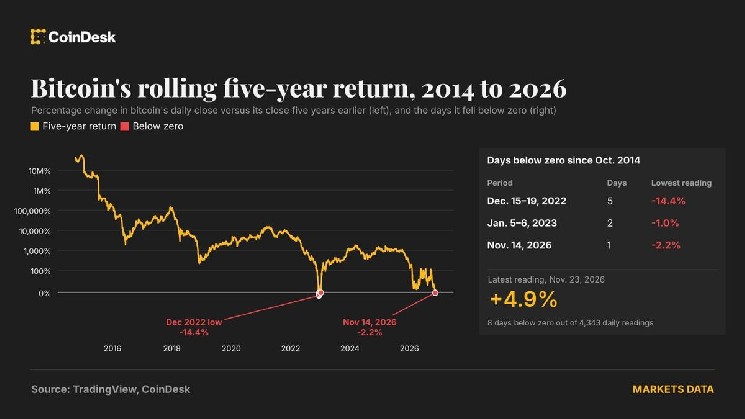
Bitcoin's five-year return has all but disappeared, the market's grandest narratives are losing their grip, and what remains as the decisive force is the Federal Reserve.
At the height of the bull market early last year, posts on social media argued that the U.S. government could buy large amounts of bitcoin ($BTC), sell them a few years later, and use the profit to write off its debt. That belief was rooted in past data: bitcoin went from nothing to more than $100,000 in 17 years, and its wealth-generating effect has been enormous.
As of now, however, the five-year return is next to nothing. The rolling five-year return — a measure of what a coin bought on any given day is worth five years later — shows that a dollar put into bitcoin on Nov. 18, 2021, is worth about $1.10 today. Bitcoin traded around $61,500 at the time of writing ($61,425.11), against roughly $58,600 five years earlier — a gain of less than 10% over five years, before inflation, meaning the inflation-adjusted return would be smaller still. The rolling five-year return was actually negative a couple of days ago, something last seen in December 2022. After that episode, bitcoin rallied from about $16,000 to more than $126,000, in line with the halving cycle.
Shrinking Upside Across Cycles
The halving is a piece of programmed code, hard-coded into the bitcoin network, that cuts the creation of new coins in half every four years. Bitcoin's price has tended to rally and bottom around these events. Bull markets have generally ended roughly 18 months after each halving, paving the way for a year-long bearish trend that is then followed by a new uptrend. That is the four-year cycle, and its peaks came in 2013, 2017, 2021 and October 2025.
Bitcoin is at the start of that bullish phase again. It peaked at a record high above $126,000 on Oct. 6, 2025, and now sits about 49% below that level. There is a possibility that history repeats itself.
Bitcoin will almost certainly stage another bull run, but that run could be less — well — bullish, and negative rolling five-year returns could become more common. The data supports that view: each cycle has produced a smaller peak relative to the one before it. In other words, bitcoin's upside multiples have shrunk dramatically from cycle to cycle. That shrinkage is the arithmetic problem behind the debt-erasure visions described above: they assumed yesterday's multiples, not today's.
- The 2013 peak was about 42 times the 2011 peak.
- The 2017 peak was about 16 times the 2013 peak.
- The 2021 peak was about 3.5 times the 2017 peak.
- The 2025 peak was just 1.8 times the 2021 peak.
The cycle lows have been rising more slowly as well. Each bear market's low has acted as a floor, and a line drawn through those lows shows how quickly the floor was rising: from the 2011 low to the 2015 low, it climbed about 300% a year; from 2015 to the 2018 low, about 110% a year; and from 2018 to the 2022 low, about 50% a year.
No Yield, No Business, No Cash
The second issue is that bitcoin pays no yield and has no business behind it, so it produces no cash. That matters because of what economists call the investment multiplier, which measures how much total output a single dollar of spending or investment creates. When money is invested in a power plant or a technology firm, it pays workers and suppliers, who spend it again, and the economy ends up producing more than the original dollar.
When someone buys bitcoin, the money simply moves from one owner to another and nothing new gets built, so the direct effect on growth is close to zero. Apple, by contrast, reinvests its profits in new products, factories and jobs, and its shareholders own a claim on all of that. Gold pays nothing either, yet central banks hold plenty of it — the difference being a track record of centuries and far lower volatility.
This matters more than ever because governments are carrying so much fiscal debt. The U.S. federal government's debt passed $40 trillion in August, and the International Monetary Fund (IMF) says global public debt is on course to reach 100% of global GDP by 2029 — a level last seen after World War II. With debt that high, every dollar has to earn its keep, and a government under that pressure is unlikely to place reserves in an asset that earns nothing and adds nothing to growth.
Treasury Companies and Bitcoin-Backed Finance
The same logic explains why most companies with solid operating businesses have not embraced bitcoin to date. Most of the so-called digital asset treasury companies rode the 2024–25 bull run and had little business beyond holding the coin — leaving their share prices to track the coin itself rather than any operating earnings. Bloomberg described them as public firms "built to buy crypto and often doing little else," noting that many were small businesses that rebranded overnight — among them a Japanese nail salon, a cannabis seller and a marketing agency. Strategy, the biggest of them, was recently dropped from MSCI's index, a benchmark widely followed by institutional investors, for lacking an operating business.
One bright spot is the growth of bitcoin-backed finance. It has expanded across retail, institutional and traditional banking channels as borrowers use $BTC as collateral to fund real-world expenses and operations without selling their holdings. Even so, with volatility still significantly elevated relative to traditional fiat currencies and preferred collateral such as Treasury notes, widespread institutional adoption could be limited at best.
That Leaves Risk Appetite and the Fed
With its narratives seemingly exhausted, bitcoin now trades on risk-on and risk-off swings — that is, on whether investors feel bold or defensive — and on dollar liquidity, the amount of dollars available in the financial system.
Arthur Hayes, chief investment officer of Maelstrom Fund, said today that Anthropic's $1.5 trillion IPO could send bitcoin much higher. "If it massively pops, it's game back on. $BTC is going to go up too," Hayes said. "If it fails, every government will bail out the AI industry," he added. "$BTC wins either way." Hayes predicted that all-time highs are coming.
Most analysts CoinDesk has spoken to recently likewise pointed to Fed rates as the main factor that matters for bitcoin. In practical terms, that makes the Fed's next rate decisions and the reception of Anthropic's IPO — which Hayes framed as a live test of risk appetite — the nearest markers for readers to watch.
So, after more than 17 years of meteoric price gains, the arrival of spot ETFs and a pro-crypto president, bitcoin's fate still appears tied to what the Fed does. If that is the case, bitcoin's primary role may be evolving into a 24/7 VIX — a blockchain-based counterpart to Cboe's VIX, Wall Street's so-called fear index.
Note: The views expressed in this column are those of the author and do not necessarily reflect those of CoinDesk, Inc. or its owners and affiliates.
This opinion column was originally published by CoinDesk: Bitcoin's 5-year return is nearly zero, great narratives are fading and what's left is the Fed.

