Bitcoin Could Deliver 3–5x Returns This Cycle as Volatility Fades, CryptoQuant CEO Says
Key Takeaways
- •CryptoQuant CEO Ki Young Ju forecast on Sept. 22 that Bitcoin's bull cycle will likely produce 3–5x gains rather than a 10x+ parabolic rally, followed by a milder bear market.
- •Ju attributes the narrowing of extreme price swings to Bitcoin's larger market size and expanding institutional ownership, which he says limit both upside and downside moves.
- •Ju identified rising realized capitalization, a halt in selling by longstanding large holders, and substantial bullish futures as signals supporting his outlook.
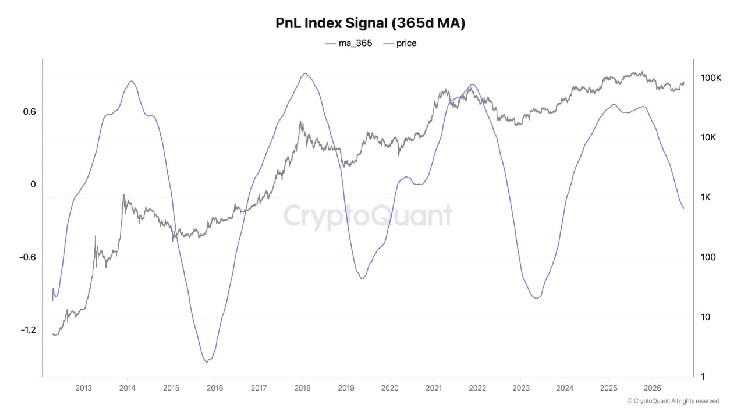
- •On-chain metrics including the PnL index's 365-day moving average and an MVRV ratio above one indicate more moderate cycle peaks, with holders collectively remaining above their estimated cost basis even at this cycle's lows.
- •Glassnode's Sept. 8 analysis found long-term holder supply explains nearly 19% of detrended volatility variance versus roughly 3% for market capitalization, suggesting market size alone offers an incomplete explanation for Bitcoin's price stability.
Bitcoin investors could see smaller cycle gains paired with shallower losses as institutional ownership expands, according to Ki Young Ju, founder and CEO of cryptocurrency analytics platform CryptoQuant. In a Sept. 22 Bitcoin cycle forecast posted on X, Ju argued that a much larger market is narrowing the extremes that defined earlier speculative booms.
"I expect this bitcoin bull cycle to deliver 3–5x rather than another 10x+ parabolic rally, followed by a milder bear market," Ju stated.
He attributed the shift to structural changes in the market's composition. "When Bitcoin was smaller and retail dominated, hot money fueled explosive rallies and 80% crashes. Today, a much larger market and growing institutional ownership are dampening both extremes. The same forces that limit the upside also soften the downside," he explained.
Ju's outlook aligns with historical analysis from Fidelity Digital Assets, which documented Bitcoin's declining volatility in May 2024. The financial giant explained that capital entering a larger market have a smaller price impact, while its research carefully distinguished historical correlations from any evidence that a particular price outcome must follow.
Holder Profitability Data Point the Same Direction
Ju's assessment draws on a profitability index that, in his view, shows less extreme peaks and increasingly resilient cycle lows. The profit-and-loss (PnL) index tracks aggregate holder profitability. He highlighted a developing turn in its 365-day moving average, a slower-moving measure that smooths short-term fluctuations and typically responds only after market conditions begin changing. On the accompanying chart, Bitcoin's price is plotted in gray against the index's 365-day moving average in purple. Recent profitability peaks sit below earlier cycle highs, supporting the argument that market extremes are moderating — though the purple line remained below zero and was still declining at the chart's right edge.
The analyst further reported that Bitcoin stayed above holders' average on-chain cost basis even at this cycle's lows. He cited the market-value-to-realized-value (MVRV) ratio, which compares market capitalization with a valuation based on coins' last on-chain movements, remaining above one. In his interpretation, some investors absorbed losses while the holder base collectively remained above its estimated acquisition cost.
Independent research adds an important nuance. According to Glassnode, Bitcoin's historically low volatility is more closely associated with long-term holder supply than with market size. Its Sept. 8 analysis identified long-term holder supply as the strongest explanatory variable among those examined, accounting for nearly 19% of detrended volatility variance. Market capitalization explained approximately 3%, illustrating that market size alone offers an incomplete explanation for price stability.
Institutional Demand Could Reshape Bitcoin's Cycles
Ju identified three supporting signals: rising realized capitalization — a metric that values each coin at the price of its most recent on-chain movement rather than the current market price — a halt in selling by longstanding large holders, and substantial bullish futures positions. He interpreted rising realized capitalization as fresh capital entering the market, and reported that large futures traders built long positions near the bottom.
His latest argument extends an earlier forecast that international institutional demand and ETF access could shape Bitcoin's cycle peak. In August, Ju highlighted markets where regulated investment access remained limited, and said he expected broader fund availability, deeper stablecoin liquidity, and financial infrastructure using tokenized assets to support participation beyond the United States. That access is recent even in the United States itself: spot Bitcoin exchange-traded funds did not begin trading there until January 2024, a regulated vehicle absent from every earlier Bitcoin cycle.
Recent wallet data offer another view of ownership changes. Two smaller-holder groups shrank by 69,494 addresses before Bitcoin's recovery above $85,000, and analytics firm Santiment associated the July–August contraction with capitulation — a pattern in which holders sell at a loss to exit positions. Those figures describe changes in address balance categories, however, rather than establishing that an equivalent number of individual investors left Bitcoin.
"Giving up the 10x parabola also means giving up the 80% crash, and that is exactly what invites patient, long-horizon capital instead of hot money," Ju remarked.
Lower volatility — the speed and extent of price changes — is central to Ju's longer-term argument about adoption. His broader thesis extends beyond returns: greater stability, he contends, could eventually make Bitcoin more practical for use as money. Whether that moderation takes hold is something readers can follow through the same measures cited here — the PnL index's 365-day moving average, the MVRV ratio, realized capitalization, and long-term holder supply — all of which analytics firms publish as regularly updated on-chain data.
The original report was published by Bitcoin.com News.

