Bitcoin Rebounds to $60,000 After Crash Near $55,000, Leaving Billions in Liquidations
Key Takeaways
- •Bitcoin fell to roughly $55,300 overnight Saturday, Nov. 21, its lowest level since September 2024, before recovering to trade above $60,200.
- •The sell-off forced $2.67 billion in crypto market liquidations over 24 hours, with bitcoin positions accounting for about $1.3 billion of the losses.
- •Bitcoin now sits 52% below its October 2025 all-time high of $126,080, and Cryptoquant data indicates nearly $950 billion of invested capital is underwater versus $119 billion in profit.
- •U.S. spot bitcoin ETFs saw more than $1.25 billion in net outflows from Tuesday through Friday, including $582 million on Thursday, with BlackRock's IBIT accounting for $541 million of that day's withdrawals.
- •Wintermute warned bitcoin could drop into the $50,000 range unless conditions improve, with traders monitoring the December Federal Reserve rate decision and upcoming ETF flow reports.
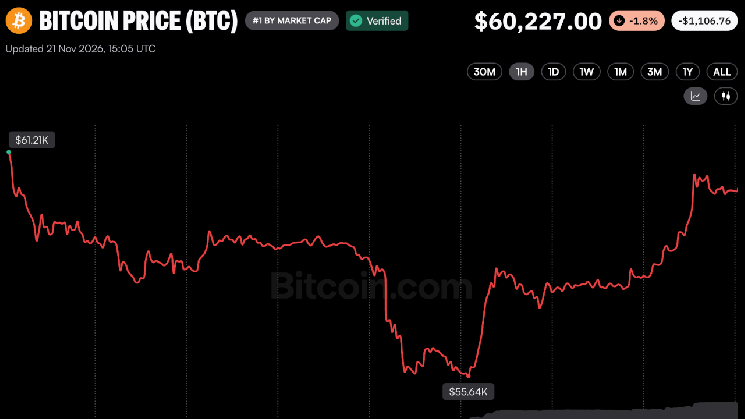
Bitcoin plunged to its lowest level in more than two years early Saturday, extending a devastating week for cryptocurrency markets in which leveraged traders lost billions and investors retreated from riskier assets.
The leading cryptocurrency crashed to nearly $55,000 overnight Saturday, Nov. 21, as an intensifying sell-off triggered $2.67 billion in liquidations across the crypto market over 24 hours, according to Coinglass data. CoinGecko figures put the trough at approximately $55,300, the weakest level since September 2024, returning bitcoin to territory last visited before the rally that culminated in its October 2025 record. Bitcoin subsequently recovered some ground, trading above $60,200, but the sharp decline capped a brutal stretch that has erased nearly one-third of its value over the past month.
Billions Wiped Out in Forced Liquidations
The plunge set off widespread forced closures of leveraged cryptocurrency positions. Coinglass data showed $2.67 billion in liquidations over the preceding 24 hours, with traders betting on rising prices accounting for the overwhelming majority of losses.
Liquidations occur when exchanges automatically close a leveraged position after its collateral no longer covers potential losses, converting paper losses into sales at prevailing market prices. Bitcoin positions took the largest hit, with roughly $1.3 billion wiped out, followed by ether, as falling prices triggered margin calls and automatic position closures that likely intensified the downward pressure. The liquidation figures reflect a rolling 24-hour window and fluctuate as market conditions change.
November Slide Accelerates
Saturday's crash followed an already turbulent week in which bitcoin repeatedly broke through key price levels. The cryptocurrency traded above $70,000 earlier in the week before sliding below $65,000 on Tuesday, $62,000 on Thursday and, eventually, $60,000 on Friday.
Even after the morning rebound, bitcoin sits 52% below its all-time high of $126,080, set in October 2025, and most investors likely remain well underwater on their holdings.
"The amount of capital invested in bitcoin currently sitting at an unrealized loss has just reached an all-time high," Cryptoquant analyst Darkfost posted on X overnight. "With BTC trading around $58,000 and its market capitalization standing at approximately $1.17 trillion, nearly $950 billion in invested capital is now underwater. By contrast, only $119 billion remains in profit."
The cryptocurrency's collapse has coincided with a punishing week for U.S. equities, particularly technology and cryptocurrency-related stocks. Bitcoin treasury giant Strategy lost approximately 30% of its market value during the week, while Coinbase and Robinhood each declined about 20%. Ethereum treasury firm Bitmine plunged roughly 26%.
The technology-heavy Nasdaq Composite dropped approximately 10% for the week, including a 5.3% decline on Friday. Nvidia shares slid nearly 14% on Friday as investors reassessed artificial intelligence valuations, while newly public Anthropic also struggled after its highly anticipated initial public offering.
ETF Outflows and Macro Fears Mount
Institutional selling has compounded the downturn. U.S. spot bitcoin exchange-traded funds recorded more than $1.25 billion in net outflows from Tuesday through Friday, including $582 million on Thursday alone. BlackRock's IBIT accounted for $541 million of Thursday's withdrawals.
The latest redemptions followed consecutive weeks of billion-dollar outflows, signaling a sustained retreat from bitcoin investment products. ETF flows are closely watched as a barometer of institutional demand for bitcoin exposure.
Meanwhile, persistent inflation, concerns about elevated AI spending and expectations of tighter Federal Reserve monetary policy have weighed on investor sentiment. Hotter-than-expected October inflation data heightened concerns about another interest-rate increase in December, which could further reduce appetite for speculative investments.
Crypto market maker Wintermute recently warned that bitcoin could fall into the $50,000 range unless market conditions improve, while stressing the importance of renewed ETF inflows to support a sustained recovery. With bitcoin now approaching that territory, traders face mounting uncertainty over whether the latest liquidation cascade signals an approaching bottom or another stage in the cryptocurrency market's deepening downturn. The December Federal Reserve rate decision and the direction of upcoming ETF flow reports now stand among the key markers traders are monitoring.

