Bitcoin Dips to 12-Week Low Under $72,000, Triggering Over $700 Million in Liquidations
Key Takeaways
- •Bitcoin fell to $71,182 on Thursday, its lowest level in three months and the first time trading below $72,000 since August 20.
- •The decline wiped out roughly $717 million in futures positions over 24 hours, with long traders absorbing 89.5% of liquidation losses and BTC accounting for $282 million.
- •MSTR is scheduled for removal from the MSCI USA index on November 30 under October rules changes for holding and investment companies, leaving Strategy without access to passive index-tracking investors.
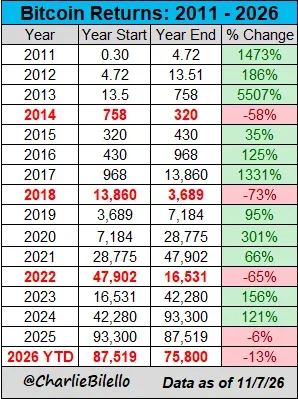
- •Bitcoin is trading almost 20% below its start-of-year price and would need to climb above $87,000, roughly 22% above Thursday's low, by December 31 to avoid its first-ever back-to-back yearly losses.
- •The crypto Fear & Greed Index dropped to 23/100, nearing extreme fear from 53/100 a month earlier, though analyst Jesse Myers argues the correction reflects an early-stage bull market with a local bottom forming.
Key Insights
- Bitcoin fell to $71,182 on Thursday, its lowest level in three months, ending hopes of a quick recovery.
- The price performance has produced more than $700 million in liquidation losses over the past day.
- As it stands, Bitcoin is on course to record its first back-to-back yearly losses.
Bitcoin dropped to a 12-week low on Thursday after crashing below $72,000. The more than 3% decline confirms that Wednesday's recovery attempt was a dead cat bounce, and according to CoinMarketCap, BTC fell as low as $71,182 during the session after starting the day around $74,700. It marks the first time Bitcoin has traded below $72,000 since August 20.
The flagship asset's slide also dragged down the rest of the crypto market. Major altcoins, including Ethereum, Solana, BNB, Zcash, XRP and HYPE, declined by 3% to 6%.
Bitcoin's performance on the day mirrored that of tech equities, most notably Nvidia, which fell 5% after its CEO, Jensen Huang, resigned over a cheating scandal.
A more consequential development for Bitcoin, however, is that treasury company MSTR is set to be removed from the MSCI USA index on November 30. The removal follows new rules around holding and investment companies that the index adopted in October. It means Strategy loses access to passive investors who allocate to MSCI indexes, as index-tracking funds generally hold the constituents they follow — a setback at a time when institutional demand is drying up.
Bitcoin Decline Triggers Over $700 Million in Liquidations
The drop in Bitcoin's value has left futures traders absorbing heavy losses, with more than $700 million in liquidations over the past 24 hours. Liquidations occur when exchanges forcibly close leveraged positions after traders can no longer meet margin requirements, turning an adverse price move into realized losses at scale. According to Coinglass, a total of $717 million worth of positions were wiped out, with BTC accounting for $282 million of that figure.
Long traders were disproportionately impacted, with 95% of Bitcoin's liquidations coming from long positions, a pattern that reflects how the session's decline hit traders positioned for higher prices. Ethereum accounted for $117 million in liquidations, while tokenized NVDA recorded more than $50 million. Overall, long traders accounted for 89.5% of liquidation losses, while short traders accounted for only 10.5%. The largest liquidated position was a BTC-USD position on Hyperliquid.
Overall open interest, which measures the total value of outstanding futures contracts, has fallen by 4% in the past 24 hours. Futures traders, however, remain mostly neutral, with only 50.96% of 24-hour buy/sell volume short and 49% long.
That measured positioning stands in sharp contrast to the crypto Fear & Greed Index, which is now at 23/100 and in danger of slipping into extreme fear territory (@charliebilello on X). The gauge was at 53/100 just one month ago, reflecting how quickly the market can collapse.
Bitcoin at Risk of Consecutive Yearly Losses
With Bitcoin now trading almost 20% below its price at the start of the year, the asset could set an unwanted record in 2026. If it does not see any major recovery, it would register its first back-to-back yearly losses ever.
Since 2011, Bitcoin has never had a down year twice in a row, with a yearly loss occurring only once every four years. However, it finished 2026 at $87,519, which is 6% below its $93,000 price at the start of that year. Only a climb above $87,000 between now and December 31 could stop that unwanted record. That threshold sits roughly 22% above Thursday's low of $71,182.
While most sentiment around the asset is currently bearish, some analysts believe a bull market is underway. Crypto analyst Jesse Myers (@Croesus_BTC on X) believes this is an early bull market correction. He noted that with the majority of recent buyers now underwater, a local bottom is forming.
This article provides cryptocurrency market information, not financial or investment advice. Network amendments face approval and implementation risks. Technical indicators and analyst projections do not guarantee future prices.
This article first appeared on The Market Periodical.

