Bitcoin Falls to 12-Week Low Near $68,500 as Fed Rate-Hike Fears Mount
Key Takeaways
- •Bitcoin dropped to about $68,500 on November 13, 2026, a 12-week low roughly 21% below its autumn peak of $86,000, though it remained around 16% above its late-June floor near $59,000.
- •Fed Governor Christopher Waller's November 10 speech supported a 25-basis-point December hike and suggested 50 basis points should be considered if core CPI stays at or above 0.3%, with CME FedWatch data showing 91.9% odds of a December hike.
- •Total crypto liquidations reached $1.64 billion in 24 hours, with long positions making up 88.7%, including $916 million in Bitcoin liquidations and $289 million in Ether.
- •Spot Bitcoin ETFs saw six straight sessions of net outflows totaling approximately $1.49 billion between November 5 and November 12, though cumulative ETF inflows since launch stand near $55.5 billion.
- •Bitcoin's RSI fell to 25.4, well into oversold territory, while an ADX of 25.3 confirmed an established downtrend, leaving the roughly $59,000 June low as the key support level ahead of the December FOMC meeting.
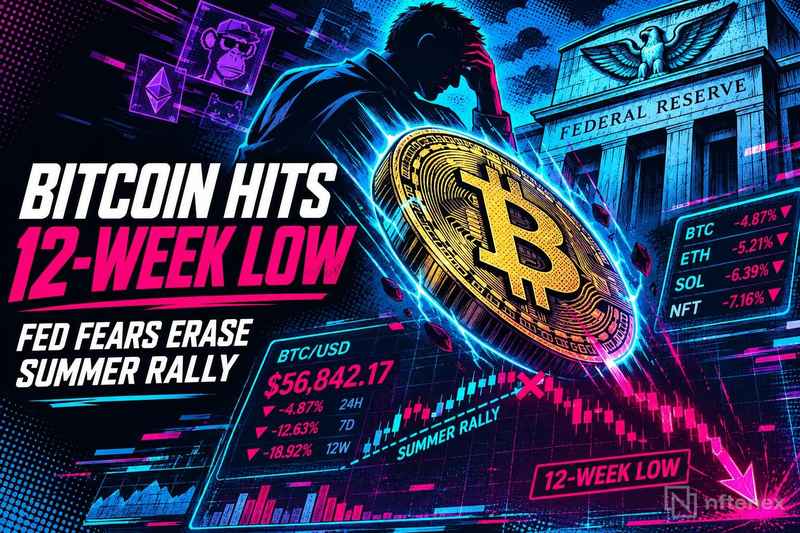
Bitcoin fell to approximately $68,500 on November 13, 2026, its lowest level since August 19 — a 12-week low that erased roughly 21% from the cryptocurrency's autumn peak of $86,000 and unwound most of the gains from a summer rally that had lifted Bitcoin more than 45% off its late-June floor.
Key Points
- Bitcoin hit a 12-week low near $68,500, down roughly 4.5% in 24 hours and 9.5% for the week.
- Federal Reserve Governor Christopher Waller's November 10 speech, signaling support for a December rate hike, was viewed as a potential catalyst for the selloff.
- Spot Bitcoin ETFs recorded six consecutive sessions of net outflows totaling approximately $1.49 billion, while total crypto liquidations over 24 hours reached $1.64 billion.
Bitcoin Slides to a 12-Week Low as Rate Fears Return
The drop left Bitcoin at its weakest point since mid-August, undoing a summer rally that had carried prices from a late-June low of roughly $59,000 to an autumn peak near $86,000. According to Decrypt, Bitcoin remained about 16% above that June floor — meaning the summer rally is not entirely gone, though most of it is. For related coverage, see Grayscale Sees New ETF Era as Zcash ETF Hits $1B.
The selloff was broad and fast. According to CryptoNews, total crypto liquidations over 24 hours reached $1.64 billion — a tally of forced closures of leveraged positions that occur when price moves exhaust a trader's margin — with long positions accounting for 88.7% of that figure. Bitcoin-specific liquidations came in at $916 million, while Ether contributed another $289 million. Derivatives markets had been positioned for a continuation of the summer rally, and the reversal punished that positioning severely.
The Crypto Fear & Greed Index dropped to 20, a reading labeled “Extreme Fear,” as funding rates turned negative across Bitcoin, Ethereum, XRP, Solana, and Tron — a configuration in which traders holding short positions pay those holding longs, typically a marker of bearish leveraged positioning. Options markets shifted as well: the put/call skew jumped to roughly 14%, signaling strong demand for downside protection among traders who had not yet exited.
How Fed Expectations Unwound Bitcoin's Summer Rally
The immediate macro trigger was a November 10 speech by Federal Reserve Governor Christopher Waller, published on the Federal Reserve's official site. Waller voiced support for a 25-basis-point rate hike at the December 8–9 FOMC meeting, then went further: “If October CPI inflation data are similar to the past two monthly readings — with core CPI inflation around 0.3 percent or even higher — then a 50 basis point hike in the policy rate should be considered.”
That language landed hard on risk assets. Higher interest rates raise the opportunity cost of holding non-yielding assets like Bitcoin, and markets interpreted Waller's comments as a signal that the Fed's tightening cycle has further to run than previously priced in. CME FedWatch data cited by Decrypt placed the probability of a 25-basis-point December hike at 91.9%, with 8–12% odds of a larger 50-basis-point move.
Chicago Fed President Austan Goolsbee compounded the concern. According to Decrypt's reporting, Goolsbee said he is not confident the economy is on a path back to 2% inflation and that policymakers need to deal with that reality. The dual Fed messaging reinforced the market's shift toward pricing in a tighter-for-longer rate environment — a dynamic that echoes the pattern seen when Bitcoin and XRP slid after the September PPI reading came in at 6.3%, as macro data surprises have consistently punished crypto positioning.
The inflation data behind Waller's hawkish posture was itself notable. The Federal Reserve speech cited September PCE rising 0.5% month-over-month and 3.7% year-over-year — figures Waller described as “unambiguously bad.” Core PCE came in at 0.3% monthly and 3.1% annually, core CPI beat its 0.2% forecast with a 0.3% print, and wholesale prices rose 6.5% year-over-year. The Fed's current target range sits at 3.75% to 4.00%, meaning even a 25-basis-point hike at the December meeting would push the upper bound to 4.25%.
Institutional flows reflected the same unease. Spot Bitcoin ETFs recorded six consecutive sessions of net outflows between November 5 and November 12, totaling approximately $1.49 billion in withdrawals, per Decrypt. Because ETF flows are reported daily, the streak offers a running gauge of institutional positioning in crypto, and it stands in sharp contrast to the cumulative picture: ETFs have absorbed roughly $55.5 billion in net inflows since launch, a figure that dwarfs the recent outflows and suggests institutional conviction remains intact over a longer horizon even as near-term positioning retreats. The pattern matches what analysts observed when Bitcoin and XRP rallied sharply after a softer Fed inflation report earlier this year — institutional flows tend to track macro signals closely and reverse quickly when the data changes.
What Bitcoin Traders Will Watch Next
Technical readings suggest the selloff still carries momentum even as it approaches oversold extremes. Decrypt reported Bitcoin's RSI at 25.4, well below the 30 threshold that typically defines oversold conditions, while the ADX reading of 25.3 confirms an established bearish trend rather than a temporary spike. That combination — an oversold RSI alongside a confirmed downtrend — is unusual: selling pressure remains directionally strong even at levels that have historically attracted buyers. The 50-day exponential moving average remains above the 200-day EMA, preserving the longer-term bullish structure, though these readings indicate near-term selling pressure has not yet been exhausted.
The key upcoming catalysts are clustered tightly. Fed meeting minutes are scheduled for November 18, the PCE inflation report arrives November 25, and the FOMC rate decision lands December 8–9. Each event could extend the current selloff or give markets a reason to reassess. If October CPI data, due before the December meeting, prints at or above 0.3% core, Waller's 50-basis-point scenario moves from possibility to genuine market risk.
The broader crypto market, where altcoin spot volume has approached four times Bitcoin's level, is likely to amplify any directional move in Bitcoin given how tightly correlated risk-on positioning has become across the digital asset space.
Bitcoin still holds above its late-June low of approximately $59,000, a floor that marked the bottom of the summer setup that drove the rally now being unwound. Whether that level serves as support in a worst-case December scenario is the structural question traders will carry into the final weeks of 2026. The broader crypto rally earlier this autumn, which lifted assets including Zcash to multi-year highs, was built on expectations of a more accommodative Fed posture; a confirmed pivot back toward aggressive tightening would test whether that structural bid holds.
Source: NFTENEX
Disclaimer: This article is for informational purposes only and does not constitute financial or investment advice. Cryptocurrency and digital asset markets carry significant risk. Always do your own research before making decisions.

