Banks Advance Stablecoin Plans Even as BIS Questions Their Role as Money
Key Takeaways
- •BIS General Manager Pablo Hernández de Cos told the Jackson Hole Economic Symposium on August 28 that stablecoins fail to meet the core properties of money—singleness, interoperability, and financial integrity—and that tokenized deposits are more promising.
- •A consortium of more than 12 global banks, including Bank of America, Wells Fargo, Santander, Citi, Goldman Sachs, and UBS, is preparing to issue its own stablecoin on public blockchains, reportedly starting with a dollar-pegged token.
- •The GENIUS Act, implemented July 18, 2025, created a US federal framework allowing banks to issue payment stablecoins through OCC-approved subsidiaries, though issuers cannot pay interest to holders.
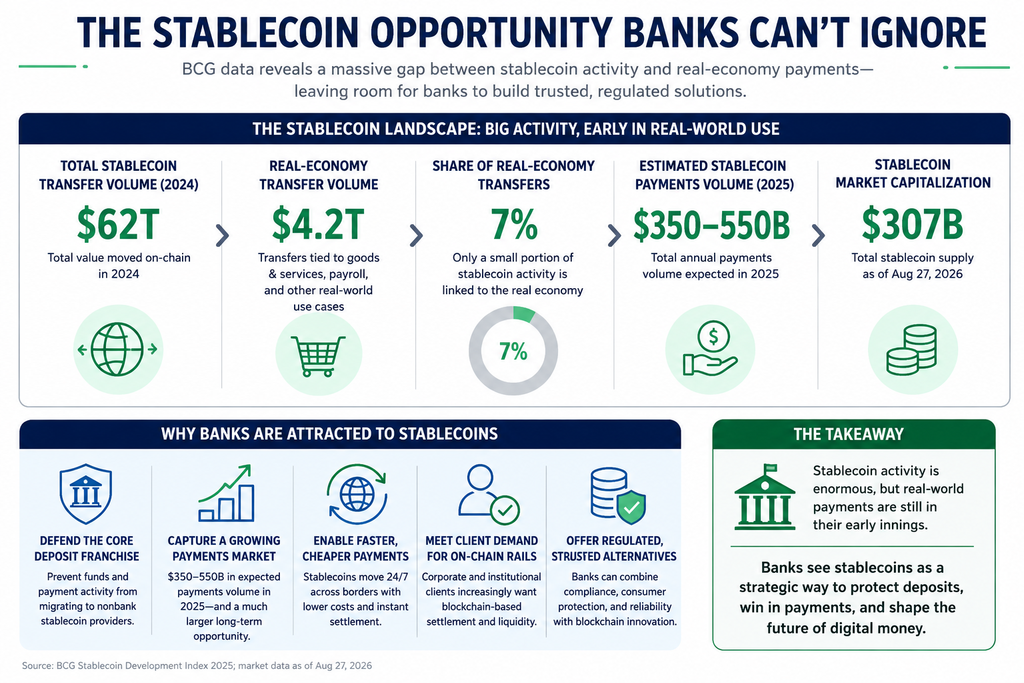
- •A BCG and Allium white paper found public blockchains processed over $62 trillion in stablecoin transactions in a year, but only about $4.2 trillion, roughly 7%, represented real-economy payments.
- •Bank of America CEO Brian Moynihan warned that up to $6 trillion in deposits could leave banks if stablecoin issuers were allowed to offer yield, saying the bank would enter that business if it became legal.
The head of the Bank for International Settlements (BIS) may argue that stablecoins do not qualify as money at scale, but the world's largest banks are pressing ahead with moving financial settlement and everyday transactions onto publicly accessible blockchains.
Speaking at the Jackson Hole Economic Symposium on August 28, BIS General Manager Pablo Hernández de Cos said a framework built on tokenized deposits "looks more promising" than stablecoins. BIS officials have stressed that tokenized deposits should serve as the backbone of modern digital payment systems as banks migrate their operations to blockchains. The BIS, often described as the central bank for central banks, has positioned itself as a key standard-setter in this debate, coordinating research on tokenized settlement through initiatives with member central banks.
For banks, the dilemma is straightforward: adopt blockchain now, or wait until regulators approve a more technologically advanced version of the technology.
Where de Cos says stablecoins fall short
De Cos built his argument around three properties he says money must have: singleness, interoperability, and financial integrity. These criteria echo long-standing principles for payment systems, under which a claim used as money should be exchangeable at par everywhere and settle with finality.
On singleness, he offered a simple illustration. If someone holding Tether's USDT wants to send money to a recipient who accepts only Circle's USDC, they must first sell the USDT and buy USDC. Because the market prices of these coins can fluctuate, the final value of the transfer may not equal one US dollar. The system provides no guarantee that the two stablecoins are exchangeable one-to-one.
Interoperability raises another problem. Most fiat-pegged stablecoins operate across fragmented public, permissionless blockchains and scaling layers. Moving even the same stablecoin, issued on multiple blockchains, from one chain to another requires complicated—and sometimes costly—procedures.
By contrast, de Cos noted, the settlement of tokenized deposits relies on central bank accounts, which preserves par redemption and settlement finality for those deposits.
The integrity problem the BIS keeps returning to
Financial integrity is the third concern. According to de Cos, available information shows that most stablecoins are now held in self-custodied wallets, and a growing share of transfers occur wallet-to-wallet on the blockchain without any platform performing know-your-customer checks. That stands in sharp contrast to traditional finance, where bank deposits—the least anonymous form of money—dominate.
The BIS took a similar position in its Annual Economic Report published June 23. Its stablecoin section concluded that existing stablecoin designs "fall short on foundational properties of money and threaten financial integrity." The report also warned of "stablecoin dollarization" in emerging economies, where demand for foreign stablecoins could affect capital transfers and erode monetary sovereignty.
What the payment data shows
The debate over scale is backed by substantial figures. According to a white paper published in January 2026 by the Boston Consulting Group (BCG) and blockchain data firm Allium, public blockchains processed more than $62 trillion in stablecoin transactions over the course of a year. Only about $4.2 trillion of that—roughly 7% of the total—represented payments in the real economy. The gap between headline transaction volume and actual payments has become a recurring point of contention between stablecoin proponents and regulators assessing the technology's real-world use.
BCG estimated observable bilateral payments for goods and services in 2025 at $350 billion to $550 billion, a figure it described as a minimum. The paper also noted that stablecoin market capitalization rose to $307 billion in December 2025.
Why banks are moving anyway
Those warnings have not stopped banks from going on-chain.
Forkast reported on August 28 that a consortium of more than 12 global banks—including Bank of America, Wells Fargo, Santander, Citi, Goldman Sachs, and UBS—is preparing to issue its own stablecoin on public blockchains rather than cede the market to Tether and Circle.
The GENIUS Act, implemented on July 18, 2025, opened a federal-level pathway for banks through OCC-approved subsidiaries, though it bars issuers from paying interest to holders. The law made the United States one of the first major jurisdictions with a comprehensive federal framework for payment stablecoins, a step that other regulators, including the European Union with its Markets in Crypto-Assets regulation, have approached with their own licensing and reserve requirements.
Bank of America CEO Brian Moynihan has warned that as much as $6 trillion in deposits could leave banks if stablecoin issuers were permitted to offer yield. "If they make that legal, we'll go into that business."
Smaller lenders are moving as well. Cryptopolitan previously reported that 39 state bankers' associations formed the BankChain Alliance, targeting a 2027 launch. The initiative is designed to give community banks a shared route into tokenized deposits and stablecoins without relying on crypto-native platforms.
From exploration toward a joint stablecoin?
Coverage in Seoul Economic Daily says the major bank group is considering a dollar-pegged token initially, with later expansion to G7 currencies. It also points to the strategic driver: banks fear stablecoins could pull deposits away from traditional institutions.
Central banks want tokenized deposits and central-bank money at the center of the on-chain economy, while commercial banks increasingly conclude they also need stablecoins. JPMorgan, for its part, maintains that it has no current plans to issue a stablecoin. How regulators reconcile the BIS's preference for tokenized deposits with the GENIUS Act's stablecoin pathway will shape which model banks ultimately adopt at scale.
