A Wrong Turn on Congressional Ave. Leads to a Rewarding Meal at Binondo Boys
Key Takeaways
- •Binondo Boys is part of Food Records, Inc., a new venture by Locavore co-founder Mikel Zaguirre, alongside a coffee shop and a bar in San Juan.
- •The Congressional Ave. branch, opened in 2025, is the brand's second location after the Sct. Torillo branch in Quezon City.
- •The restaurant operates 24 hours and targets a 'micro dining' market by aiming to restore the P300-P400 price point for casual dining without compromising quality.
- •A review found standout dishes such as the shrimp wonton noodle soup and white chicken rice, with a five-course meal costing approximately P1,300.
- •Zaguirre said Quezon City is seen as a major player in casual dining and that the brand would welcome the chance to open in Binondo, its namesake district.
By Joseph L. Garcia, Senior Reporter
Last month, a sign along Congressional Ave. diverted us from a neighborhood favorite Chinese restaurant and led us instead to Binondo Boys.
Binondo Boys, it turns out, is one of the outlets under Food Records, Inc. — a new venture by Locavore co-founder Mikel Zaguirre that also includes a coffee shop and a bar in San Juan. Locavore, which Mr. Zaguirre co-founded, built its reputation on modern reinterpretations of Filipino cooking, a sensibility that carries over here. The brand's name itself nods to Binondo, Manila's centuries-old Chinatown — long established as one of the oldest of its kind in the world and the historical heart of Filipino-Chinese cuisine in the country. Founded in 2025, the Congressional Ave. branch is the brand's second location, following its Sct. Torillo branch.
The decor takes its cue from tiny Hong Kong eateries: fashionable “difficult” metal burger-bar chairs, tile-topped tables, red lanterns, and benches upholstered with flour sacks. The menu is accessed via QR code (and the app is messy).
We navigated the online menu — begrudgingly — and ordered the Hakaw (shrimp dumplings), a Crab Roe Bun, a Shrimp Wonton Noodle Soup, a White Chicken Rice, and, finally, a Beef Brisket and Tendon Braised Noodle. More adventurous options exist, such as the Kare-Kare Noodles modeled after the Philippines' peanut-based stew, but we reasoned that if a kitchen can't get the basics right, there's little point in trying anything new.
Reader, despite the inconvenience of the QR menu (well, for us), I was glad to be proven wrong again and again by my selections.
The Hakaw was glossy and wonderfully translucent. Achieving that shell is typically a test for dim sum chefs: it must be strong enough to withstand being picked up and dipped, yet thin enough for a refined mouthfeel. Despite its refinement, there was still a hint of life and vigor in its taste.
The White Chicken Rice, which we ordered in the same pursuit of mild flavors, turned out to be its complete opposite — much to our delighted surprise. The dish is usually a staid affair of steamed or poached chicken, but this one was alive with flavor. The delicate chicken came topped with fried onions and a soy-based sauce that lent earthiness and depth. A freshly made ginger-scallion sauce (prepared in-house rather than jarred) added spice and pep, while a soy egg rounded everything out.
The Shrimp Wonton Noodle Soup arrived with pickled wood ear mushrooms and white kimchi. Our notes said “daaaamn.” This was the dish that made the drive truly worthwhile. The broth tasted new and full of youthful energy, very unlike the star-anise-bombarded broths we had grown accustomed to — and which, in fact, was what we had been craving that night. We are now grateful to have been steered in another direction. The broth was silky with rendered fat, with pronounced umami and a welcome earthiness no doubt helped by the thinly chopped mushrooms. The wontons, for their part, were dense and compact, with a heavy dough that hinted at hand-making, accompanied by delightfully springy noodles. The whole bowl could admittedly be too rich, but that is where the pickles come in, and they are effective at cutting the heft.
The Crab Roe Buns were tiny balls shaped like larger, traditional buns, served on a stick and deep-fried, with a choice of dip: sweet chili oil or wasabi mayo. Each ball felt packed to its limits with crab roe, spurting into your mouth with each bite. Our wasabi mayo choice was slightly unorthodox, but like the rest of the restaurant's attempt to present a perspective on Filipino-Chinese food rather than authentically Chinese cuisine, it works. The sweetish crab meat complements the creamy mayo nicely — until the sharp heat of the wasabi kicks in, making it something of a timed bite.
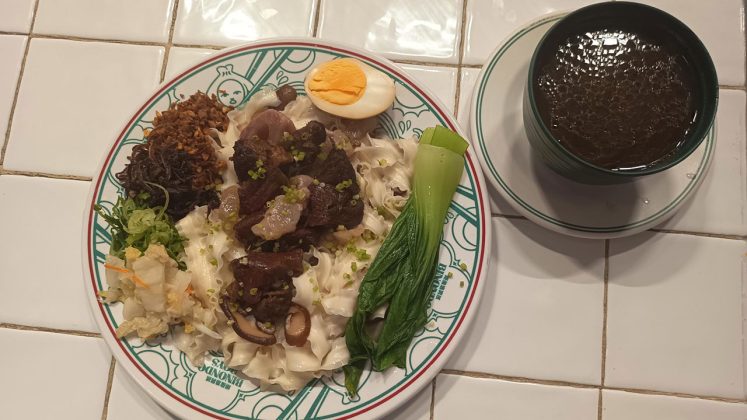
We were an easy sell on the Beef Brisket and Tendon Noodles because we happen to enjoy the textures of tendon and the knife-cut noodles they use: curly, pale, and almost perpetually firm. These noodles are served dry with the broth on the side, and they clumped up while we ate the previous dishes (thanks to the surprisingly quick service), so we had to mix in a little broth to resurrect them. The course offered a novel way of eating — dipping the noodles into the broth, as one does with a similar Japanese dish. It forces the diner to slow down and catch all the nuances, from the slow-braised beef to the spicy sauce to the texture of the noodles. It is a hefty meal all by itself, and we regretted ordering and eating it last.
We spent roughly P1,300 for a five-course meal (and we are slightly miffed that we missed their unlimited dim sum promo). But we can return again and again: after all, they are open 24 hours.
OPEN 24 HOURS, 'MICRO DINING'
In an e-mail to BusinessWorld, Mr. Zaguirre laid out the pros and cons of running a literally all-day restaurant. “One of the advantages is being able to maximize the lease because you're operating for more hours. Operationally, though, it can be more stressful because the restaurant doesn't really stop. It's a continuous process of cooking, serving, inventory management, and everything else that comes with running a restaurant,” he said.
However, “We've also discovered an opportunity in what we call micro dining. For quite some time, there has been a gap in the market for mid-range casual restaurants in the P300-P400 range. Now, a P500 meal has become the new benchmark for casual dining. We want to bring that price point back and give people more options within that budget, without having to compromise on the quality of the food or service.”
Mr. Zaguirre linked this approach of unorthodox interpretations of traditional cuisine to what he did at Locavore, which did the same with Filipino food. “We're just staying true to how we enjoy things and how we interpret them. We become inspired by what we see, what we feel, and what we eat — and that has been our signature ever since,” he said. “We wanted to appeal to a younger market, so we needed something fresh and new to represent food that is comforting, approachable, and easy to understand.
“To me, cooking — whether it's for families, casual eating, or convenience — is always about the love for cooking and feeding people. That has always been at the heart of what we do,” he said.
On opening in Quezon City, he said: “We recognize that the market in Quezon City has been evolving. There is a growing market looking for better options and new gastronomic adventures, which is why we see Quezon City as a major player in casual dining.
“And if the opportunity comes for us to bring Binondo Boys to its namesake, Binondo, we would love to take that opportunity as well.”
Evidently, we had a good meal, and we have already told friends and family to visit — just in case they have a hankering for something Chinese, but not quite.
Binondo Boys has branches at 37 Sct. Torillo St., Diliman, Quezon City and at the Congressional Town Center on Congressional Ave. Check their Instagram () for promos and merch.

