Binance Trading Bots in 2026: Eight Bot Types, Fees, Security and Profitability Explained
Key Takeaways
- •Binance provides eight built-in automated trading bots—Spot Grid, Futures Grid, Arbitrage, Rebalancing, Algo Order, Futures TWAP, Futures VP, and Spot DCA—each designed for a specific strategy or market condition.
- •The bots incur no extra charge beyond standard trading fees, which are approximately 0.1% for spot transactions and 0.02% to 0.04% for futures, with discounts available when paying in BNB or reaching higher VIP levels.
- •Users must complete Binance's KYC verification and secure their API keys with withdrawal permissions disabled, and the bots cannot be used in regions where the platform does not operate, including the US.
- •The Futures Grid bot supports long and short positions with up to 125x leverage, while the Arbitrage Bot profits from funding rate differences between spot and futures markets.
- •Despite operating 24/7 without emotional bias, the bots do not guarantee profits and expose users to risks including technical glitches, market volatility, overtrading, and regulatory concerns.
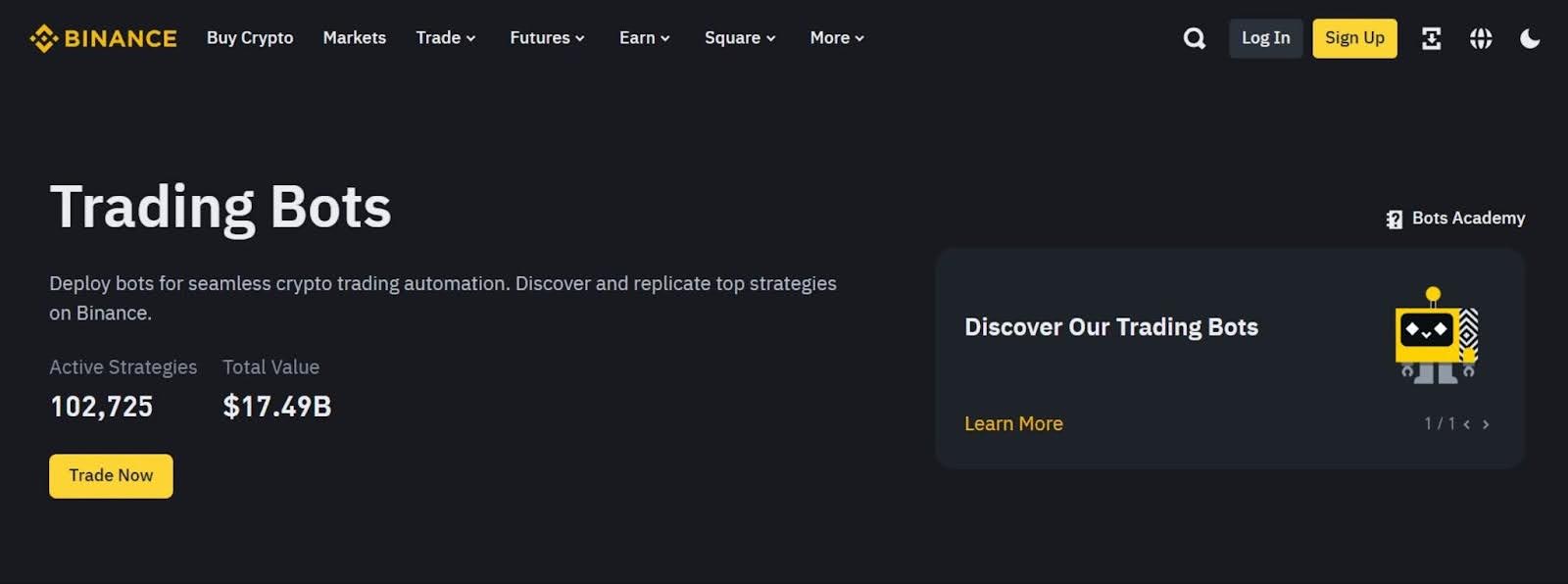
Binance trading bots are automated trading tools that execute trades on behalf of users according to predefined strategies. The bots operate 24/7 and are designed to make cryptocurrency trading more efficient, reduce emotional decision-making, and capture market opportunities that traders may miss while they are inactive or trading manually.
To ensure precision, Binance's automated trading bots can collect market data, analyze it, and execute trades based on preset strategies and collated data within milliseconds. As the name indicates, the bots are provided by Binance, a global cryptocurrency exchange that allows investors to buy, hold, sell, and trade crypto coins and non-fungible tokens (NFTs) in one place.
Traders on the platform can access eight crypto bots designed to execute different trading strategies automatically. This review examines Binance's trading bots in detail, including what each type does, the fees involved, how to set one up, and the risks users should understand.
What Is a Binance Trading Bot?
Binance trading bots are advanced tools that help investors trade cryptocurrencies automatically on the Binance exchange. They use preset rules to analyze market trends, monitor prices, and place buy or sell orders without human supervision. Binance offers eight trading bots, each designed to suit a particular strategy or market condition.
Rather than placing every trade manually or managing many positions at once, a Binance trading bot can carry out tasks such as buying low and selling high (grid bots), maintaining a specific investment ratio (rebalancing bots), executing large trades over time (TWAP or VP bots), or gradually building a position over time (DCA bots).
The bots are built directly into the Binance platform, which means users do not need third-party software or coding skills to get started. Once configured, the bot follows the rules the user sets and trades continuously, even when the trader is offline.
Pros and Cons of Binance Trading Bots
The Pros
24/7 trading. Like other crypto bots, Binance trading bots do not need rest. The tools are designed to keep watching the market, opening positions, and managing trades around the clock, so users do not miss opportunities while away from their screens.
No emotional trading. Emotions such as fear, greed, impatience, or excitement often lead to poor trading decisions. Bots strictly follow programmed logic, meaning they do not panic during sudden price drops or become greedy during rallies. This helps maintain discipline and adherence to the initial trading strategy.
Faster trade execution. Execution speed is one major reason traders deploy bots for a seamless crypto trading experience. Bots can open, modify, and cancel orders faster than humans, monitor dozens of trading pairs simultaneously, and execute multiple trades within seconds.
Backtesting trading strategies. Many bots allow users to backtest their strategies using historical data, showing how a strategy would have performed in the past before any funds are risked.
Customization options. Binance bots offer a range of strategies tailored to different market conditions. Whether the goal is placing simple buy and sell orders to profit from price fluctuations or reducing entry risk over time, there is a bot for nearly every trading style, giving users control over how the bot trades based on their goals and risk level.
The Cons
Not beginner-friendly. Although coding skills and advanced trading experience are not required, a basic understanding of trading concepts such as stop-loss, leverage, volatility, and risk management is necessary. Users who do not understand what the bot is doing could risk more than intended.
Losses remain possible. Bots follow rules, but they do not guarantee profits. If markets move against a strategy or the bot is configured poorly (for example, with the wrong price range), significant losses can occur. Trading with leverage-based bots, such as those for the futures market, is even riskier than spot-based bots.
Requires monitoring and strategy adjustments. Despite the automation, users still need to monitor their bots, especially during sudden market crashes, exchange issues, or liquidity changes. A completely ignored bot may keep executing trades based on outdated parameters.
The Eight Types of Binance Automated Trading Bots
The types of Binance automated trading bots are Spot Grid, Futures Grid, Arbitrage Bot, Rebalancing Bot, Algo Order, Futures TWAP, Futures VP, and Spot DCA. Below is a breakdown of the different trading strategies these tools execute.
Spot Grid
The Spot Grid bot automates trading in the spot market by placing a series of buy and sell orders at predefined price intervals. It is built for market conditions where prices move sideways within a specific range rather than trending up or down. The goal is to buy an asset at lower levels and sell when it moves higher, capturing small profits from market fluctuations.
Futures Grid
The Futures Grid bot is similar to the Spot Grid but is applied to the futures market instead of the spot market. It allows traders to go long or short and even apply leverage. The Futures Grid suits traders who want to profit from price movements in both directions while taking advantage of up to 125x leverage to potentially increase their returns.
Arbitrage Bot (Futures Funding Rate Arbitrage)
The Arbitrage Bot takes advantage of price differences between trading pairs or across different markets — spot and futures — to profit from funding fees. It allows traders to hedge their positions in the futures market by taking an opposite position for the same trading pair in the spot market.
Users of this bot open both long and short positions in different markets to profit from either one and collect funding rates. If a loss is incurred on the open position in the futures market, it can be offset with the profit made in the spot market, and vice versa.
Rebalancing Bot
The Rebalancing Bot automatically adjusts portfolio positions in a selected token combination to ensure a fixed ratio is maintained among a group of assets. For example, to keep a 50/50 balance between Bitcoin and Ethereum, the bot monitors price changes and buys or sells automatically to maintain that ratio.
Institutional and long-term traders often use this bot not for passive portfolio management, but for active trading. It manages risk by spreading capital across various cryptocurrencies, helps users stick to their trading goals, and can potentially increase returns by selling overvalued assets and buying undervalued ones.
Algo Order (TWAP and POV Strategies)
The Spot Algo Order helps traders execute large orders and potentially illiquid trades without significantly impacting the market. Instead of placing one massive order that could cause slippage or unfavorable price movements, this bot breaks the order into smaller parts and spreads them out over time according to a selected automated trading algorithm.
Binance offers two types of algorithmic orders: Time-weighted Average Price (TWAP) and Percentage of Volume (POV). TWAP is a time-based algo bot that monitors the order book and executes small portions of the total order at regular intervals throughout a specified duration, minimizing market impact and reducing slippage. The POV algo bot is percentage-based, executing trades based on a specified percentage of the total market trading volume. The execution rate of a POV algo order depends on market volume or activity: when market activity is high, the order executes faster; when volume decreases, execution slows down, maintaining a consistent participation rate.
Futures TWAP
The Futures TWAP bot disperses large futures orders into smaller quantities and places them gradually over a set period to obtain better execution prices. It aims to achieve an average execution price that reflects the time-based average of market prices specified by the trader.
The futures TWAP bot is useful when trying to enter or exit a position without causing noticeable price disruption, especially in less liquid markets. Binance supports the futures TWAP bot on USD-M Futures contracts via API and through the futures trading bots interface.
Futures VP
The Futures Volume Participation (VP) bot is designed to execute trades based on the level of market activity. Instead of using fixed time intervals like TWAP, VP executes orders proportionally to the current market trading volume: when market volume is high, the order executes faster; when volume is low, execution slows down. This helps maintain a steady market participation rate and reduces the risk of moving the market price.
Spot DCA
The Spot DCA (Dollar-Cost Averaging) bot helps investors buy or sell a fixed amount of cryptocurrency assets at regular intervals or when the price changes by a predetermined percentage. The bot buys more of the asset when the market price falls below the initial purchase price, aiming to lower the average buy cost. It continues buying until the price rises above the preset take-profit percentage, at which point it sells the asset to lock in profits.
How Do Binance Trading Bots Work?
Binance trading bots work by following predefined strategies and parameters to automatically execute trades on the Binance platform. Users configure the bot with specific rules such as price ranges, order sizes, price deviation percentages, take-profit targets, and order frequency. The bot then automatically places buy or sell orders according to these settings.
Once activated, the bot continuously monitors the market and executes trades according to the chosen strategy, whether grid trading, dollar-cost averaging (DCA), arbitrage, or another supported strategy. This automation ensures trades happen promptly and consistently, even when the user is offline.
Another standout feature of Binance bot trading is the Bot Marketplace, which allows users to discover and replicate top bot strategies created by experienced traders, making it easier for beginners to start automated trading without building strategies from scratch.
Rules for Automated Binance Trading Bots
API access and permissions. To use a bot on Binance, users need to create an API key directly from their account settings. This Binance API key allows the bot to interact with the account and carry out trades on the user's behalf. Permissions can be configured to determine whether the bot can only read data or actively place trades. For security reasons, it is best to turn withdrawal permissions off.
Technical and trading limits. To maintain system stability, Binance sets technical limits, such as rate limits on order submissions (for example, a maximum of 10 orders per second on Binance Futures). It also limits how many API calls a bot can make within a specific time frame. If a bot sends too many requests too quickly, Binance might temporarily block it. This helps keep the system fair and stable for everyone on the platform, so bots should be programmed to stay within the allowed rate limits.
Security compliance. Users should never share their API key with anyone and should avoid storing it in insecure locations. Hackers often target bots with poor security setups, so protecting trading credentials is essential. Even if a bot is reliable, a single security breach can wipe out funds. Two-factor authentication should always be used, and the bot's access settings should be checked regularly.
KYC and regional restrictions. Before starting Binance bot trading, users must complete Binance's KYC verification process, which ensures all users are identified and meet local compliance rules. Users in a region where the Binance global platform cannot operate, including the US, cannot bypass the restrictions to use the bots.
Compliance with terms of use. All automated trading activity must follow Binance's terms of use and any policies the exchange updates over time. If a bot violates any terms, Binance reserves the right to freeze and restrict the account, which would affect the Binance bot trading account.
Fees for Using Trading Bots on Binance
When using Binance's trading bots, there is no extra fee specifically for the bot itself; the service is built in at no additional cost. This means users can take advantage of automated strategies with a Binance trading bot free of charge, without paying anything extra beyond their usual trading expenses.
However, normal trading fees still apply when transactions are executed. On the spot market, the cost is around 0.1% for both makers and takers. For futures trading, the fees are about 0.02% for makers and 0.04% for takers. These fees can drop to 0.075% if users pay fees with BNB or reach a higher VIP level backed by a higher 30-day trading volume.
How to Set Up a Trading Bot on Binance
To set up a trading bot on Binance, users first need to create a Binance account and fund it. The steps are as follows:
Step 1: Visit the Binance official website, provide the required information, enter a current Binance referral code to be eligible for bonuses, and complete the KYC verification process.
Step 2: Once registered, log in to the Binance account, go to the “Trade” menu, and then go to “Trading Bots.” Read the terms carefully; if in agreement, check the box and click “Confirm” to continue.
Step 3: Next, the trading bot landing page will appear. Click “Trade Now,” and the system will take the user to the trading page.
Step 4: Different trading bots are listed at the top of the page. Choose the one to create and set the parameters, including details such as the trading pair, the order type, and the amount to trade. After setting the parameters, click Start. The bot will then automatically place buy and sell orders within the specified range.
Is the Binance Trading Bot Profitable?
Yes, Binance trading bots can be profitable, but it depends on how they are used. Their success comes down to the trading strategy, how correctly the bot is set up, and how well the bot's performance is monitored.
Does Binance Have a Trading Bot?
Yes, Binance has about eight trading bots that automate trades. The bots are designed for different traders and strategies, and they generally allow users to set up strategies for spot trading, futures, and algorithmic trading. Once set, the bots carry out trades based on the conditions the user defines, which helps manage investments without being active all the time.
Are Binance Trading Bots Safe and Legal?
Binance trading bots are safe and legal. Using them can only become a problem if they are used against the company's terms and conditions or in countries where Binance is banned. Binance itself is a trusted exchange licensed in many countries. The trading platform also implements strong security measures, such as cold storage for users' funds, a separate fund to reimburse victims of security breaches, and a bug bounty program to help catch vulnerabilities early.
What Are the Risks of Using Binance Automated Trading Bots?
Binance automated trading bots can make trading easier and more profitable, but they also come with risks, and it is essential to understand these products before using them. The main risks are technical issues, market volatility, overtrading, dependency on strategy, regulatory concerns, lack of human oversight, and over-reliance.
Technical issues. Bots can experience glitches or connection problems, leading to missed trades or incorrect actions. If the bot's code is not well-written, it can result in unexpected behavior, which can cause significant losses if performance is not being monitored.
Market volatility. Bots do not have the flexibility to adjust to changes in market sentiment. They are programmed with fixed strategies that cannot adapt quickly to sudden market shifts, and they might execute trades based on outdated signals in volatile markets, leading to losses.
Overtrading. Some bots, such as the Grid bots, are set to execute trades frequently, which can lead to excessive transaction fees. If a bot is not programmed to avoid overtrading, it might take on more risk than intended.
Dependency on strategy. Bots follow a set strategy, which might not be effective in all market conditions. If the strategy becomes outdated or is not suited to current trends, the bot will struggle because it cannot improvise or adjust to unforeseen circumstances.
Regulatory risks. Different countries have laws regarding cryptocurrency trading, and bots can sometimes fall into grey areas. Using an automated bot without considering local regulations could lead to legal issues; users could face fines or account restrictions if a bot violates their country's rules.
Lack of human oversight. Bots operate 24/7 without human intervention. If something goes wrong, it might not be caught immediately, leading to substantial losses. Without oversight, it is easy to miss key changes in the market.
Over-reliance on bots. Relying solely on bots can prevent traders from gaining valuable experience. Bots follow predefined strategies and do not help users learn to read the market. Over time, traders might lose the skills needed to trade effectively on their own, so it is essential to balance using bots with learning how to trade manually.
Do Binance Trading Bots Guarantee Profits?
No, Binance trading bots do not guarantee profits. While they can help traders earn profit, they automate trades based on predefined strategies. As a result, the bot cannot be profitable if the trader's strategy or instructions are flawed or if the markets move against them.
This article is based on “Binance Trading Bot Review (2026): Types, Fees, Security, and Profitability,” originally published by Crypto Ninjas at https://www.cryptoninjas.net/exchange/binance-trading-bot/.

