Binance Stablecoin Reserves Fall to $41.6 Billion as OCC Finalizes GENIUS Act Rules
Key Takeaways
- •Binance's stablecoin holdings declined by $6.3 billion since April 2026, reaching $41.6 billion on October 21, a level last seen around early October 2025, based on CryptoQuant data tracking ERC-20 stablecoins on the exchange.
- •Other major exchanges saw comparable outflows since April, with Bybit reserves down $2.3 billion, Coinbase Advanced down $2.5 billion, and OKX down $2.4 billion.
- •Binance accounts for more than 70% of stablecoin reserves held across centralized exchanges, meaning shifts in its balances alone can move the aggregate total for all platforms.
- •The OCC finalized its GENIUS Act rules on October 21, dropping a proposed presumption that certain issuer-third-party agreements violated interest payment restrictions and instead planning to review potential violations individually.
- •The final regulations kept one-to-one reserve backing but removed the proposed 20-day weighted-average maturity cap, cut immediate liquidity requirements from 10% to 5%, permitted more frequent surplus reserve withdrawals, and take effect on January 18, 2027.
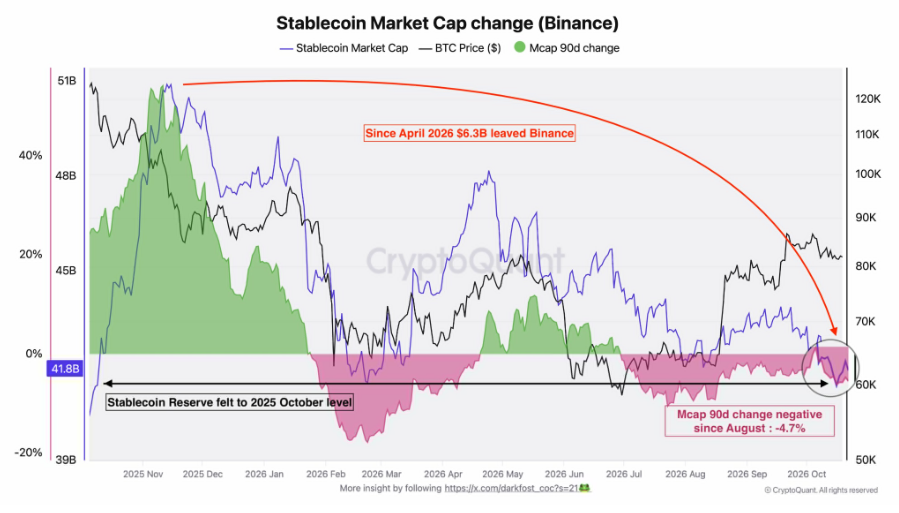
Stablecoin reserves on Binance fell to $41.6 billion on October 21, their lowest level in approximately one year, according to CryptoQuant analyst Darkfost. The decline followed a $6.3 billion reduction in tracked holdings since April 2026.
The same day, the Office of the Comptroller of the Currency (OCC) finalized its GENIUS Act regulations, a development also flagged by Eleanor Ter on X. The regulator removed a proposed presumption against certain third-party stablecoin rewards while retaining issuer reserve requirements.
The two developments highlighted separate issues involving exchange liquidity and U.S. stablecoin regulation.
Binance Stablecoin Reserves Drop $6.3 Billion Since April
Darkfost reported that Binance's stablecoin holdings have declined by $6.3 billion since April 2026, and that the current balance matches levels last seen in early October 2025. Binance's stablecoin reserves rose above $50 billion late last year before retreating through much of 2026, according to CryptoQuant. The figures track ERC-20 stablecoins held on the exchange rather than the total supply of stablecoins in circulation.
The data also shows a 4.7% decline in Binance's stablecoin market capitalization over the past 90 days. That measure has remained negative since June, despite a brief recovery in late August.
Darkfost placed average monthly stablecoin netflows at approximately negative $62 million. The latest reading extends a period in which outgoing balances have exceeded incoming transfers, reducing the stablecoins available on the platform.
Other Major Exchanges Report Falling Stablecoin Balances
Other exchanges have recorded similar withdrawals since April. According to Darkfost, Bybit's stablecoin reserves fell by $2.3 billion, while Coinbase Advanced reported a $2.5 billion reduction. OKX recorded a further $2.4 billion decline over the same period.
Binance nevertheless accounts for more than 70% of stablecoin reserves held across centralized exchanges, giving its balances a large share of the market's exchange-based liquidity. That concentration means movements in Binance's balances alone can shift the aggregate total for all centralized exchanges.
Darkfost outlined two possible explanations for the withdrawals. Exchanges may adjust their stablecoin inventories as customer demand changes, while some investors may move funds to platforms that offer yield. The figures alone do not establish where withdrawn funds went or whether their owners plan to return. Renewed inflows would indicate stronger demand for funds held on exchanges, where traders can deploy stablecoins into cryptocurrency markets.
OCC Leaves Third-Party Stablecoin Rewards Question Open
The OCC finalized its GENIUS Act rules on October 21, setting federal requirements for payment stablecoin issuers under its supervision. The regulator removed a proposed provision that would have presumed certain agreements between issuers and third parties violated restrictions on stablecoin interest payments. Instead, the OCC plans to review potential violations individually and take enforcement action where necessary.
The GENIUS Act prevents issuers from paying interest or yield directly to stablecoin holders. However, the law does not expressly prohibit exchanges and other independent firms from providing rewards.
Banks have sought tighter restrictions, arguing that such programs could draw deposits away from traditional accounts. The OCC declined to determine whether existing exchange rewards arrangements comply with the final rule. The decision leaves that dispute open as lawmakers continue debating the proposed Clarity Act. The next markers in that dispute will be the OCC's individual reviews of specific rewards arrangements and the Senate's handling of the Clarity Act.
Final Rules Give Issuers More Flexibility Over Reserves
The OCC also removed its proposed 20-day weighted-average maturity cap for reserve assets, allowing eligible issuers to hold longer-dated assets within the rules' investment requirements. The final rules retained the requirement for one-to-one backing while reducing immediate liquidity requirements from 10% to 5%.
The regulator will allow issuers to withdraw surplus reserves whenever they meet the requirement to back outstanding fully, rather than limiting withdrawals to once a month. Issuers must maintain backing of at least one dollar in reserve assets for every dollar of stablecoins outstanding.
The final regulations cover licensing, custody, capital, risk management, and redemption procedures. Issuers must notify the OCC within 24 hours when redemption requests exceed 10% of a stablecoin's outstanding value during a single day. The rules take effect on January 18, 2027. The OCC and the Treasury Department will develop separate requirements covering anti-money laundering controls and sanctions compliance.
This article is for informational purposes only and does not constitute financial or legal advice. Stablecoins carry custody, liquidity, and regulatory risks. Readers should conduct independent research before making financial decisions.

