Binance Review 2026: A Hands-On Examination From Registration to Live Trading
Key Takeaways
- •A live review on October 8, 2026 confirmed Binance's position as the largest cryptocurrency exchange, with the homepage displaying over 332 million users and more than $81.6 billion in 24-hour trading volume.
- •New 2026 offerings include an AI trading tools tab, tokenized stocks called bStocks featuring SpaceX and NVIDIA tickers, and traditional-finance yield products within the Earn section.
- •Paying fees in BNB reduces spot trading costs by 25%, lowering the base taker fee from 0.100% to 0.075%, while USDC-margined futures carry a 0.0000% maker fee for regular users.
- •U.S. residents are mandatorily redirected to the legally separate Binance.US platform, which offers a smaller product range, and EU users face MiCA-related access constraints after July 2026.
- •The November 2023 DOJ settlement keeps Binance under a five-year compliance monitorship expected to run through approximately 2028, involving enhanced anti-money-laundering screening and federal oversight.
Binance Review 2026: A Hands-On Examination From Registration to Live Trading
For anyone evaluating Binance in 2026, the central question is not whether it is the largest cryptocurrency exchange—it is. The question is whether its scale, complexity, regulatory history, and jurisdiction-specific availability make it suitable for a particular user.
This review is based on a live browser session conducted on 2026-10-08. It covered registration, login, identity verification, spot trading, futures, the fee schedule, and Earn products. Screenshots were captured during the process, and source URLs were recorded for each stage. Because eligibility, fees, rates, and product access can vary by jurisdiction and change over time, readers should confirm the current terms on Binance before opening an account or using a product.
Overall assessment
Binance offers deep liquidity, low base fees, a broad product range, and the largest ecosystem among centralized exchanges in 2026. At the same time, it has substantial regulatory baggage, a steep learning curve, and a U.S. Department of Justice settlement that remains subject to an active compliance monitorship.
For many active traders outside the United States, Binance remains a practical default. For users who place regulatory clarity above all other considerations, it may be less suitable. The distinction matters because the same global brand does not provide the same access everywhere: U.S. visitors are directed to Binance.US, while product availability and compliance requirements also depend on residence and verification status.
Binance versus major competitors
A comparison of Binance and major competitors is available from the following sources:
- Fee comparison: spark.money/tools/crypto-exchange-fee-comparison
- Kraken fee update: jeangalea.com/binance-vs-kraken
Step 1: Homepage
Live capture: binance.com/en, 2026-10-08
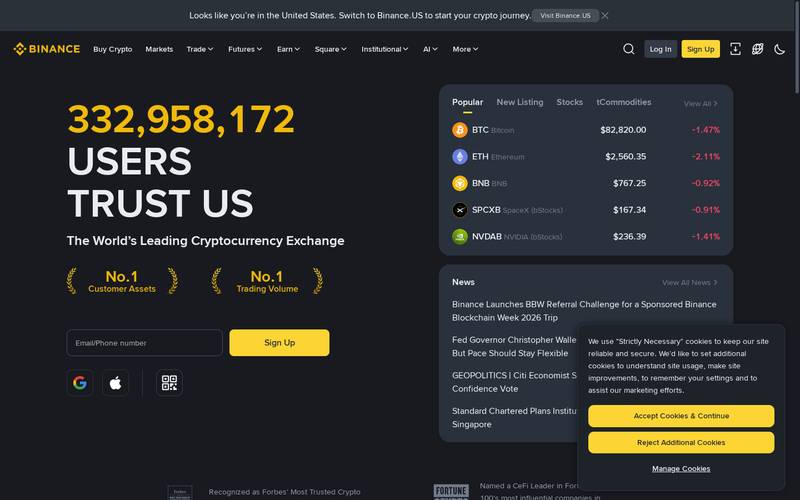
The homepage displayed 332,958,172 users at the time of capture. It also carried two No. 1 claims relating to customer assets and trading volume.
A live market ticker showed BTC at $82,820, ETH at $2,560.35, and BNB at $767.25. The ticker also displayed SPCXB, described as SpaceX bStocks, and NVDAB, described as NVIDIA bStocks. These are tokenized stock products available through Binance.
The main navigation showed the exchange’s product breadth: Buy Crypto, Markets, Trade, Futures, Earn, Square, Institutional, AI, and More. The AI tab was a new addition in 2026 and linked to Binance’s AI trading tools.
A banner at the top of the page instructed visitors in the United States to switch to Binance.US. The redirect is enforced rather than optional. The homepage also displayed recognition badges for Forbes’ Most Trusted Crypto Exchanges 2025 and Fortune Crypto 100 CeFi Leader.
Step 2: Registration
Live capture: binance.com/en/register, 2026-10-08
The registration page used a split layout. The left panel promoted “Up to 100 USD Sign Up Rewards” and displayed social-proof statistics. It also showed the SAFU fund wallet address directly on the registration screen:
0x420ef1f25563593aF5FE3f9b9d3bC56a8bd8c104
The right panel contained the account-creation form. The elements visible on the first screen were:
- One Email/Phone number field. Email and phone registration use the same input rather than separate tabs.
- A checkbox stating: “By creating an account, I agree to Binance’s Privacy Notice.” There was no separate Terms of Service checkbox at this stage.
- A yellow Register button.
- An “or” divider.
- Continue with Google.
- Continue with Apple.
- Continue with Telegram.
- Footer links for “Sign up as an entity” and “Log in.”
The initial screen did not show a password field, referral-code input, or password requirements. Those appeared after email or phone verification. A slide-puzzle CAPTCHA appeared before the verification code was sent.
The entity-registration option led to a separate corporate onboarding process. It was accessible at the bottom of the page but was not presented alongside the personal-registration options.
Sources: Official registration flow, binance.com/en/register | SAFU fund overview, binance.com/en/safu
Step 3: Login and authentication
Live capture: binance.com/en/login, 2026-10-08
The login page presented a centered card with six authentication methods. A QR-code icon appeared in the upper-right corner of the card, providing an option for mobile users who prefer not to type their credentials.
The available login methods were:
- Email or phone number, followed by a two-step process in which the email or phone number is entered first and the password on the next screen.
- Passkey, using a FIDO2/WebAuthn hardware key or device biometric.
- Google.
- Apple.
- Telegram.
- QR code, scanned with the Binance mobile application.
Keeping the password field off the first screen is an intentional design choice. If a user reaches a phishing clone that does not reproduce the sequence correctly, the flow may break before credentials are entered. This is a recognized phishing-resistance pattern.
The page also included a “Can’t log in?” account-recovery link and a “Create a Binance Account” link for new users. No “Forgot password” text appeared; recovery is routed through the support system.
Sources: binance.com/en/login | Binance 2FA guide, binance.com/en/support/faq/detail/115003717211
Step 4: Identity verification
Know-your-customer verification is mandatory in 2026. Without completing identity verification, users cannot access spot or futures trading, fiat deposits and withdrawals, Earn products, Launchpad, or staking.
According to the official documentation, the process has six stages:
- Open Identification: Go to Account menu → Identification → Get Verified.
- Select residence and document type: Enter the actual country of residence, then the issuing country and document type. Depending on the combination, supported documents include a passport, national identity card, or driver’s license.
- Upload document images: The full document must be visible and free from glare or blur.
- Complete the liveness check: Camera permission is required. The user follows on-screen movement prompts; filters and prerecorded video are rejected.
- Confirm personal information: The user reviews the extracted name and date of birth before submitting. These details cannot be changed within this step.
- Submit and wait: Binance states that review is completed within 48 hours for most accounts.
U.S. residents cannot use the main Binance platform, regardless of whether they complete KYC, and are redirected to Binance.US. This makes residence verification a practical gateway to the rest of the review: an account can be created only where the relevant platform and products are available.
Sources: Official KYC guide, binance.com/en/support/faq/detail/360027287111 | KYC flow walkthrough, kyclane.com/en/articles/binance-kyc-guide.html
Step 5: Spot trading interface
Live capture: binance.com/en/trade/BTC_USDT, 2026-10-08 at 04:40 UTC
At the time of capture, BTC/USDT was trading at $82,844.02, down 1.42% for the day. The 24-hour range was $82,227.56 to $84,052.00. The order book, market-trades feed, and chart were live and updating in real time.
The interface displayed the following panels and controls:
- Top navigation: Buy Crypto, Markets, Trade, Futures, Earn, Square, Institutional, AI, and More.
- Pair header: Live price, 24-hour change, 24-hour high and low, volume in BTC and USDT, network tags, and Token Tags with quick filters for Payments, Vol, Hot, and Price Protection.
- Order book: Red asks appeared at the top and green bids at the bottom. Each row showed Price, Amount BTC, and Total, with a visual depth bar. The spread between the best bid and ask was highlighted.
- Chart: A candlestick chart displayed MA(7) in yellow, MA(25) in pink, and MA(99) in purple. Available timeframes included 1s, 15m, 1H, 4H, 1D, and 1W. Views included Original, Trading View, and Depth. The interface also included Info, Data, and Square tabs, with Square showing community posts.
- Volume sub-chart: BTC and USDT volume bars appeared below the main chart.
- Market Trades: A real-time execution feed included a My Trades tab.
- Top Movers: A live leaderboard showed the biggest movers.
- Order form: Buy and Sell sides were available, with Limit, Market, and Stop Limit order types.
- Trading modes: Spot, Cross, Isolated, and Grid were available from the same panel. Grid trading and margin were accessible there.
- Market selector: Categories included All, New, bStocks with a NEW badge, tCommodities, USDC, USDT, U, USD1, USD, BNB, and BTC.
The bStocks category enabled users to trade tokenized stocks such as SpaceX and NVIDIA directly through the spot interface. The source describes this as a 2026 addition that was not present in older reviews.
The terminal is designed for users who already understand trading interfaces. Its panels are dense and appear simultaneously. For new users, the Convert interface is considerably simpler: select the asset to exchange, select the asset to receive, review the quoted price, and confirm. Convert is available through Buy Crypto → Convert in the top navigation.
Source: binance.com/en/trade/BTC_USDT
Step 6: Fee schedule
Live capture: binance.com/en/fee/schedule, 2026-10-08
The fee page used two navigation layers. The top tabs were Trading, Spot Promotions, Liquidity Program, Interest Rate, Deposit-Withdrawal, and Buy-Sell. A second row contained Spot & Margin, Stocks, USD(c)-M Futures, COIN-M Futures, TradFi Futures, Options, NFT, P2P, and Fiat. The review captured the Spot & Margin view.
The spot-fee table showed a column labeled “BNB 25% off” in orange. The USDC Maker/Taker column displayed “Standard / 0.095%” for the Regular User tier.
For VIP 1 and higher, qualification was presented as an AND requirement: users need both the required trading volume and the required BNB balance, rather than only one of those criteria.
The captured futures fees for USDT-M perpetual contracts were:
- Regular User: Maker 0.0200% and Taker 0.0500%.
- BNB futures discount: 10% off, separate from the 25% spot discount.
- USDC-margined contracts: Maker 0.0000% and Taker 0.0400%.
Deposits were free. Withdrawal fees varied by asset and network and were shown before confirmation on the withdrawal screen. The fee schedule therefore needs to be read together with the selected product, account tier, asset, network, and any applicable promotion.
Sources: binance.com/en/fee/schedule | Fee comparison versus competitors, spark.money/tools/crypto-exchange-fee-comparison
Step 7: Futures interface
Live capture: binance.com/en/futures/BTCUSDT, 2026-10-08 at 04:41 UTC
The futures section had separate navigation for Futures, Options, Trading Bots, Copy Trading, Smart Money, Campaigns, Data, and More. The top bar simultaneously displayed live tickers for BTCUSDT, ETHUSDT, and BNBUSDT.
The page showed futures-specific risk features, including a live funding-rate countdown. Users pay or receive funding every eight hours, depending on their position and the sign of the rate. At the captured snapshot, the funding rate was -0.00213%; the page indicated that short holders paid long holders at that rate.
The footer included Disclaimer and Responsible Trading links. The navigation also included Copy Trading, which allows users to mirror professional traders’ positions automatically. Futures, margin, grid trading, and copy trading add operational complexity beyond a simple spot purchase, so the interface’s product breadth is relevant to both experienced users and people trying to avoid derivatives.
Sources: binance.com/en/futures/BTCUSDT | Futures risk features, binance.com/en/support/faq/detail/360033525371
Step 8: Earn products
Live capture: binance.com/en/earn, 2026-10-08
The Earn page carried the headline “Smart Earning Starts Here, 300+ Crypto Assets Supported.” Its sub-navigation included Earn, Advanced Earn, TradFi with a NEW label, Loan, and VIP Earn.
The new TradFi label indicated that Binance had added traditional-finance yield products in 2026. The page also displayed featured APY cards and a Popular Products table.
The review noted that “Max APR” figures on featured cards represented the highest possible rate. Reaching those rates typically required locked-term products, structured yield, or participation in Launchpool. The lower flexible rate for stablecoins was described as the more realistic figure, at 2.49%-2.83%.
A promotional banner advertised “Share 70 BNB in APR Boost Giveaway” for PLUME Flexible Products. Rates during promotional periods can temporarily exceed standard rates. Product terms, lockups, eligibility, and rates should therefore be checked before relying on a promotional or maximum figure.
Source: binance.com/en/earn
Security and recorded incidents
Binance’s security-related features and claims included the following:
- SAFU fund: A 15,000 BTC reserve, stated as maintained in February 2026.
- Public wallet: The BTC wallet address
1BAuq7Vho2CEkVkUxbfU26LhwQjbCmWQkDis publicly auditable on-chain. - USDC wallet: The Ethereum/USDC address
0x420ef1f25563593aF5FE3f9b9d3bC56a8bd8c104appeared directly on the registration page and in the review screenshot. - Account protection: Authenticator-based two-factor authentication, FIDO2 passkeys, and a withdrawal-address allowlist.
- Homepage recovery statistic: The homepage showed 7,488,223 users helped and $229,433,449 in funds recovered at the time of capture.
The review also referenced the DOJ settlement, an SEC dismissal, and MiCA access. Its cited sources were:
- DOJ settlement: justice.gov/opa/pr/binance-and-ceo-plead-guilty-federal-charges
- SEC dismissal reference: blocklr.com/exchanges/binance-review
- MiCA access reference: hoge.gg/coinbase-vs-binance-vs-kraken-vs-okx
The compliance history remains relevant when comparing Binance with competitors because regulation affects onboarding, available products, and the obligations of institutional users. The five-year compliance monitorship established under the November 2023 settlement runs through approximately 2028.
Who Binance may suit in 2026
The review identified the following as potentially strong fits:
- Active spot and futures traders outside the United States and the European Union after MiCA.
- Users seeking access to more than 600 coins and more than 3,500 trading pairs.
- Traders prepared to hold BNB to reduce fees.
- Users who want trading, staking, P2P, bStocks, and Earn products on one platform.
- Institutional and high-volume traders who can qualify for VIP tiers.
The review identified the following as potentially poor fits:
- U.S. residents, who are directed to Binance.US, a legally separate platform with a smaller product range.
- European Union residents who require access to a MiCA-compliant exchange after July 2026.
- Users seeking a minimal buy-and-hold experience without exposure to derivatives.
- Anyone for whom regulatory clarity is a non-negotiable requirement.
The most important items to recheck before use are residence eligibility, KYC requirements, the fee tier, withdrawal terms, and the availability of products such as bStocks, Earn, futures, and staking. These conditions determine whether Binance’s headline breadth is actually available to a particular user.
All screenshots in the review were captured live on 2026-10-08, and the source URLs point to the live pages used during the review.
Frequently asked questions
Is Binance still the largest crypto exchange in 2026?
By combined spot and derivatives volume, yes, according to the review. The homepage displayed more than $81.6 billion in 24-hour trading volume and a No. 1 Trading Volume badge.
CoinMarketCap’s April 2026 report noted that Coinbase briefly surpassed Binance in BTC order-book depth, while overall volume leadership remained with Binance.
Source: hoge.gg/coinbase-vs-binance-vs-kraken-vs-okx
Can U.S. users use Binance?
No. The homepage screenshot showed U.S. visitors a banner reading: “Looks like you’re in the United States. Switch to Binance.US to start your crypto journey.” Binance.US is a legally separate entity with a smaller product range.
What is the BNB fee discount?
Paying trading fees in BNB provides a 25% discount on spot fees. The discount reduces the base taker fee from 0.100% to 0.075%, according to the fee-schedule screenshot. For a trader generating $10,000 in monthly volume, the review calculated a saving of $25 per month. The BNB column in the VIP table showed that the discount applies at every tier.
Is the DOJ settlement still relevant in 2026?
Yes. The five-year compliance monitorship established under the November 2023 settlement runs through approximately 2028. Binance operates under enhanced anti-money-laundering screening and federal oversight.
The review stated that the effect is largely invisible to retail users, while the monitorship structure is material for institutional users with their own compliance obligations.
What is the SAFU fund, and where is the proof?
The Secure Asset Fund for Users holds 15,000 BTC as of February 2026. The BTC wallet address 1BAuq7Vho2CEkVkUxbfU26LhwQjbCmWQkD and the Ethereum/USDC address 0x420ef1f25563593aF5FE3f9b9d3bC56a8bd8c104 are publicly auditable. The USDC address is also displayed directly on Binance’s registration page.
Source: binance.com/en/safu
How long does KYC verification take?
Binance states that verification review is completed within 48 hours. Most users report same-day approval, while cases involving document-quality issues, jurisdiction-specific flags, or failed liveness checks can take longer.
Source: binance.com/en/support/faq/detail/360027287111
What is bStocks on Binance?
bStocks are tokenized versions of publicly traded stocks that can be traded directly through Binance’s spot interface. In the captured trading interface, SpaceX, identified by the ticker SPCXB, and NVIDIA, identified by NVDAB, appeared in the homepage market ticker and in a dedicated bStocks category.
The review describes bStocks as a 2026 product expansion.
Source: binance.com/en/trade/BTC_USDT, bStocks tab visible in market selector

