Binance Restores Hyperliquid HYPE Withdrawals as INJ, NEAR and LTC Remain Locked
Key Takeaways
- •Binance re-enabled withdrawals for HYPE and APT on November 8 after completing security audits, while withdrawals for INJ, PLASMA, NEAR and LTC remain locked with no restoration timetable.
- •The withdrawal freeze followed an October 29 breach in which the FBI and Chainalysis attributed the theft of approximately $6.3 billion from Binance's hot wallets to the North Korean hacking group TraderTraitor, executed in roughly 20 minutes.
- •Binance worked with stablecoin issuers Tether and Circle to block about $3 billion of the stolen funds and pledged to cover 100% of user losses through its SAFU emergency fund.
- •HYPE's later restoration resulted from the additional time required to audit HyperEVM, its custom Layer-1 blockchain, compared with standard Ethereum and Solana networks.
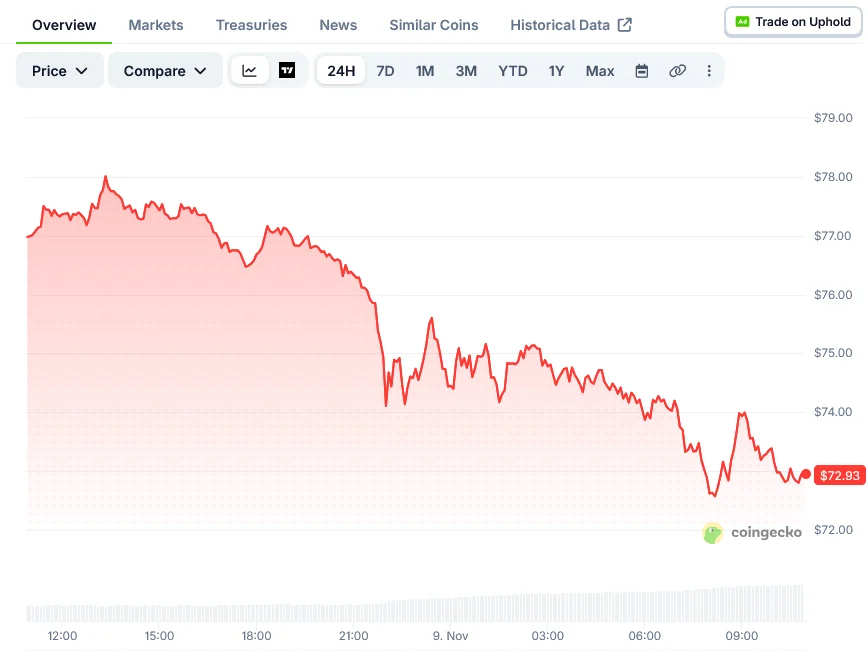
- •HYPE traded near $77.37 after the announcement, down about 1.7% in 24 hours, amid pressure signals including $38.2 million of withdrawals from the Hyperliquidity Provider vault and $7.96 million of net outflows from U.S. spot HYPE ETFs on November 6.
Binance has restored withdrawal services for Hyperliquid's HYPE token and Aptos's APT token, with the change taking effect on November 8 after the exchange completed audits of both networks. Binance co-founder and president Yi He confirmed the update in a post on X. Withdrawals for INJ, PLASMA, NEAR and LTC remain locked, with no timetable given. Withdrawal availability is a core operational signal for exchange users, since locked withdrawals prevent holders from moving tokens to self-custody or other trading venues.
HYPE was among the last major tokens to return after Binance froze withdrawals following a security breach on October 29, a step exchanges commonly take to stop further outflows while they assess the damage. According to the FBI and blockchain analytics firm Chainalysis, the North Korean hacking group known as TraderTraitor drained approximately $6.3 billion from Binance's hot wallets — the internet-connected wallets used to process customer withdrawals — carrying out the theft in roughly 20 minutes.
Binance said it worked with Tether and Circle, the issuers of the USDT and USDC stablecoins, to block about $3 billion of the stolen funds. The exchange also pledged to cover 100% of user losses through its SAFU (Secure Asset Fund for Users) emergency fund.
Latest Withdrawal Update
Binance's November 8 notice listed the newly re-enabled assets:
Latest Withdrawal Update — Withdrawals have now been re-enabled for the following networks and assets:
New: ✅ HYPE ✅ APT
Already Enabled: ✅ ETH: RLUSD, USD1, TUSD, FDUSD, XUSD ✅ ETH: ENA, USDE, PENDLE, WLD, QNT, SHIB, ZRO, FET, NIL, ONDO, ALT, SKY, LINK, ETHFI, REZ,…
— Binance (@binance) November 8, 2026
Why HYPE Took Longer
Binance began reopening withdrawals on November 1, starting with Bitcoin and selected assets on several networks. The exchange ran audits across the Ethereum and Solana chains before restoring tokens in groups.
HYPE runs on its own Layer-1 blockchain, HyperEVM, rather than a standard Ethereum or Solana setup. According to reports, auditing a custom network after a hack of this size requires extra time, which contributed to the asset returning later than many others.
Some members of the Hyperliquid community said the delay was unfair, and critics described the pause as sabotage, pointing to a long-running dispute between Binance and Hyperliquid, a leading platform for on-chain derivatives trading. In 2025, Hyperliquid founder Jeff Yan accused Binance of underreporting liquidation data after the market crash on October 10, 2025. Binance later delayed the spot listing of HYPE until September 24, 2026, and assigned it a “Seed Tag,” a label used for higher-risk tokens.
Binance founder Changpeng Zhao rejected the accusations, saying strong decentralized exchanges help grow the overall market for the whole industry.
HYPE Price and Remaining Restrictions
HYPE traded near $77.37 after the announcement, down about 1.7% over 24 hours, according to CoinGecko. Its market value stood at $18.53 billion, with $450.38 million in daily trading volume. The token moved between $76.69 and $78.14 during the day. Aptos's APT token traded near $0.5944 at the time of the update.
Other data pointed to pressure on Hyperliquid. The Hyperliquidity Provider vault recorded $38.2 million in withdrawals, and its value has fallen about 20% from its September peak. U.S. spot HYPE ETFs reportedly posted $7.96 million in net outflows on November 6, and one large trader held a $33 million short position on the token.
Binance's November 8 notice also listed Ethereum and Solana assets already available for withdrawals. These included stablecoins such as RLUSD, USD1, TUSD, FDUSD and XUSD, along with tokens like LINK, SHIB, ONDO, BONK, Jupiter and Render.
The exchange did not say whether every network route for HYPE and APT is open. Availability can differ by blockchain, so users are advised to verify the selected asset and network before sending funds.
Binance said more assets and networks will return in phases as security checks finish. The notice did not provide a new timetable and did not say whether INJ, PLASMA, NEAR or LTC had cleared their checks, making the timing of the next restoration batch the main detail to watch in Binance's follow-up announcements.

