Binance Stock Put Options Require Sellers to Lock Full USDC Reserves
Key Takeaways
- •Binance introduced covered-call and cash-secured-put strategies on Oct. 15, allowing eligible customers to earn premiums while committing shares or USDC to potential assignment.
- •Put sellers must hold the full strike-price amount in USDC in their Funding Account, with collateral set aside at order placement and the premium credited separately without reducing the reserve.
- •US persons, people located in the United States, and accounts they beneficially own or control are excluded, with additional possible restrictions in China, Hong Kong, and the European Union.
- •Orders flow through Nest Trading Limited as introducing broker to Alpaca Securities LLC for execution, clearing, settlement, and custody, with T+1 settlement and the possibility of overnight early assignment.
- •The linked Stock Options Trading Product Terms and the general FAQ still describe long-only trading, creating an inconsistency with the new selling features whose governing terms remain unresolved.
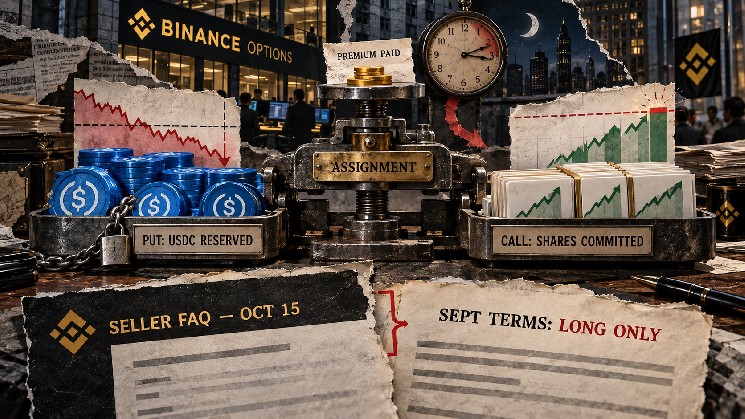
Binance introduced covered-call and cash-secured-put strategies for its stock-options offering on Oct. 15, enabling eligible customers to earn premiums while committing either shares or $USDC to a potential assignment.
For put sellers, assignment — the process triggered when an option buyer exercises and the seller must fulfill the contract — carries the obligation to buy the underlying shares at the agreed price, even where their market value has since fallen. In a cash-secured put, the seller is paid a premium for taking on that purchase obligation, and the agreed purchase price is known as the strike price. If the stock falls sharply, the premium recoups only part of the loss from buying above the prevailing market price.
A covered-call seller, meanwhile, pledges shares already held and must sell them at the strike if assigned. The approach caps gains above the strike while leaving the seller exposed to any decline in the stock.
Eligibility limits and collateral rules
The linked September options terms exclude US persons, people located in the United States, and accounts they beneficially own or control. They also flag possible restrictions in China, Hong Kong, the European Union, and other prohibited jurisdictions.
According to Binance's new seller FAQ, put sellers must hold enough $USDC collateral in the Funding Account to pay the strike price for every share covered by their contracts. In effect, each written contract commits capital equal to the full purchase amount upfront. The premium is credited separately and does not reduce that full reserve.
The FAQ states that the funds are set aside when the sell order is placed and cannot support other orders or withdrawals. The money remains held after a fill and is released if the order is canceled or expires unfilled. Premium payments and share settlement after assignment follow T+1 settlement, meaning transactions finalize one business day after the trade date.
The earlier stock-options offering already relied on securities brokers, and the newly added selling strategies run through that same structure: Nest Trading Limited serves as the introducing broker, routing orders topaca Securities LLC, which provides execution, clearing, settlement, and securities custody.
Binance's seller FAQ adds that early assignment can occur overnight and that the seller cannot control the buyer's decision to exercise. Written positions are not automatically closed at expiry, unlike eligible long options, which are subject to best-efforts closure.
Linked terms still exclude selling
Those seller instructions conflict with Binance's linked Stock Options Trading Product Terms. The document remains at version 1.0, effective Sept. 1. Section 6.2 allows opening long calls and puts and closing those positions, while expressly excluding writing and short positions.
The older general FAQ, last updated Oct. 9, likewise describes long-only trading. Neither document reflects the newly announced selling strategies.
Binance's new FAQ describes a premium in exchange for a funded share-purchase or delivery obligation. The public terms remain inconsistent with that description, leaving unresolved which seller-enabled terms govern those commitments. Any reconciliation would need to appear in a revised Product Terms version or an updated FAQ, making those documents' version notes and update dates the immediate markers to watch.

