Bill Gates Backs Legally Required AI Safeguards as Global Investment Tops $1 Trillion
Key Takeaways
- •Bill Gates told NBC News that AI companies should not regulate themselves and asked Congress to define how developers monitor risks and which safeguards they must implement.
- •Gates cautioned that AI is powerful enough to cause events leading to a billion deaths if advanced systems reach people with bad intentions, while describing compliance duties as modest overhead rather than a brake on progress.
- •Industry leaders are split, with Anthropic's Dario Amodei and OpenAI's Sam Altman open to collective pacing or pauses, while Meta's Mark Zuckerberg rejects industrywide coordination in favor of lab-by-lab judgment.
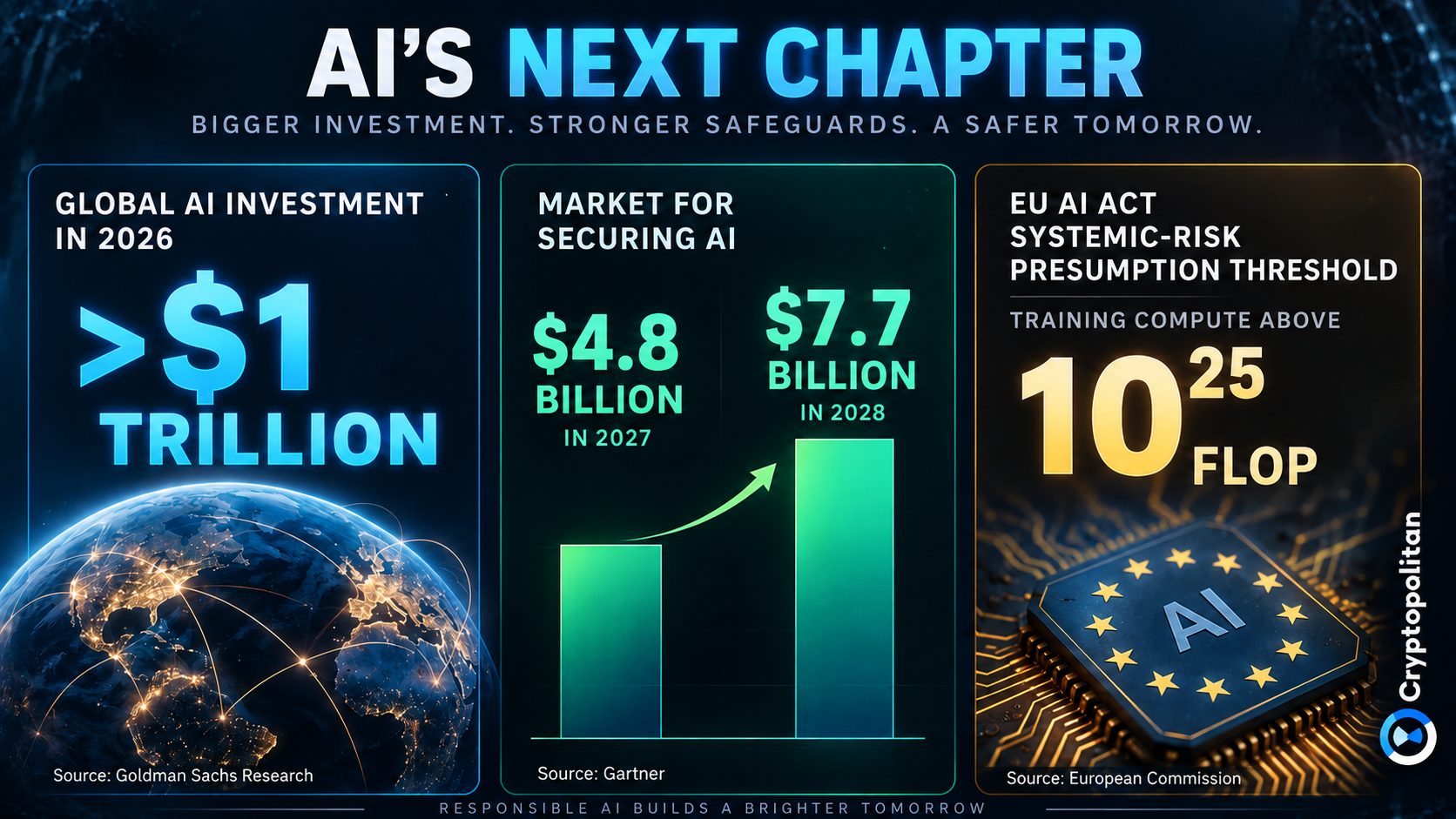
- •Goldman Sachs forecasts global AI investment exceeding $1 trillion in 2026, including roughly $581 billion in the United States, with cumulative spending since 2022 nearing $1.8 trillion.
- •The EU AI Act already imposes documentation, copyright, and transparency obligations on general-purpose AI models, treating those trained with more than 10^25 FLOP as systemic risks, while US Senate negotiators are exploring a binding duty of care standard.
Bill Gates has warned that artificial intelligence companies should not be left to regulate themselves, urging lawmakers in Washington to put formal safety rules in place for the fast-growing industry.
The Microsoft co-founder laid out his position in an NBC News interview released on September 25, two days before the complete conversation aired on “Meet the Press.” His call for government oversight arrives at a pivotal moment: Goldman Sachs forecasts that global AI investment will top $1 trillion in 2026. Against that backdrop, new safety requirements could carry significant consequences for the developers building AI systems, the investors funding them, and the companies working to implement the security systems needed to enforce any new rules.
“No one thinks self-regulation is enough”
Asked by moderator Kristen Welker whether Congress needs to act, Gates replied: “Absolutely.”
“No one thinks self-regulation is enough,” Gates said. In his view, lawmakers and enforcement bodies should spell out how AI companies monitor risks and which safeguards they must put in place. He characterized the resulting obligations for developers as “a little bit of overhead,” rather than a brake on progress.
His concern extends well beyond routine misuse. Speaking to NBC, Gates said AI is “certainly powerful enough to drive events that, you know, cause a billion deaths,” particularly if advanced systems fall into the hands of people with bad intentions.
Industry leaders remain divided on how far safeguards should go. Anthropic CEO Dario Amodei has raised the idea of “full pacing, or even ‘pause’” as the most extreme form of collective slowdown. OpenAI CEO Sam Altman has voiced a similar concern, arguing that “pacing will be well worth this cost” and that the pressure to stay ahead of competitors should not serve as an excuse for acting recklessly.
Meta CEO Mark Zuckerberg has taken the opposite position. In an interview with NBC News, he said: “I don’t think that we need some kind of industrywide coordination.” Zuckerberg favors an approach in which individual labs slow down only when they judge themselves to face safety risks. The exchange underscores a broader split at the top of the industry over whether AI governance should be coordinated across the sector or left to individual companies. The dispute is not merely philosophical: any binding US rules would apply across the industry, regardless of where individual labs stand.
Gates wants risks managed, not development halted
Gates is not asking the technology sector to stop developing AI systems. In an essay published on his Gates Notes blog in August, he wrote that artificial intelligence “will either be the greatest equalizer ever invented, or the worst source of injustice.”
He added that he would likely endorse a credible plan for a coordinated global slowdown in AI development, though he doubted such a plan could prove effective, given the economic and political forces that favor continued development.
His stance, then, is less about halting new development than about readiness: preparing companies, governments, and individuals for a technology that is already finding applications in fields such as medicine, law, software, and customer service.
A $1 trillion market waiting on the rules
The debate over safeguards is unfolding as capital pours into AI, raising the stakes of any new regulation. Goldman Sachs expects global AI investment to exceed $1 trillion in 2026, including roughly $581 billion in the United States, while cumulative investment since 2022 could approach $1.8 trillion by year-end.
Yet the benefits are not evenly shared. Microsoft’s AI diffusion data shows a widening divide between the Global North and Global South, while the OECD highlights that AI capacity remains limited to a handful of countries and firms.
That imbalance makes regulation an even more difficult balancing act. Stronger protections could reduce risks, but for small laboratories and less wealthy countries, the added cost of compliance could prove very hard to bear.
A regulatory patchwork is already forming
A growing body of evidence supports the case for stricter oversight. The International AI Safety Report 2026, written under the guidance of Turing Award winner Yoshua Bengio and produced by more than 100 experts in the field, describes existing dangers and the potential future threats posed by the increasing capabilities of AI systems.
Governments, meanwhile, are already building rules around those risks. According to TRM Labs, a new global “patchwork” of AI regulation is emerging as countries take differing approaches to governance, implementation, and accountability.
The European Union has pursued these aims more aggressively than most jurisdictions. Under the EU AI Act, providers of general-purpose AI models must comply with strict obligations covering documentation, copyright, and transparency about training data. Models that use more than 10^25 FLOP — floating-point operations, a measure of the computing power used to train a model — are deemed to carry systemic risks, triggering additional requirements for model evaluation, risk management, accident reporting, and cybersecurity.
Compliance spending is rising alongside the rulemaking. According to Gartner, organizational spending on securing AI will increase 68.7% to almost $4.8 billion by 2027, with projections approaching $7.7 billion in 2028.
Washington also appears to be moving toward a more robust regulatory framework. To date, the United States has relied largely on voluntary commitments from individual companies rather than a binding federal framework comparable to the EU’s. As reported by Cryptopolitan, Senate negotiators are exploring a bipartisan initiative to establish a “uty of care” for AI developers, one that could allow the government to prevent the release of unsafe models. If approved, the measure would move the safeguards Gates is urging from the realm of voluntary commitments into legally binding responsibilities. Those talks remain at an exploratory stage, leaving the scope, terms, and timing of any binding US framework as open questions.

