STRK, TIA, ARB Lead Day's Crypto Gainers: Why the Rally Is Uneven
Key Takeaways
- •Starknet led the daily gainers with a 54% surge following its October 6 v0.14.4 mainnet upgrade, which expanded the network's proving capabilities for more complex transactions.
- •Celestia gained 21% during its latest mainnet upgrade cycle, which included work on Fibre, the project's high-throughput data-availability design.
- •Arbitrum rose 8% after the USDG dollar token launched on the network with integrations spanning Fluid, Morpho, GMX, Maple and Uniswap.
- •Aerodrome's 15% advance arrived without a same-day announcement, though Aerodrome and Velodrome have outlined a planned consolidation into Aero as a longer-term ecosystem element.
- •Injective's 7% and Stacks' 4% gains lacked clear public triggers, and Stacks is a repeat gainer from an earlier broad altcoin rebound this month.
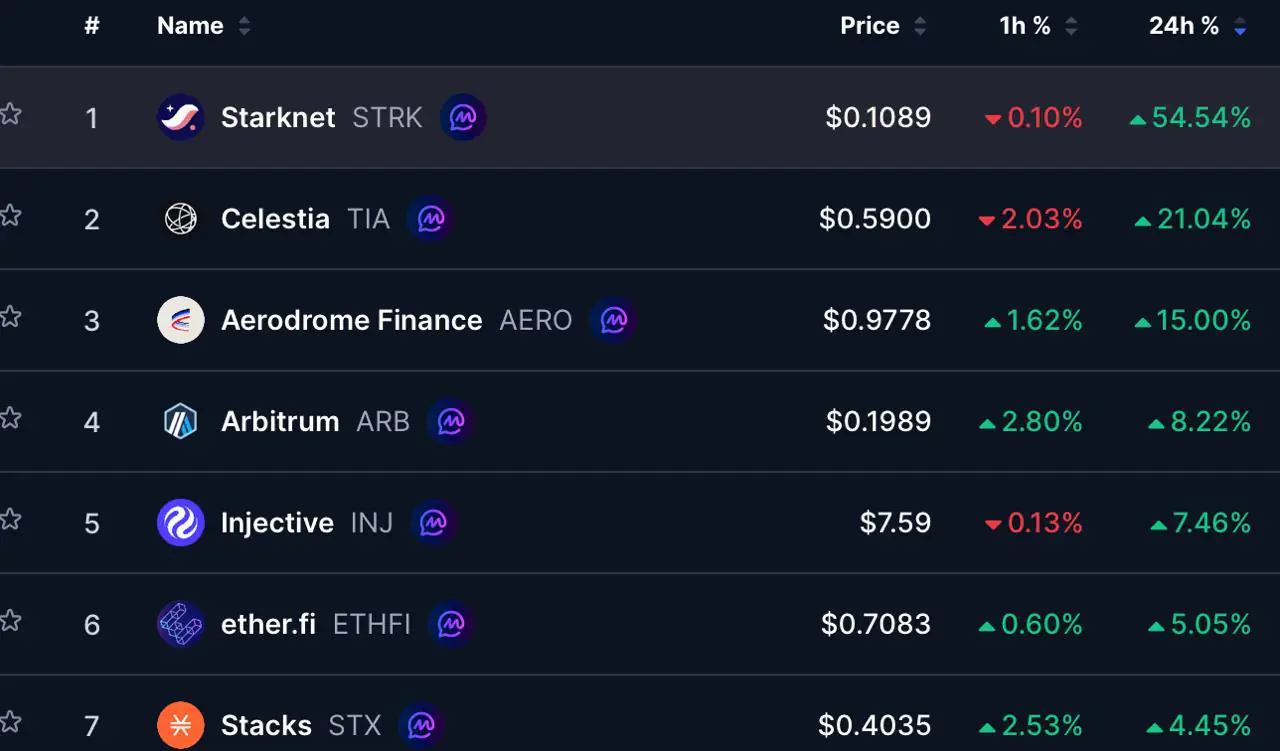
CoinMarketCap's data on October 11, 2026 at 09:30 UTC placed Starknet (STRK), Celestia (TIA), Aerodrome Finance (AERO), Arbitrum (ARB), Injective (INJ), ether.fi (ETHFI) and Stacks (STX) among the day's largest gainers. Starknet led the board with a 54% jump, Celestia added 21%, and Aerodrome rose 15%. Arbitrum gained 8%, Injective 7% and Stacks 4%, with ether.fi also among the top movers. The seven names span different corners of the market — Ethereum scaling, modular data availability, onchain trading and lending, restaking, and Bitcoin smart contracts.
A 24-hour gainers ranking records only price performance over the previous day. The buying behind any single entry may trace back to a product release, fresh liquidity, thinner order books, short covering, or traders rotating capital between sectors. For that reason, the leaderboard works best as the starting point of the research process rather than its conclusion; wider market evidence has to fill in the rest. A single daily ranking therefore mixes several very different market stories.
STRK and TIA offer the clearest examples of that difference. Both tokens advanced while their networks carried recent technical developments for traders to assess, though the practical test now facing each network is not the same.
Starknet and Celestia Put New Technology to the Test
Starknet is a validity rollup, a network that scales Ethereum by verifying computation with cryptographic proofs. Its 54.54% gain followed the October 6 v0.14.4 mainnet upgrade, a release that expanded the network's proving capabilities for more complex transactions, giving developers a broader toolkit for applications that need computation to be verified efficiently on the rollup.
STRK had already drawn market attention after Starknet completed the v0.14.4 upgrade during a weak Bitcoin session, a stretch in which the linked report noted Bitcoin trading under $82,000. The relevant follow-up is whether the added capacity translates into developer activity, application usage and fees — measures that would show more clearly whether the upgrade is becoming economically meaningful for the network, rather than a one-day catalyst.
Celestia is a modular data-availability network. TIA's advance arrived during its latest mainnet upgrade cycle, which included work related to Fibre, the project's high-throughput data-availability design. The development concerns how much data the network can support for rollups and other chains that publish information externally. Added capacity becomes economically relevant only when other networks actually use it and pay for the service — the same question that sat behind Celestia's earlier Fibre-led recovery. A technical milestone can attract attention, but sustained data publication is what would demonstrate practical traction.
Three broad lenses frame the difference between a headline gain and durable demand:
- Technical milestone. A release can attract attention. An upgrade may change what a network can do, but it does not show that users have already created new demand for its token.
- Liquidity development. A new asset needs lasting use. Integrations matter when users retain deposits, liquidity and borrowing activity after the announcement.
- Market movement. A gain can arrive before an explanation. Spot demand, leverage and thinner order books can move a token before a clear project-level event emerges.
Arbitrum Gains a New Route for Onchain Dollar Liquidity
Arbitrum, an Ethereum layer-2 network, rose 8% after USDG went live on the network with integrations spanning Fluid, Morpho, GMX, Maple and Uniswap. A regulated dollar token can add another settlement balance for lending, trading and liquidity provision across an existing DeFi ecosystem.
The announcement gives the market a concrete development to track, but availability alone does not establish adoption. A listing is the beginning of that evaluation, not the end. The more meaningful evidence would be whether USDG balances remain on Arbitrum, whether lending markets attract sustained deposits, and whether the integrations generate regular activity beyond the initial liquidity push.
Longer-Running Stories Behind AERO and ETHFI
Aerodrome, a decentralized exchange and liquidity protocol, saw its 15% move arrive without an equally clear same-day project announcement. Aerodrome and Velodrome have outlined a planned consolidation into Aero, a longer-term element of the ecosystem narrative that does not, by itself, provide a confirmed explanation for a single daily candle.
ETHFI presents another longer-running mechanism for traders to weigh: it is the token of ether.fi, a restaking and DeFi protocol whose revenue-funded buyback framework may generate recurring token demand when protocol activity remains strong. Yet ETHFI's recent pullback showed why such a program does not create a fixed price floor: wider market conditions, selling pressure and leverage can still shape the token's short-term direction.
In both cases, the mechanisms offer background rather than confirmation. A broad ecosystem plan or buyback program may explain why a token stays on traders' radar, but measurable liquidity, revenue or token demand would give a stronger basis for judging the moven
INJ and STX Show the Limits of a Gainers Page
Injective, a layer-1 blockchain geared toward financial applications, rose 7%, and Stacks, a network that brings smart contracts to Bitcoin, added 4%. Neither move requires a dramatic public announcement to be genuine: crypto prices can rise through spot buying, derivatives repositioning and rotation as traders move between sectors after an earlier rally. That makes rushed explanations risky.
Stacks also appeared among the leading gainers during an earlier broad altcoin rebound this month, making it one of the few names on the current list with a recent repeat appearance. Reappearing on a ranking signals renewed market attention, but it does not prove that the earlier conditions are still driving the token.
For INJ and STX alike, the more useful checks are whether spot volume holds after the move, whether derivatives open interest grows alongside it, and whether order-book liquidity remains deep enough to support the higher price. A gain that survives those tests says more than a position on a daily leaderboard.
Why the Rally Is Uneven
The seven gains rest on different foundations. STRK and TIA carry recent technical milestones for the market to assess. ARB has a new route for onchain dollar liquidity. AERO and ETHFI draw attention from longer-running ecosystem and token mechanisms. INJ and STX, meanwhile, moved without an equally clear public trigger tied to the latest session.
That is what makes the rally uneven: the same 24-hour ranking blends projects with fresh releases, projects with broader operating narratives, and tokens whose move may reflect market positioning more than any new development. Network usage, liquidity, protocol revenue and sustained trading activity will help show which of these gains has support beyond the first burst of attention.
This article is provided for informational purposes only and does not constitute financial or investment advice. Cryptocurrency markets are volatile, and a daily price move does not guarantee continued performance.
Based on reporting first published by Coindoo.

