Big Tech Earnings Week Ends With Intel and ServiceNow Ahead as Tesla and Alphabet Slide
Key Takeaways
- •Seven major technology companies reported earnings over four days, providing a broad test of investor tolerance for AI-related capital spending.
- •Intel posted 25% revenue growth to $16.1 billion, doubled earnings estimates, and rose more than 12% in after-hours trading.
- •Tesla shares fell 14.5% after earnings missed consensus, free cash flow turned negative, and capital spending rose 142%.
- •Alphabet reported 24% revenue growth and 82% Cloud revenue growth, but its stock dropped 7.1% after it raised 2026 capital spending guidance to as much as $205 billion.
- •Texas Instruments, IBM, and SAP ended the week with mixed signals across analyst revisions, money flow, options positioning, and earnings results.
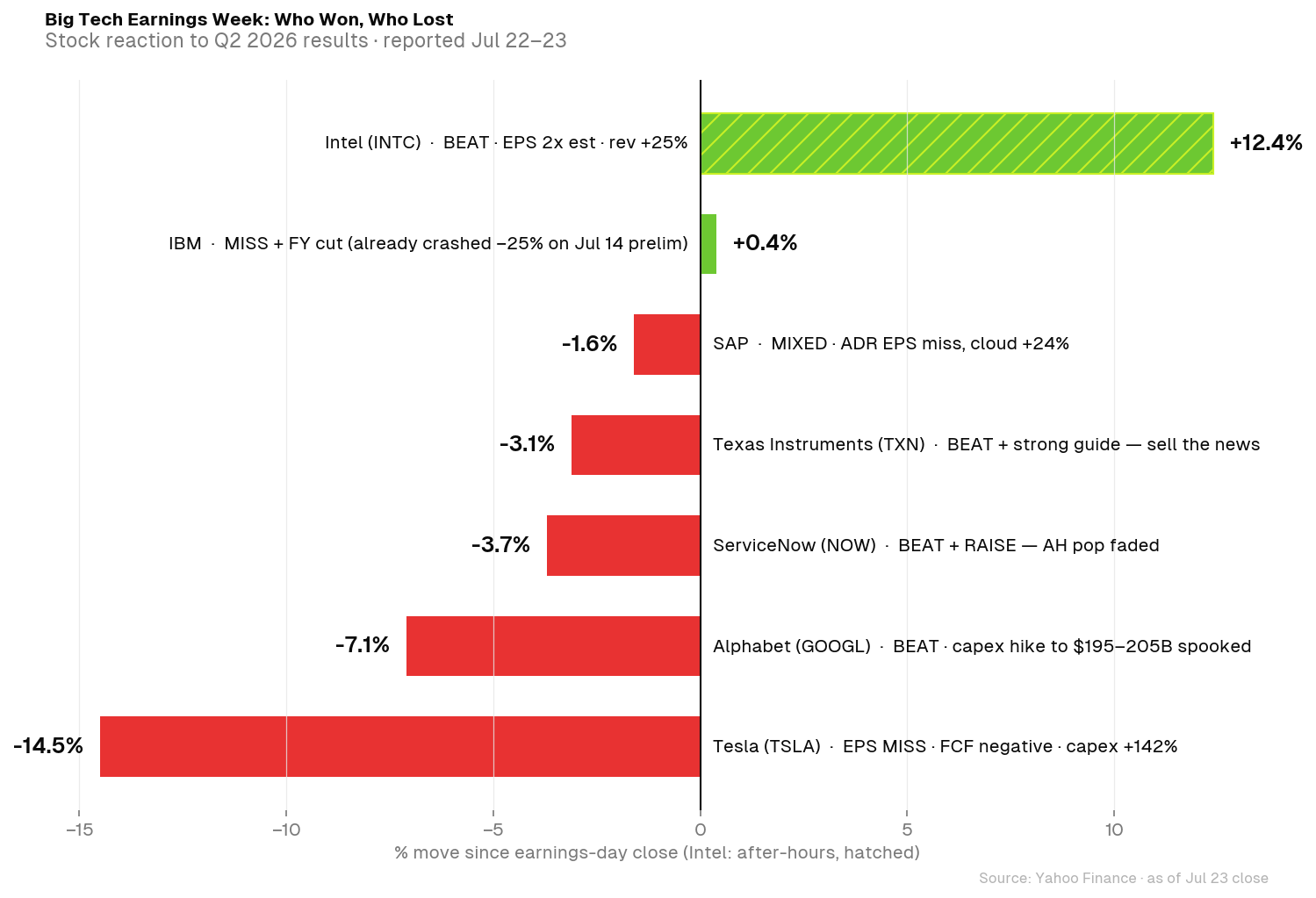
Big Tech earnings week ended with an unusual scoreboard. Most companies beat Wall Street estimates, but almost every stock declined, and commentators estimated that hundreds of billions of dollars in market value disappeared across two sessions.
Four signals offered a clearer picture than headline earnings alone: price reaction, money flow, options positioning, and analyst revisions. Together, they showed which companies emerged stronger from the week and which were punished despite solid demand.
Why the Week Mattered
Seven major companies reported results in four days. Texas Instruments opened the sequence on July 21. Alphabet, Tesla, IBM, and ServiceNow followed on July 22, while Intel and SAP closed the group on July 23.
The reports also served as a broad test of artificial intelligence capital spending at scale, after earlier calls to reduce exposure to technology shares before earnings. Investors were looking for evidence that record data center budgets are translating into profits. That question has hung over the sector since the current AI buildout cycle began, with semiconductor and cloud infrastructure providers largely recognized as early revenue beneficiaries while enterprises adopting AI face substantial upfront costs before returns materialize.
Commentators estimated that the megacap group lost $800 billion in market value in a single day, the worst such decline since April 2025. Because companies like Alphabet and Tesla represent a significant share of the S&P 500 and Nasdaq Composite, their post-earnings declines rippled through index-tracking funds and sector benchmarks.
A TON OF THINGS HAPPENED IN THE STOCK MARKET TODAY. Here's a full recap: 1. Tesla $TSLA was down 14% today, its worst day since January 2024, while Google $GOOGL was down 7% after posting its first negative free cash flow quarter since 2004. The macro backdrop is not helping… — amit (@amitisinvesting) July 24, 2026
A TON OF THINGS HAPPENED IN THE STOCK MARKET TODAY. Here's a full recap: 1. Tesla $TSLA was down 14% today, its worst day since January 2024, while Google $GOOGL was down 7% after posting its first negative free cash flow quarter since 2004. The macro backdrop is not helping…
The week showed that spending guidance is now moving these stocks more than earnings results alone.
Who Won Big Tech Earnings Week?
Two companies left the week in stronger positions. Intel stood out on reported results, while ServiceNow showed more strength in positioning despite a negative share-price reaction.
Intel
Intel delivered the cleanest earnings beat among the group. Revenue rose 25% to $16.1 billion, marking its fastest growth in almost 15 years. Earnings of $0.42 per share were double estimates, and the stock jumped more than 12% in after-hours trading.
Money-flow data was more cautious. Chaikin Money Flow, or CMF, a proxy for institutional money flow, stood at -0.13 before the report.
Barchart showed put/call open interest, the measure of contracts still held, at 0.96. That indicated rising bearish hedging compared with Intel's 0.6 to 0.75 baseline.
Analysts lifted price targets but did not raise ratings. Morgan Stanley kept its Hold rating at $84, while JPMorgan maintained a Sell rating at $85, according to TipRanks.
ServiceNow
ServiceNow fell 3.7% in the session after its report, a move that initially looked negative. The underlying details were stronger. The company beat earnings expectations, increased subscription revenue by 24.5%, and raised its outlook. As an enterprise software platform whose workflow automation tools are increasingly tied to AI features, ServiceNow's results offered a read on whether corporate customers are sustaining software budgets even as infrastructure spending dominates headlines.
SERVICENOW $NOW Q2'26 EARNINGS HIGHLIGHTS 🔹 Subscription: $3.88B; +24.5% YoY, +23% cc 🔹 Total Revenue: $3.99B (Est. $3.92B) 🟢; +24% YoY, +22.5% cc 🔹 Adj. EPS: $0.90 (Est. $0.86) 🟢 🔹 cRPO: $13.20B (Est. ~$13.03B) 🟢; +21% YoY, +21.5% cc Q3 Guide: 🔹 Subscription:… pic.twitter.com/7sgK7CjWS0 — Wall St Engine (@wallstengine) July 22, 2026
SERVICENOW $NOW Q2'26 EARNINGS HIGHLIGHTS 🔹 Subscription: $3.88B; +24.5% YoY, +23% cc 🔹 Total Revenue: $3.99B (Est. $3.92B) 🟢; +24% YoY, +22.5% cc 🔹 Adj. EPS: $0.90 (Est. $0.86) 🟢 🔹 cRPO: $13.20B (Est. ~$13.03B) 🟢; +21% YoY, +21.5% cc Q3 Guide: 🔹 Subscription:… pic.twitter.com/7sgK7CjWS0
CMF slipped to -0.10, meaning large investors had not yet confirmed a recovery. Options data, however, improved after the print. Put/call ratios fell from 0.54 to 0.42 on volume and from 0.83 to 0.80 on open interest, showing bullish buildup.
Analysts at Bernstein and Evercore raised targets, while KeyBanc maintained a single Sell call. Positioning suggested the post-earnings decline was treated as an entry point.
Who Lost the Week?
The weakest performers shared a common problem: markets punished heavy spending more aggressively than weak demand.
Tesla
Tesla failed all four tests. Earnings of $0.33 per share missed the $0.51 consensus, free cash flow turned negative, and capital spending rose 142%. The stock dropped 14.5%, its worst session in more than a year, following a tense Tesla earnings preview week.
BREAKING: Tesla $TSLA delivered a record quarter and still missed on profit. $28.24 billion in revenue, beating the $26.32 billion estimate, on record deliveries of 480,126 vehicles, up 25% YOY. Adjusted EPS came in at 33 cents, well below the 51 cent estimate. Gross margin… pic.twitter.com/3o9kzLbfLJ — Bull Theory (@BullTheoryio) July 22, 2026
BREAKING: Tesla $TSLA delivered a record quarter and still missed on profit. $28.24 billion in revenue, beating the $26.32 billion estimate, on record deliveries of 480,126 vehicles, up 25% YOY. Adjusted EPS came in at 33 cents, well below the 51 cent estimate. Gross margin… pic.twitter.com/3o9kzLbfLJ
Money flow confirmed the pressure. CMF worsened from -0.06 to -0.12, showing that sellers intensified despite record deliveries.
Put volume increased from 0.78 to 0.83 times calls. At least six firms cut targets, including JPMorgan and UBS.
$TSLA is plunging more than 12% after a huge wave of downgrades from WS 🤯 ⚠️ Canaccord Genuity lowered Tesla's target price from $450 to $410 ⚠️ JPMorgan lowered Tesla's target price from $475 to $445 ⚠️ TD Cowen lowered Tesla's target price from $490 to $460 ⚠️ Truist… pic.twitter.com/w6ZLZyyNhT — Ming (@tslaming) July 23, 2026
$TSLA is plunging more than 12% after a huge wave of downgrades from WS 🤯 ⚠️ Canaccord Genuity lowered Tesla's target price from $450 to $410 ⚠️ JPMorgan lowered Tesla's target price from $475 to $445 ⚠️ TD Cowen lowered Tesla's target price from $490 to $460 ⚠️ Truist… pic.twitter.com/w6ZLZyyNhT
Alphabet
Alphabet reported some of the week's strongest numbers but still finished among the losers. Alphabet's July earnings showed revenue up 24% to $119.8 billion, with Cloud revenue growing 82%, according to CNBC. Management also raised 2026 capital spending guidance to as much as $205 billion, and the stock fell 7.1%.
Analysts noted that the spending pushed quarterly free cash flow negative for the first time in more than two decades, meaning shareholders were funding the AI buildout upfront.
$GOOGL just delivered one of the strongest quarters of the AI cycle with Cloud revenue growing 82% and operating margins reaching 36%. But the market focused on several shock factors including another $15B capex increase in just three months, a further step-up expected in 2027… pic.twitter.com/pQ5M5nzEwA — Shay Boloor (@StockSavvyShay) July 23, 2026
$GOOGL just delivered one of the strongest quarters of the AI cycle with Cloud revenue growing 82% and operating margins reaching 36%. But the market focused on several shock factors including another $15B capex increase in just three months, a further step-up expected in 2027… pic.twitter.com/pQ5M5nzEwA
Money flow weakened before the headline reaction. CMF declined from 0.14 on July 20 to 0.03 after the report, indicating that institutional buyers had been pulling back during the week. Analystists kept Buy ratings, while JPMorgan, Piper Sandler, and UBS cut targets. Open interest edged up from 0.68 to 0.70.
Investors who had priced in large earnings moves received them, weeks after AI spending came under scrutiny.
Three Stocks Ended the Week Neutral
Three companies finished in the middle, with signals pointing in different directions.
Texas Instruments received the broadest analyst target increases of the week, including JPMorgan's move to $340. As a leading analog chipmaker whose components serve a wide range of industries from automotive to industrial equipment, Texas Instruments is often viewed as a barometer for broader semiconductor demand beyond AI alone. That did not prevent put volume from doubling to 0.76 from 0.38. At the same time, CMF improved to -0.03, indicating that buyers absorbed the profit-taking decline. The reaction was mixed.
IBM missed expectations, cut guidance, and received the sharpest target reductions, including Morgan Stanley's move to $190. Even so, the stock closed higher and CMF improved to -0.09, because the 25% crash on July 14 had already priced in much of the weakness. The put/call ratio remained bullish, and several Wall Street analysts still held higher targets. Jefferies assigned a Buy rating after the results.
SAP's American Depositary Receipt, the US-listed version of the German stock, missed earnings expectations while cloud backlog grew 27%.
$SAP Q2'26 EARNINGS HIGHLIGHTS 🔹 Non-IFRS EPS: €1.59 (Est. €1.75) 🔴 🔹 Revenue: €9.88B (Est. €9.85B) 🟢; +9% YoY 🔹 Cloud Revenue: €6.28B (Est. €6.26B) 🟢; +22% YoY 🔹 Cloud ERP Suite Revenue: €5.53B; +25% YoY 🔹 Current Cloud Backlog: €22.93B; +27% YoY FY26 Guidance:… — Wall St Engine (@wallstengine) July 23, 2026
$SAP Q2'26 EARNINGS HIGHLIGHTS 🔹 Non-IFRS EPS: €1.59 (Est. €1.75) 🔴 🔹 Revenue: €9.88B (Est. €9.85B) 🟢; +9% YoY 🔹 Cloud Revenue: €6.28B (Est. €6.26B) 🟢; +22% YoY 🔹 Cloud ERP Suite Revenue: €5.53B; +25% YoY 🔹 Current Cloud Backlog: €22.93B; +27% YoY FY26 Guidance:…
SAP put volume fell from 1.99 to 0.60 as speculators exited, while hedges rose to 1.10. The source said the key analyst targets were sourced directly from TipRanks.
The pattern from Big Tech earnings week was clear: markets rewarded companies collecting AI spending and punished those writing the checks. The next set of money-flow and options data will show whether Intel remains the week's clearest winner.

