Best Crypto Trading Bots for 2026: Why Bitsgap Tops the List
Key Takeaways
- •Bitsgap, operating since 2017, provides six bot types across more than 17 exchanges and currently offers free COMBO futures bots through EVEDEX with no paid subscription required.
- •TV-Hub, active since 2019 with a reported user base exceeding 40,000, turns TradingView alerts into exchange orders, with subscriptions starting at $23 per month and a seven-day trial available per exchange.
- •3Commas lets traders monitor and adjust multiple strategies from a single interface with plans starting at $20 monthly, though poorly configured settings can cause a bot to keep adding exposure during falling markets.
- •Cryptohopper offers a strategy marketplace with backtesting and paper trading, with subscription tiers priced at $29, $69, and $129 per month.
- •Pionex runs grid and DCA bots directly inside its exchange without a separate subscription fee, charging a standard 0.05% spot trading fee while funds remain held on the platform itself.
Crypto markets never close. Bitcoin can reverse direction overnight, and a promising entry may disappear before a trader is back at their keyboard. Trading bots address that problem by placing orders according to rules defined in advance — yet crypto trading bots differ widely in how they handle signals, manage positions, and connect to exchanges.
For traders considering automated crypto trading, the decision often comes down to convenience versus control. Some platforms supply strategies that require little setup, while others let users automate trading systems of their own design. It is also an established product category: two of the five services below have been operating since 2017 and 2019, so longevity can be part of the comparison. Here are five options worth comparing.
1. Bitsgap — Best for Smart Crypto Trading Across Exchanges, 24/7
A trader watching Bitcoin move between two price levels might place several buy and sell orders during the day. That approach becomes difficult to sustain once prices shift overnight or attention drifts elsewhere. Bitsgap automates those repetitive orders, provided the trader has already chosen the strategy and its limits.
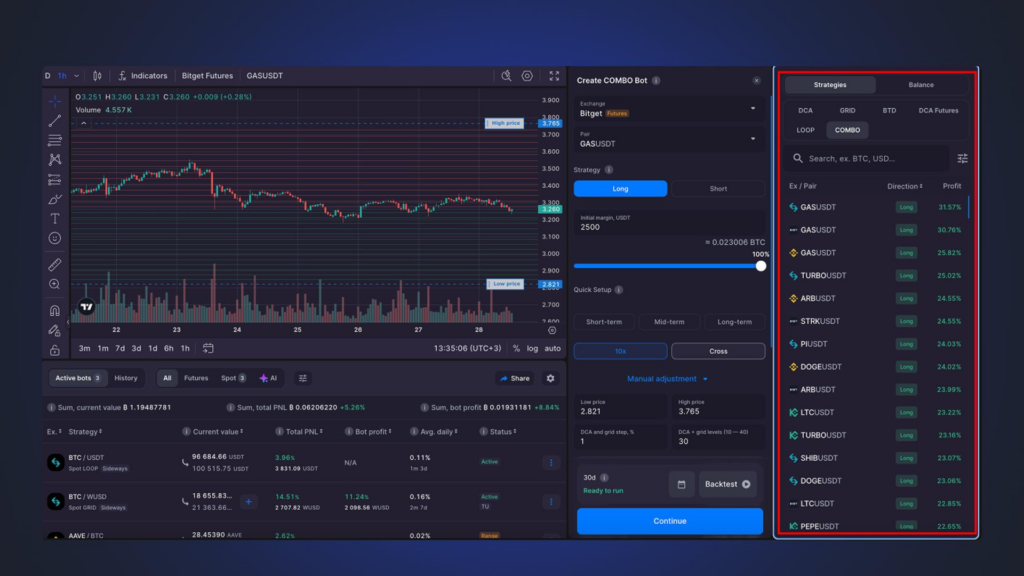
The platform has been running since 2017 and offers six bot types — GRID, DCA for spot and futures, BTD, COMBO, LOOP, and QFL — across 17+ exchanges. Users can manage their methods and review performance from a single interface rather than navigating multiple dashboards, which is especially valuable for anyone with trades spread across several exchanges.
An AI Chat feature selects a bot suited to current market conditions and launches it on request once an exchange is connected.
Before committing money, traders can backtest a strategy against historical prices or run it in demo mode. Live results will still drift from test outcomes, particularly when volatility spikes.
The COMBO bot combines GRID and DCA mechanics for futures trading and supports both long and short positions. Traders can apply up to 10× leverage and configure Stop-Loss and Take-Profit orders. The added exposure also means losses can mount more quickly, so position sizing matters.
Bitsgap currently provides three free COMBO bots through EVEDEX, with no paid subscription required. Funds stay on connected exchanges, and withdrawal permissions are not needed. The company also reports no security breaches since its launch.
For traders who want to spend less time executing routine orders, Bitsgap offers a practical way to keep strategies running around the clock.
2. TV-Hub — Best for Automating TradingView Strategies
Many traders already rely on TradingView to time their entries and exits. Charts can generate alerts, but someone still has to open an exchange and place the trade — and when prices move quickly, that delay can change the entry considerably.
TV-Hub connects TradingView alerts to exchange orders, removing most of that manual work. Unlike platforms built around ready-made strategies, it leaves room for traders to use the indicators and trading rules they have already developed.
An alert can carry more than a basic buy or sell instruction. Users can include position size, trade direction, Stop Loss, and Take Profit settings, and TradingView placeholders allow those values to change with each new signal rather than remaining fixed.
The service connects to Binance, Bybit, OKX, KuCoin, Coinbase, Bitget, and Hyperliquid. It supports DCA and grid trading, along with signals received via Telegram channels, a messaging app widely used to distribute trading signals. An activity log records what happened to each alert, while Telegram notifications provide updates without requiring users to stay on the dashboard.
Funds remain on the connected exchange. TV-Hub uses API keys with trading permission only and does not require withdrawal access.
Subscriptions start at $23 for one month, with a six-month purchase reducing the monthly rate to $19. A seven-day trial is available per exchange, while eligible partner registrations provide free access. Hyperliquid users can also access the service by approving its builder fee — the mechanism Hyperliquid provides for third-party tools to collect a fee on trades placed through them.
TV-Hub has operated since 2019 and reports more than 40,000 users. It makes the most sense for someone who already has a TradingView strategy and wants the exchange to act on it automatically.
3. 3Commas — Best for Managing Several Trading Strategies
Running one automated position is usually manageable. Complexity grows when a trader operates several strategies across Bitcoin, Ethereum, and smaller cryptocurrencies, particularly when each requires different exit rules.
3Commas brings those strategies into a single interface. Its DCA bots automate purchases and position adjustments, while grid bots place orders between predefined price levels. Traders can also connect external signals, such as TradingView alerts, rather than relying entirely on the platform's built-in tools.
The difference becomes clearest when multiple positions are live. of checking each exchange separately, users can monitor active bots and adjust their settings from one place.
There is more to configure than simply choosing a coin, however. Trading ranges, order sizes, and exit conditions all need attention, and poorly chosen settings can cause a bot to keep adding exposure during a falling market.
Plans start at $20 per month, with higher subscriptions increasing bot limits and adding features. For traders handling several strategies, the extra management tools may justify the cost; someone running only one simple bot might not need them.
4. Cryptohopper — Best for Testing Different Trading Strategies
Coming up with a trading idea is one thing. Turning it into a strategy that places orders consistently is another challenge, especially for traders who do not know how to code.
Cryptohopper provides a strategy marketplace where users can explore templates and trading signals. Instead of building everything from scratch, they can start with an existing approach and adjust its settings to suit their preferences.
That convenience calls for caution. A strategy that performs well in rising markets might struggle through a prolonged decline, so marketplace performance figures should be treated as a starting point for research — not proof that future trades will be profitable.
Backtesting and paper trading are available on the platform, allowing users to test strategies before putting real money at risk. They can review settings, examine past outcomes, and see how a concept performs in possible market scenarios.
Cryptohopper's Explorer plan starts at $29 monthly, followed by Adventurer at $69 and Hero at $129. The higher plans offer additional trading features and capacity.
It is a solid option for any trader exploring a few strategies. Those with a clear idea of how they wish to trade may find the marketplace less beneficial.
5. Pionex — Best for Beginners Seeking Built-In Trading Bots
Most third-party platforms require an exchange connection before a bot can begin working, which means creating API keys, selecting permissions, and confirming that the exchange supports the intended strategy. Pionex avoids much of that setup because its bots run directly inside the exchange. Users can choose a trading pair, select a strategy, and configure the bot without connecting to another service.
Its grid bots place buy and sell orders at different prices, letting a trader follow a predefined trading range. DCA tools take a different approach by spreading purchases over time instead of entering an entire position at once.
Neither method prevents losses. A grid bot can struggle when prices move outside its chosen range, while DCA keeps buying even if the market continues to fall.
Pionex does not charge a separate subscription for its built-in bots. Its standard spot trading fee is 0.05% per executed trade, although fees may differ across products.
The main consideration is that funds remain on Pionex rather than on an exchange the trader selects separately. For beginners comfortable with that arrangement, the integrated setup removes several technical steps.
Which Automated Crypto Trading Platform Is Best?
The answer depends less on the number of features and more on how someone trades. Bitsgap suits traders who want to run automated strategies across multiple exchanges. TV-Hub is designed for people who already use TradingView signals, while 3Commas provides tools to manage several strategies at once. Cryptohopper works well for testing new ideas, and Pionex offers an easier path for traders seeking built-in bots.
Before signing up, traders should verify an exchange's availability, fees, withdrawal permissions, and risk controls. Demo trading can also help determine whether a strategy performs as intended. Note that figures such as user counts and security records cited in this roundup are reported by the platforms themselves.
A trading bot can eliminate repetitive tasks, but it cannot transform an unprofitable strategy into a profitable one. The outcome still depends on the market, trading costs, and the rules governing each order.
This article is based on a report published by The Market Periodical.

