Treasury Secretary Bessent's Camp David Note Reveals Potential Yen Intervention, Raising Fears of Cascading Financial Crisis
Key Takeaways
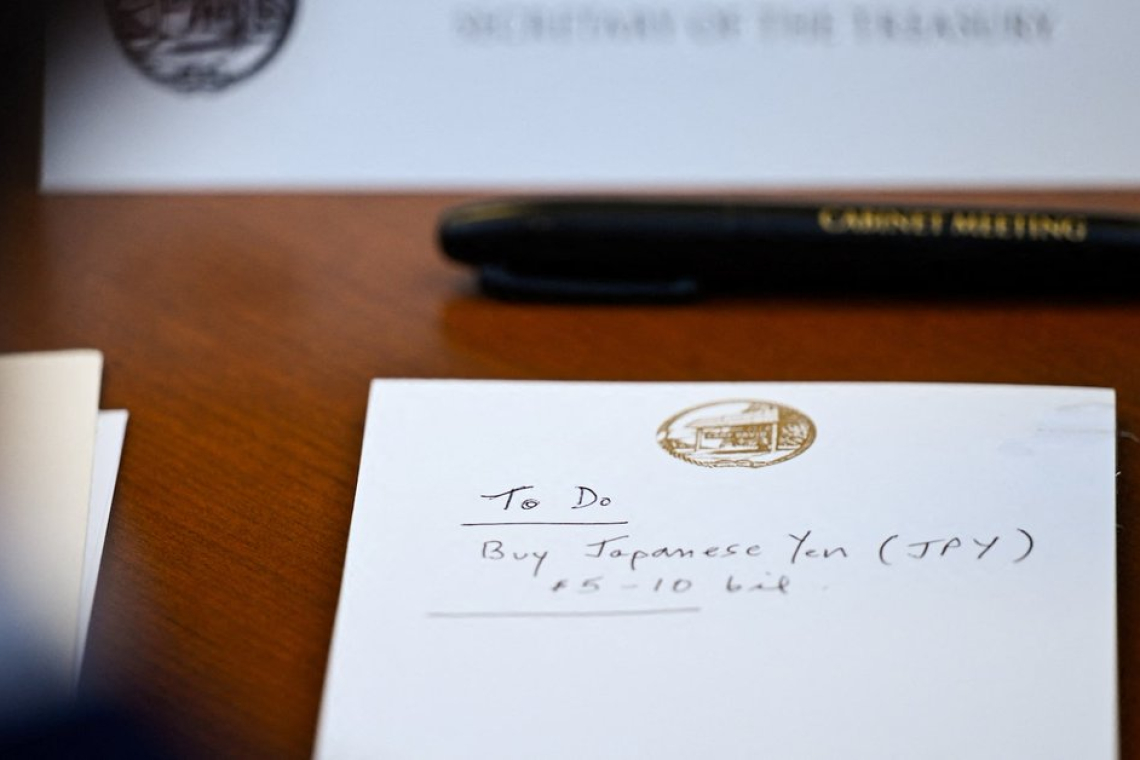
- •A Reuters image from Camp David appeared to show a note about buying $5 billion to $10 billion of Japanese yen.
- •Japan is described as the largest foreign holder of U.S. government debt, with more than $1.1 trillion in Treasury bonds.
- •The article says a weaker yen could force Japanese investors to sell U.S. bonds, which would put upward pressure on U.S. interest rates.
- •It reports that the Treasury may be funding yen purchases by selling euro reserves rather than printing new dollars.
- •The editorial warns that continued currency intervention and a yen carry trade unwind could strain bond markets and potentially require Federal Reserve support.
Treasury Secretary Bessent's Camp David Note Reveals Potential Yen Intervention, Raising Fears of Cascading Financial Crisis
Ed Steer, SilverSeek
A reader, Brad Robertson, forwarded an opinion-editorial originally published on the Hal Turner Radio Show website on Sunday morning EDT. The piece addresses a development considered significant enough to warrant immediate publication rather than waiting for a scheduled column.
Whether the scenario described unfolds over days, weeks, or months remains uncertain. However, the argument presented is that the process is not only accelerating but has become irreversible within the context of the world's 50-plus-year experiment with fiat currencies.
The Camp David Photograph
On Friday, July 31, U.S. Treasury Secretary Scott Bessent was photographed during a cabinet meeting at Camp David convened by President Donald Trump. A Reuters image captured what appeared to be a handwritten "to-do" list reading: "Buy Japanese Yen (JPY) 5-10 billion dollars." The photograph suggested that the Treasury Department was contemplating direct U.S. purchases of $5 billion to $10 billion worth of Japanese yen.
The editorial argues that a ten-billion-dollar currency intervention note is not something written for a routine meeting, but rather signals concern that the world's third-largest economy could destabilize the global bond market.
The article also notes what it describes as a near-simultaneous Federal Reserve intervention to support India's rupee.
The Japan Trap
Japan is the largest foreign holder of U.S. government debt, holding over $1.1 trillion in Treasury bonds. The country's economy is being squeezed by rising energy costs affecting global markets. The price of liquefied natural gas (LNG)—a critical import for Japan's power generation—is reported up 77.5% year-on-year. Japan's trade balance has deteriorated significantly, and the yen has fallen to a 15-year low against the U.S. dollar.
A weakening yen increases the cost of imported energy for Japan, pressuring both domestic consumption and industrial production. The editorial argues that a collapsing yen also poses a threat to the United States: Japanese investors who have borrowed cheap yen for decades to purchase higher-yielding American assets—the so-called yen carry trade, one of the largest carry trades in global finance—now face mounting pressure. If the yen declines too far, these investors could be forced to sell U.S. bonds to cover their losses.
If Japanese institutions sell U.S. Treasuries in significant volume, U.S. interest rates could rise sharply. Higher rates would simultaneously pressure the American housing market, stock market, and federal budget. The editorial characterizes the U.S. position as needing to support the Japanese yen—not from altruism, but because Japan's potential bond sales threaten the global bond market.
The stakes are amplified by Japan's fiscal position: the country carries the highest debt-to-GDP ratio among advanced economies, exceeding 250%, which makes rising government bond yields particularly dangerous for sovereign debt sustainability. The Bank of Japan has intervened in currency markets unilaterally in recent years, including multiple rounds of yen buying in 2022 and 2024, but coordinated intervention involving the U.S. Treasury would mark a significant escalation reminiscent of the 1985 Plaza Accord, when the U.S., Japan, and European allies jointly acted to weaken the dollar.
The Euro as Funding Mechanism
The editorial reports that the U.S. Treasury is not funding the yen purchase with newly printed dollars—which would add inflationary pressure—but is instead selling euro reserves to finance the intervention. The described strategy is to sacrifice the eurozone's currency to shield the dollar from the consequences of a potential Japanese bond sell-off.
The article characterizes this as the U.S. effectively engaging in a currency conflict with its own allies—selling European assets to support a Japanese financial system it describes as structurally insolvent under the weight of uncontrollable energy costs. The editorial labels this "Zombie QE" and characterizes it as a severe macroeconomic warning sign.
ECB Response and Broader Implications
The European Central Bank has not publicly responded, but the editorial argues it cannot remain silent indefinitely. The U.S. is effectively exporting financial instability to the eurozone by weakening the euro at a time when Europe faces a diesel crisis, declining industrial production, and gas storage levels that may be insufficient for winter.
If the ECB retaliates by selling its own dollar reserves to defend the euro, the editorial warns of open conflict between central banks, threatening the post-1971 fiat currency system.
Meanwhile, the yield on the 10-year Japanese government bond is approaching levels that could make Japan's sovereign debt mathematically unsustainable. The Bank of Japan faces a dilemma: raising rates to defend the yen could bankrupt the Japanese government, while cutting rates could accelerate the yen's decline, triggering the very bond sell-off it seeks to avoid. This is compounded by the Bank of Japan's status as the largest single holder of Japanese government bonds, meaning it is effectively both creditor and debtor in a system where any meaningful rate normalization would dramatically increase debt-service costs on its own holdings.
Projected Scenarios
The editorial outlines several potential developments:
-
Continued Yen Intervention: The U.S. and Japan may continue supporting the yen through direct market operations. This could provide short-term stabilization but would not address the underlying issue of Japan's inability to afford energy imports at current exchange rates.
-
ECB Retaliation Risk: If the euro weakens excessively, the ECB may respond verbally or through direct dollar sales, potentially escalating from managed crisis to open conflict between central banks.
-
Carry Trade Unwind: Even with temporary yen stabilization, the broader unwind of the yen carry trade could continue, placing selling pressure on U.S. equities and bonds and upward pressure on yields.
-
Bond Market Disruption: The editorial suggests that a large Japanese institution—a pension fund, bank, or insurer—could eventually be forced to liquidate a significant block of U.S. Treasuries to meet margin calls, potentially causing the bond market to seize up and forcing the Federal Reserve to intervene as buyer of last resort.
Structural Assessment
The editorial concludes by linking military and financial pressures as two dimensions of the same systemic challenge. It argues that the post-1971 petrodollar order, which relied on affordable energy and compliant creditor nations, is dissolving.
The article states that while political negotiations and currency interventions may continue, neither can manufacture energy resources or restore creditor confidence once collateral trust is eroded.
Originally published at SilverSeek. Opinion-editorial content attributed to the Hal Turner Radio Show, forwarded by reader Brad Robertson. Column by Ed Steer.

