Berachain Rebrands HONEY Stablecoin to BUSD as On-Chain Activity Sits Near Record Lows
Key Takeaways
- •Berachain renamed its HONEY stablecoin to Bera USD, or BUSD, while keeping the same contract address and user balances unchanged.
- •The foundation announced the rebrand on X, and the post received a relatively muted response in its first hours.
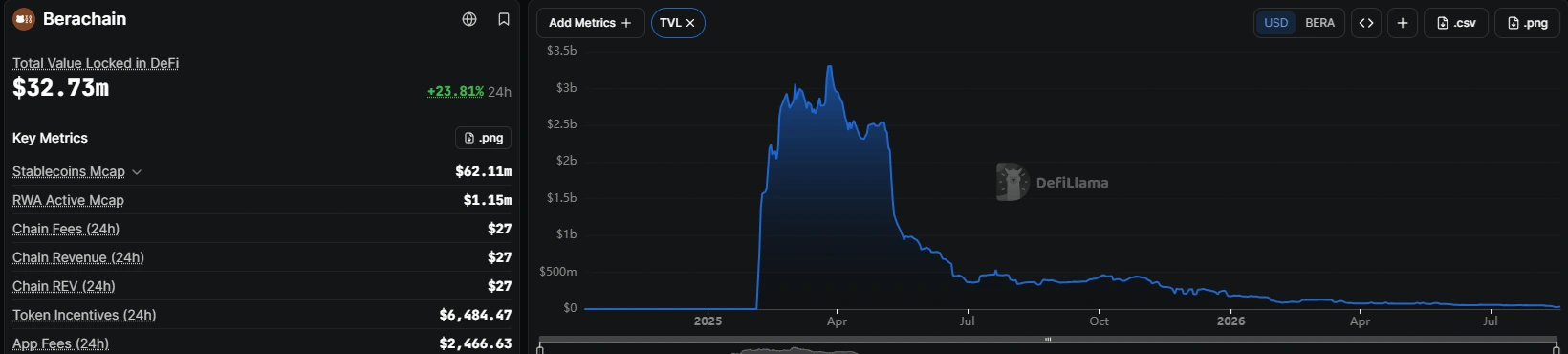
- •Berachain’s network activity is currently weak, with about $32 million in total value locked, roughly $62 million in stablecoin supply, and about $27 in daily chain fees.
- •The project’s BERA token is trading around $0.15, which is about 99% below its February 2025 all-time high of $14.99.
- •Berachain raised $142 million across two funding rounds and originally designed its Proof of Liquidity model to attract deposits and support network security.
Berachain has renamed its HONEY stablecoin to Bera USD (BUSD), a change announced on 19 August 2026 that alters only the token's name and symbol while keeping the same token and contract address. The rebrand comes as on-chain activity on the Layer 1 network drops to near record lows.
New name, same token
The Berachain Foundation announced the news on X, informing holders that HONEY, the network's dollar-pegged stablecoin, will now officially be known as BUSD (berachain.com/busd). Current user balances are unaffected because the token retained the same contract address.
The announcement drew a muted response, gathering about 117 likes and 14 reposts in its first hours.
The BUSD symbol carries its own history in the stablecoin sector: it was previously used by Binance USD, a Paxos-issued token that New York regulators ordered to stop minting in February 2023 and that was wound down in the years after. Berachain's BUSD is a separate, unrelated token native to its own chain.
HONEY had been a pillar of Berachain's token structure since launch, operating alongside sister tokens BERA, used for gas and staking, and BGT, used for governance, according to Cryptopolitan.
Berachain fees under a few dollars a day
The rebrand arrives as Berachain's on-chain economy experiences a significant slowdown. According to DefiLlama, the network's total value locked sits around $32 million, while its stablecoin market capitalization hovers near $62 million, with Tether making up roughly two-thirds of that supply.
Daily network activity has also weakened, with Berachain bringing in just about $27 in chain fees and processing roughly 65,000 transactions from 3,329 active addresses, figures that sit far below the daily fee intake of the largest smart-contract networks.
A Cryptopolitan report released in March also found that the network typically generates under $100 in daily fees, grouping it with other Layer 1 projects that raised substantial funding but lost engagement, developer interest, and liquidity over time.
From a $1.1 billion vault to a 99% decline
Berachain's launch painted a very different picture. Before the project's mainnet went live in February 2025, its pre-deposit vault held well over $1.1 billion, supported by more than 127,000 depositors and including large contributions from protocols such as StakeStone (Cryptopolitan).
Since then, market conditions have heavily repriced the project. The network's BERA token has fallen steeply from its previous all-time high, pulling its overall market valuation down significantly amid record-low trading thresholds.
According to CoinMarketCap, BERA is trading around $0.15, a 99% decline from its all-time record of $14.99 set in February 2025, leaving the project with a market value of $47 million.
Where the rebrand fits
Berachain raised $142 million across two funding rounds from backers including Brevan Howard Digital, Polychain, Framework Ventures, and Samsung Next, according to DefiLlama. Its Proof of Liquidity design was originally introduced as a way to tie network security to liquidity provision and draw deposits away from rival chains.
The stablecoin landscape the rebrand lands in remains dominated by Tether's USDT and Circle's USDC, which together account for the bulk of global supply, and has been reshaped by the U.S. GENIUS Act, signed into law in July 2025 as the first federal framework governing payment stablecoin issuance and reserves.
Renaming the stablecoin to match the main brand gives Berachain a cleaner marketing identity, although the foundation did not link the change to any new yield program or incentive in its announcement. Whether a fresh label can successfully restart ecosystem deposits remains to be seen, and the main indicator to watch is whether Berachain's stablecoin supply begins to climb or continues to stall in the coming weeks.

