First parliamentary polls will test BARMM’s ayuda economy, building a more capable government
Key Takeaways
- •Voters are urged to evaluate parties by their governance philosophy, fiscal discipline and reform agenda rather than by manifestos or alliances.
- •The article says BARMM needs a more capable government that can deliver services, maintain accountability and preserve fiscal sustainability.
- •Policy inconsistency is described as a risk to investment, business expansion and public confidence in government.
- •Since 2020, the Bangsamoro Transition Authority has received P515 billion in block grants and P64.7 billion in other national transfers.
- •BARMM’s first parliamentary election is framed as a test of whether the new region can avoid the failures associated with ARMM.
By Assad Baunto
(Part 2)
Against this backdrop, voters should not be tempted to judge parties solely by the generosity of their manifestos or by the romantic familiarity of their political alliances. A more meaningful standard is whether any political party has articulated a coherent philosophy of government and demonstrated fiscal discipline. It is also important to assess whether any party has proposed genuine reforms that can withstand political pressure and economic uncertainty.
The objective is not necessarily a smaller government in the Bangsamoro Autonomous Region in Muslim Mindanao (BARMM), but a more capable one. The region needs institutions that are judged by their ability to deliver essential public services with competence, discipline, prudence, transparency and accountability, especially because the first parliamentary election will help set the practical standards by which those institutions are judged.
Decades of unmet public needs have created powerful incentives for the regional government to overcompensate politically, extending its reach into every sphere of life in order to satisfy public expectations. However, this trend risks replacing historical neglect with an equally problematic model of unsustainable public sector expansion.
A government that tries to do everything often achieves remarkably little. By contrast, a government that focuses on its core responsibilities is likely to be more effective. That means delivering public services while encouraging market enterprise to flourish in a stable environment. The next BARMM government needs to maintain fiscal sustainability, strengthen institutional capacity and recognize the opportunity costs of scarce public resources.
Policy consistency is also important in maintaining political stability. Investors postpone decisions when government frequently changes course or pursues conflicting priorities. Entrepreneurs hesitate to expand when regulations become unpredictable. Consumers cannot form habits that could serve as a stabilizing anchor for the economy if resources are not allocated equitably and efficiently. Constituents can also lose confidence in government when reforms are announced and then later reversed.
From ARMM to BARMM
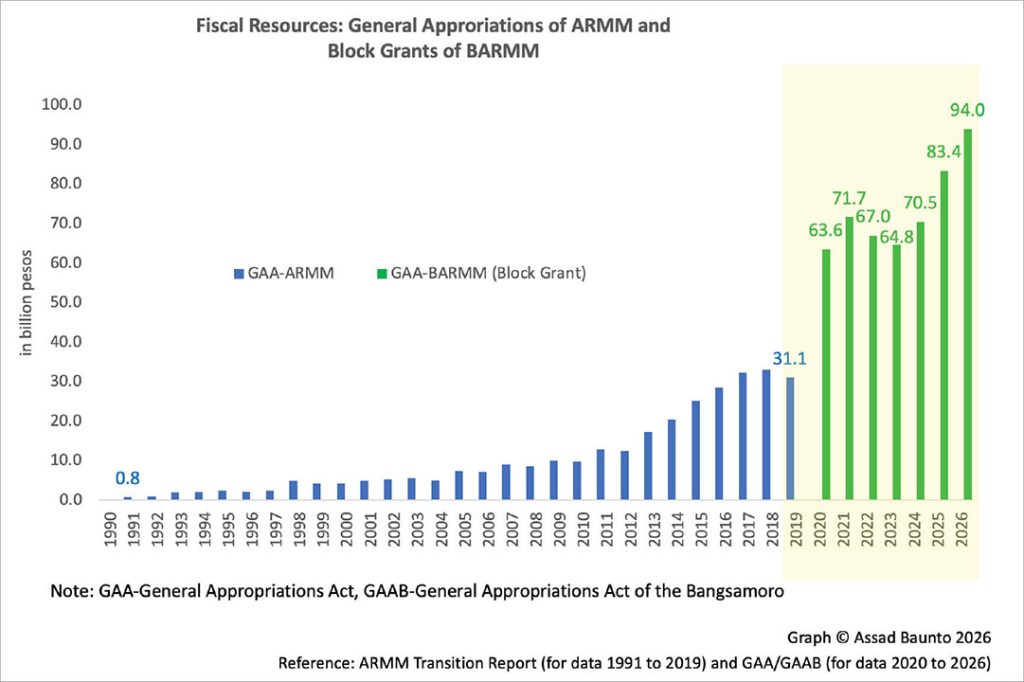
Over the past seven years, the Bangsamoro Transition Authority (BTA) has been given extraordinary fiscal resources to govern the region. When the BTA took over from the Autonomous Region in Muslim Mindanao (ARMM) in March 2019, after the Bangsamoro Organic Law (BOL) took effect, the transition government inherited a fiscal envelope representing a large part of ARMM’s P31.1-billion budget for the year under the General Appropriations Act.
Since 2020, the BTA has received a total of P515 billion in block grants, an automatic allocation equal to 5% of net national revenue and customs collections every year, as specified under the BOL. In addition, the BTA obtained P64.7 billion in other national transfers, including Special Development Funds and shares from national taxes, fees and charges collected in the region.
The scale of this fiscal transformation is striking when viewed against the history of the region’s finances. In its first five years alone, the BTA received P337.6 billion in block grants; by comparison, ARMM received only around P313.2 billion throughout its entire 29-year existence.
Such resources carry an equally extraordinary obligation to spend the funds in a transparent and responsible manner. The parliamentary system of BARMM brings together two government functions and could, in theory, help local officials become more decisive; however, it can also blur responsibility when legislators are also exercising executive authority. The system will only work if those who hold power also accept scrutiny.
Fiscal discipline, social protection, economic competitiveness and institutional reform are mutually dependent. Simplistic political slogans or short-term spending cannot reconcile these imperatives. They require leaders and planners capable of setting priorities, making difficult choices and resisting the temptation to treat every social problem as a reason for government expansion.
For these reasons, BARMM’s first parliamentary election should not be reduced to personalities, patronage or political spectacle. Founding elections are often romanticized as celebrations of democratic aspiration, but their true significance lies elsewhere. They establish institutional norms that define the relationship between the state and society. They determine whether public money is treated as a political resource or a public trust. They reveal whether political competition rests on coherent public policy or on ephemeral electoral promises repackaged in motherhood statements.
The contrast with ARMM, which has been judged a “failed experiment” and was therefore replaced by BARMM, gives this election real weight. The burden rests on the elected BARMM government to demonstrate that it can succeed where its predecessor failed.
Next month’s BARMM election is more than a democratic milestone. It is the region’s first serious examination of political judgment. It is not so much a contest for office as a test of the kind of government the Bangsamoro intend to build in the long term. The choices made at the ballot box will shape not only the next government but also the principles by which future leaders will be measured.
If voters reward credible policy over political theater, institutional reform over administrative expansion and long-term stewardship over short-term expediency, this election could lay the foundation for a more robust political order in BARMM. If not, history may conclude that the weakness does not lie in the experiment itself, but in those entrusted to carry out the experiment.
Read Part 1: First parliamentary polls will test BARMM’s ayuda economy —
This article was produced with editorial support from Mindanao-based journalist and publisher Yasmin Arquiza.
Assad Baunto is a Mëranaw economist with more than two decades of experience in public policy and development. He has advised local and national governments, worked with international development agencies as part of the team supporting the GPH-MILF Peace Process, and served as assistant planning director of ARMM. He is currently connected with the Development Advisory Group Philippines. Baunto holds master’s degrees from the University of the Philippines School of Economics and from Worcester College at the University of Oxford.

