First Parliamentary Polls Will Test BARMM's Ayuda Economy
Key Takeaways
- •The May 12 vote will be BARMM's first parliamentary election and will be held alongside the Philippine national midterms.
- •BARMM was created by the 2019 Bangsamoro Organic Law after the 2014 peace agreement, and its polls were delayed from 2022.
- •Thirteen political parties are competing for 80 seats, and the Supreme Court ruled in 2024 that Sulu is not part of BARMM.
- •The article says aid-based programs, especially rice assistance, have become a central tool of governance but have not replaced the need for long-term development.
- •According to the article, BARMM still has high poverty, the country's lowest basic literacy rate, and severe malnutrition despite large public spending.
By Assad Baunto (Part 1)
In less than a month, voters will cast their ballots in the first parliamentary election for the Bangsamoro Autonomous Region in Muslim Mindanao (BARMM). The May 12 vote, held alongside national midterm elections, completes a transition set in motion by the 2014 peace agreement between the Government of the Philippines and the Moro Islamic Liberation Front (MILF): BARMM was created under the 2019 Bangsamoro Organic Law to replace the older Autonomous Region in Muslim Mindanao (ARMM) and has since been run by an appointed interim authority, with the parliamentary polls deferred from 2022. Thirteen political parties are competing for 80 seats, and each will need to offer a credible blueprint for good governance in a geographically dispersed region confronting severe economic constraints — one whose very boundaries shifted after the Supreme Court ruled in 2024 that Sulu, which had voted against ratifying the autonomy law, is not part of BARMM.
The incoming administration will inherit a political landscape plagued by interconnected structural problems alongside policy failures. Large bureaucracies and subsidy programs have become embedded in the region's political economy, to the point where providing immediate relief has often replaced the harder task of building long-term development. Communities increasingly expect greater prosperity and better services, yet even as government spending has continued to expand, it does not meet public demand because of misplaced priorities.
The evolution of ayuda (aid or assistance) illustrates this problem. Introduced as emergency relief during the Duterte administration, it gained further popularity when President Ferdinand Marcos, Jr. began doling out rice assistance to low-income households. What was once a targeted welfare strategy has become the Bangsamoro's preferred instrument of governance, dispensed by ministries, parliamentarians, and agencies. Its appeal is obvious: in a region where poverty is widespread, few political messages are more persuasive than a sack of rice.
The relief program undoubtedly contributed to lower rice prices, helping explain BARMM's ultra-rare episode of negative inflation last year. Most news reports, however, missed the fact that this achievement was attained through sustained public intervention rather than agricultural productivity or competitive markets. Much of the rice was imported, which meant public funds flowed outside the local economy instead of strengthening domestic production.
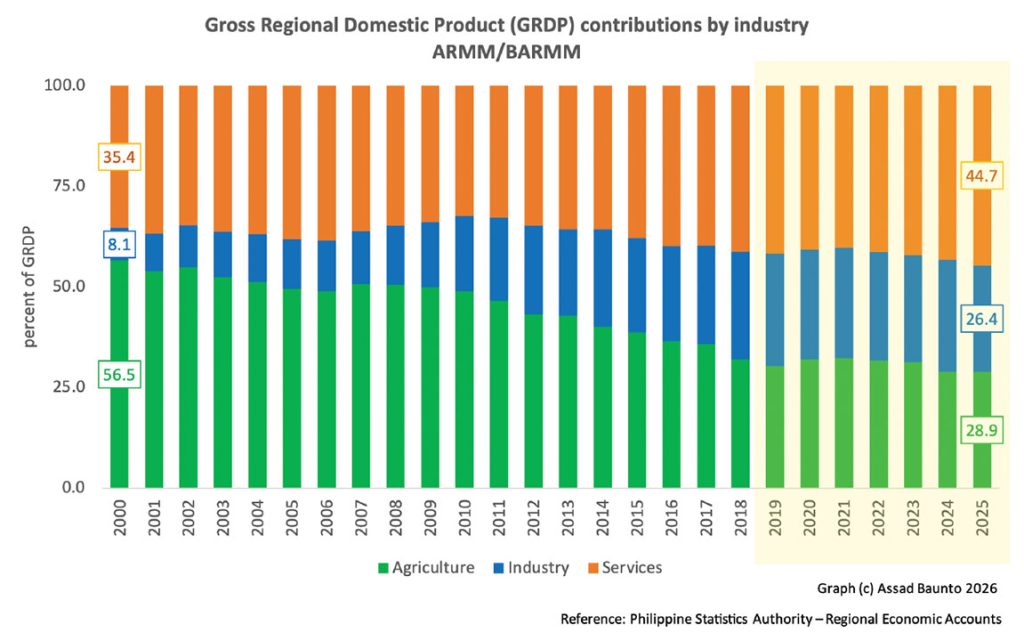
That distinction matters, because it exposes a deeper structural weakness. In just two and a half decades, the agriculture and fisheries sector has shrunk remarkably. From nearly 60% in the early 2000s, the sector registered a mere 29% of the region's Gross Regional Domestic Product from 2024 to 2025, even though many in the labor force still depend on agriculture, according to official estimates from the Philippine Statistics Authority (PSA). The aid program created economic incentives, but with the government assuming the role of principal rice dispenser, private markets retreated as small retailers at the margins struggled, and dependence gradually displaced enterprise.
"To put it simply, the ayuda economy is the political and economic opium of our time," Baunto writes. Welfare remains essential in times of hardship, but it cannot be a substitute for industry and commerce, and most certainly not for investment or employment. No society, he argues, has achieved lasting prosperity through aid distribution alone. A government that finds it easier to hand out rice rather than to create the conditions for people to earn income risks confusing relief with development.
BARMM's Bloated Public Sector
Perhaps the most immediate challenge concerns the scale and function of the Bangsamoro government itself. Across many developing democracies and fragile economies, expanding the government's responsibilities and, by implication, enlarging public sector spending have become the default response to social and economic problems. In the Bangsamoro region, however, the assumption that bigger government produces better governance has become increasingly difficult to reconcile. So far, bureaucratic expansion has more often generated duplication and rising fiscal obligations, without any corresponding improvement in public services that matter — such as education, water, and energy — or in expanding the economy and making it more diversified.
In addition to rice aid, the Bangsamoro Transition Authority (BTA) — the interim government and parliament led by MILF chairman Ahod Ebrahim as Chief Minister — relentlessly pursued spending on a range of programs that were free for the taking — from housing and agricultural equipment to business grants, burial support, and transportation and accommodation for pilgrimage to Mecca. Many of these initiatives address genuine needs, but there were hardly any counterpart obligations from beneficiaries. The practice reflects a governing philosophy that favors direct distribution over long-term economic development, spurred by political incentives for welfare populism that produces immediate and visible benefits. That spending rests on a fiscal base unlike any other Philippine region's: the Bangsamoro Organic Law automatically appropriates an annual block grant equal to 5% of the National Government's net internal revenue collections from the preceding year, plus a PHP 100-billion Special Development Fund spread over ten years, giving the regional government a steady stream of national funds to allocate.
The consequence is a public sector that has swelled to roughly 40% of BARMM's economy, compared with the National Government's 15% — a staggering expansion relative to previous decades. In relative terms, this places BARMM on a footing comparable with Japan, New Zealand, Canada, and the United Kingdom, and brings it close to the rankings achieved by welfare states in the Nordic countries.
Yet persistent poverty remains, along with high malnutrition and low life expectancy. According to PSA data, 23.5% of families in BARMM lived in poverty in 2023, more than twice the national average, and the region has consistently ranked first or second among the regions with the highest poverty incidence. These burdens weigh on communities still recovering from the 2017 siege of Marawi City, a five-month conflict that displaced hundreds of thousands of residents and whose reconstruction remains unfinished years later. From 2020 to 2025, women in BARMM could expect to live six years less, and men five years less, than the average Filipino. While child mortality has improved, three in every 10 children in the region are stunted — the highest rate in the country — according to the Food and Nutrition Research Institute of the Department of Science and Technology.
The education sector presents another serious challenge. In the PSA's 2024 Functional Literacy, Education, and Mass Media Survey, BARMM recorded the country's lowest basic literacy rate at 81%, compared with the national average of 90%. This gap limits the ability of the Bangsamoro to earn a decent income and participate fully in the economy.
Public expenditure, by itself, is not a good measure of effective governance, Baunto concludes. The more important question is whether government spending builds productive capacity and raises living standards by widening opportunities, or merely expands dependence — a question the region's first elected parliament, with control of its block grant-funded budget, will now have to answer.
(To be continued.)
This article was produced with editorial support from Mindanao-based journalist and publisher Yasmin Arquiza.
Assad Baunto is a Mëranaw economist with more than two decades of experience in public policy and development. He has advised local and national governments, worked with international development agencies as part of the team supporting the GPH-MILF Peace Process, and served as assistant planning director of ARMM. He is currently connected with the Development Advisory Group Philippines. Baunto holds master's degrees from the University of the Philippines School of Economics and from Worcester College at the University of Oxford. (assadbaunto@gmail.com)

