Banks and Regulators Launch Cross-Regional Pilot Testing Quantum-Safe Cryptography
Key Takeaways
- •A consortium is conducting a cross-regional pilot that tests quantum-safe cryptography with banks supplying payment systems and customer data and regulators providing oversight.
- •NIST has published post-quantum encryption standards including FIPS 204, and its draft transition guidance would deprecate RSA and elliptic-curve algorithms after 2030 and disallow them by 2035.
- •U.S. agencies including CISA, NSA, and NIST have warned of 'harvest now, decrypt later' attacks that collect encrypted data today for decryption once quantum computers exist.
- •The BIS-led Project Leap, run with the Banque de France and Germany's Bundesbank, has already trialled quantum-safe encryption for financial messaging between central-bank systems.
- •Bitcoin and Ethereum sign transactions with elliptic-curve cryptography, so migrating public blockchains to quantum-safe methods would require coordinated protocol changes.
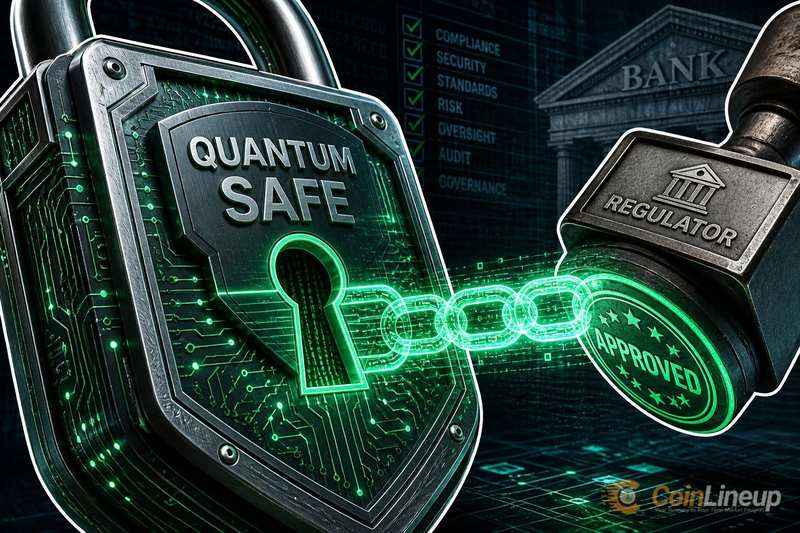
A consortium has announced a cross-regional pilot to test quantum-safe cryptography, bringing together banks and financial regulators in an early coordinated step toward protecting financial data from future quantum computers.
According to the consortium's announcement, the pilot focuses on post-quantum security and involves both banking institutions and regulatory stakeholders across multiple regions.
Quantum-safe cryptography refers to encryption designed to withstand attacks from quantum computers — powerful machines that could one day break the encryption protecting today's financial systems and crypto networks.
What the pilot is testing
A pilot is a controlled test rather than a full rollout. Participants are evaluating whether the new security methods work in real financial settings before committing to them.
The test draws on both sides of the financial system. Banks contribute the payment systems and sensitive customer data, while regulators provide oversight, reflecting their mandate to keep the wider financial system stable.
The consortium frames the effort as an evaluation of future-ready security infrastructure — in plain terms, an attempt to see how quantum-safe tools behave before real threats arrive.
Why institutions are preparing now
Today's encryption relies on mathematical problems that conventional computers cannot solve quickly. A sufficiently large quantum computer could solve some of them, exposing protected data.
U.S. agencies including CISA, NSA and NIST have also warned of "harvest now, decrypt later" attacks, in which encrypted data is collected today to be decrypted once quantum machines exist — a concern for financial records that must stay confidential for decades, which is why readiness is treated as a present-day issue.
To prepare, the U.S. National Institute of Standards and Technology (NIST) has published post-quantum encryption standards, including FIPS 204, a digital-signature standard built on lattice-based mathematics. These give institutions approved tools to build quantum-resistant systems.
NIST has additionally circulated draft transition guidance that would deprecate widely used public-key algorithms — RSA and the elliptic-curve family — after 2030 and disallow them by 2035, effectively setting a migration deadline measured in years rather than decades.
Banks are acting early because changing core systems takes years. Swapping out encryption across payments, custody, and identity systems is slow and complex work.
Regulators in Asia have signaled similar concerns. The Hong Kong Monetary Authority addressed quantum readiness in a July 2026 announcement and a related speech.
Nor is the pilot happening in isolation. The Bank for International Settlements' Project Leap, run with the Banque de France and Germany's Bundesbank, has already trialled quantum-safe encryption for financial messaging between central-bank systems, indicating that official-sector experimentation in this area is underway.
That regulatory attention mirrors a broader trend of oversight bodies scrutinizing digital assets. Watchdogs have recently weighed rules ranging from licensing deadlines for crypto platforms to capital requirements for offshore exchanges.
What it could mean for crypto and finance
If the pilot succeeds, it could shape future security standards across banking and digital assets. Institutional tests of this kind often precede wider adoption or formal policy guidance.
For crypto specifically, quantum-safe methods matter because blockchains rely on the same kind of cryptography being tested. Bitcoin and Ethereum, for instance, sign transactions with elliptic-curve cryptography — one of the algorithm families on NIST's proposed deprecation path — so any eventual switch for public blockchains would require coordinated protocol changes, a higher bar than a bank updating its own internal systems.
Stronger encryption could support institutional trust in custody and payments.
Quantum readiness may also become a competitive edge. Firms that adopt it early could stand out to regulators and cautious institutional clients, much as they do amid shifting rules on how crypto insiders handle tokens.
Still, a pilot is not a promise. Testing does not guarantee industry-wide adoption, and any rollout would likely be phased over years. Signals worth watching include whether pilot results feed into formal supervisory expectations for banks, and whether NIST's proposed 2030 and 2035 milestones survive into final guidance.
For everyday crypto holders, nothing changes today. Holdings are not suddenly at risk, and quantum computers cannot break current encryption yet. The pilot is early preparation — a sign that banks and regulators are planning ahead rather than reacting to an emergency.
Disclaimer: This article is for informational purposes only and does not constitute financial or investment advice. Cryptocurrency and digital asset markets carry significant risk. Always do your own research before making decisions.

