BancaStato and Sygnum Launch Regulated Crypto Trading in Switzerland
Key Takeaways
- •BancaStato customers can trade Bitcoin, Ether, Litecoin, and Solana directly through their existing banking apps without needing a separate crypto exchange platform.
- •BancaStato is the first bank using Avaloq's software-as-a-service model to offer crypto buying, holding, and selling through Sygnum's API integration.
- •As a Swiss cantonal bank, BancaStato provides these crypto services with the backing of a state guarantee on customer deposits.
- •Sygnum's B2B platform now serves more than 25 financial institutions seeking regulated digital-asset services, including Societe Generale-FORGE, PostFinance, and VZ Depotbank.
- •Sygnum received a MiCA crypto-asset service provider license from Liechtenstein's Financial Market Authority in late June, enabling standardized crypto service delivery across EU and EEA member states.
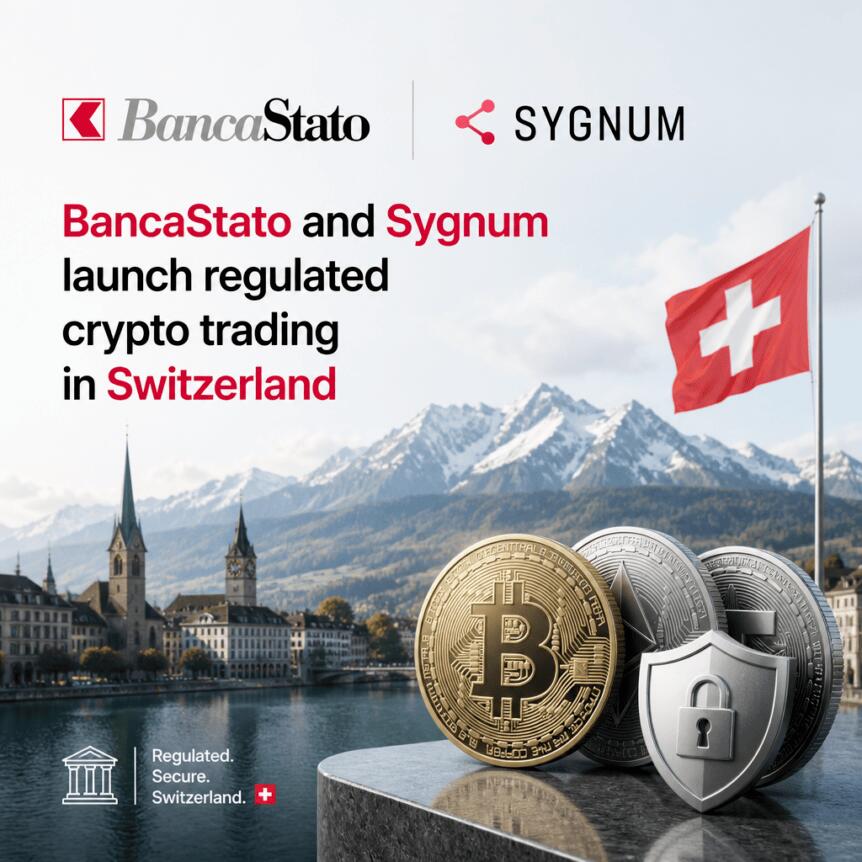
Swiss cantonal bank BancaStato has gone live with regulated cryptocurrency trading through a partnership with digital-asset banking firm Sygnum, leveraging the bank's existing technology stack. The launch, announced this week to Cointelegraph, brings crypto buy, sell, and holding services to BancaStato clients via their current web and mobile banking applications.
BancaStato's customers can access four crypto assets—Bitcoin (BTC), Ether (ETH), Litecoin (LTC), and Solana (SOL)—directly within their banking interface. The integration is built on Sygnum's B2B banking platform and connected into Avaloq's core and digital banking software, with the aim of reducing operational duplication for the bank. The move is notable because cantonal banks in Switzerland benefit from a state guarantee on customer deposits, meaning this rollout extends regulated crypto access through a public-sector-backed institution.
Crypto Access Embedded in BancaStato Banking Apps
BancaStato, the cantonal bank for the Italian-speaking Ticino region, has joined Sygnum's business-to-business platform to provide regulated digital-asset services, according to the announcement shared with Cointelegraph. Switzerland has long been an early mover in digital-asset finance, with the city of Zug earning the nickname "Crypto Valley" for its concentration of blockchain firms, and the Swiss Financial Market Supervisory Authority (FINMA) issuing digital-asset licenses as far back as 2019.
For customers, the practical change is that crypto functionality is routed through the bank's familiar user experience. BancaStato clients can buy, sell, and hold the supported assets through existing web and mobile banking applications, rather than needing to use a separate crypto venue.
Sygnum and its technology partners emphasized that the system is designed to integrate into BancaStato's current banking operations. Sygnum's trading and custody functions are connected through Avaloq's platform, allowing the bank to offer crypto services without adopting an entirely independent infrastructure stack.
How the Avaloq–Sygnum Integration Works
The integration links Sygnum's application programming interface (API) to Avaloq, which develops the core banking and digital banking software used by many financial institutions. The companies said this approach connects Sygnum directly to Avaloq's banking environment.
They also stated that the design can eliminate the need for a separate order management system for crypto activity. Order management is often one of the more complex layers in moving from the decision phase to a production-grade trading and custody service. Streamlining those components can reduce implementation friction and ongoing maintenance requirements.
Fritz Jost, Sygnum's chief B2B officer, told Cointelegraph that BancaStato is the first bank using Avaloq's software-as-a-service model to enable customers to buy, hold, and sell crypto assets via the bank's e-banking platforms using Sygnum's API. Jost described the rollout as a milestone for the maturity and scalability of regulated digital-asset infrastructure.
Sygnum's Expanding European Banking Partnerships
BancaStato is not an isolated example of European banks adopting the Sygnum model. Sygnum reports that more than 25 financial institutions are using its B2B platform to deliver regulated digital-asset services. In addition to BancaStato, Sygnum's cited banking partners include Societe Generale-FORGE, PostFinance, and VZ Depotbank.
This partnership structure is built around allowing banks to reuse a licensed and operational infrastructure layer, while the banks retain responsibility for their own customer-facing regulatory decisions and arrangements.
Jost told Cointelegraph that partner banks remain responsible for their regulatory frameworks, while Sygnum provides elements including licensing, custody, and trading infrastructure. He argued that this separation is what enables banks to move from internal planning to a live offering "in months rather than years," reflecting the time savings compared with building crypto capabilities and obtaining approvals independently.
MiCA Licensing and the Post-Transition Period
The BancaStato launch arrives amid a broader shift in Europe's crypto regulatory environment. In late June, Sygnum announced that its Liechtenstein-based subsidiary, Sygnum Europe AG, received a crypto-asset service provider (CASP) license under the EU's Markets in Crypto-Assets (MiCA) framework from Liechtenstein's Financial Market Authority (FMA). MiCA, which fully took effect across the EU and EEA in 2024, is designed to replace a patchwork of national crypto rules with a single harmonized rulebook, enabling licensed providers to passport their services across member states.
Sygnum stated that the MiCA license helps enable European partner banks to "plug into" standardized bank-to-bank infrastructure without facing a multi-year process of creating and licensing their own crypto operations. As Jost described, the licensing status supports the ability to deliver regulated services through established channels rather than starting from scratch.
The MiCA license was granted shortly before the end of the transitional period for the Markets in Crypto-Assets Regulation on July 1, according to Cointelegraph's coverage of the transition timeline. With the transitional phase concluded, regulated crypto services in Europe face more defined compliance expectations, increasing the importance for institutions to have a clear operational model for custody and trading.
For investors, traders, and other market participants, these bank integrations can influence the on-ramps available to traditional finance customers. Even when token support is initially limited, extending regulated access through mainstream banking interfaces can broaden participation and reduce reliance on separate crypto exchanges for entry-level activities.
BancaStato's next step will likely involve whether it expands beyond its initial set of four supported assets, and how quickly other Avaloq-using institutions follow the same API-based approach. Further announcements on additional token support and how partner banks refine their operational processes as MiCA compliance requirements settle into day-to-day business are also anticipated.
