Bahrain Intercepts Iranian Aerial Attacks Amid Escalating Regional Tensions
Key Takeaways
- •Bahrain's Defense Force successfully intercepted and destroyed several Iranian aerial attacks on Friday.
- •Bahraini authorities have accused Iran of conducting a deliberate and sustained campaign aimed at civilians within the kingdom.
- •The escalating Iran–U.S. conflict has drawn in multiple Gulf states, including Kuwait and Jordan, which have experienced spillover effects from the hostilities.
- •Bahrain hosts the U.S. Navy's Fifth Fleet and sits approximately 200 kilometers from Iran, placing it on the front line of regional security challenges.
- •The Persian Gulf is a critical energy corridor, with roughly one-fifth of global daily oil supply transiting the nearby Strait of Hormuz.
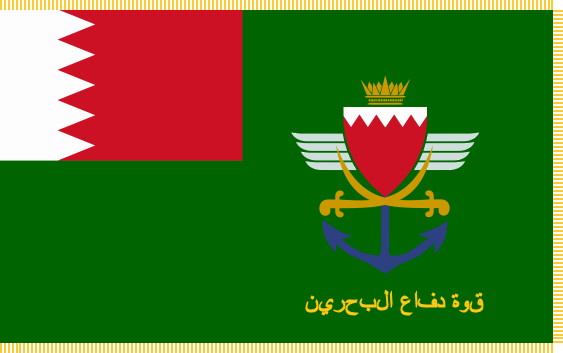
Bahrain's Defense Force reported that its air defense systems successfully intercepted and destroyed several Iranian aerial attacks on Friday. Bahraini authorities have accused Tehran of continuing a campaign aimed at civilians within the kingdom.
The incident is part of a broader pattern of escalating military activity in the region tied to the ongoing Iran–U.S. conflict. Gulf states including Bahrain, Kuwait, and Jordan have been drawn into the widening confrontation, with multiple episodes of military engagement reported across the area.
Bahrain, a small island nation in the Persian Gulf, hosts the U.S. Navy's Fifth Fleet and has long been a strategic partner of the United States in the region. The kingdom's proximity to Iran—roughly 200 kilometers across the Gulf—has placed it on the front line of recurring regional security challenges. Bahrain's ties to Iran have been strained for decades, dating back to Iran's historical territorial claims over the island, which were formally renounced in 1970 ahead of Bahrain's independence. The kingdom was also an early participant in the Saudi-led coalition that intervened in Yemen's civil war in 2015, where Iran-backed Houthi forces have periodically launched projectiles toward Gulf territory.
Friday's interception underscores the persistent aerial threat from Iran and points to heightened regional instability. Bahrain's air defense capabilities have been tested repeatedly as Tehran has pursued what Bahraini officials describe as a sustained campaign targeting civilian areas within the kingdom. The Gulf Cooperation Council, founded in 1981 partly as a collective security arrangement among the six Sunni-led Gulf monarchies, provides a framework for coordinated defense responses, though each member state maintains bilateral security agreements with Washington.
The broader Iran–U.S. conflict has intensified in recent months, drawing in neighboring Gulf states that find themselves increasingly caught between the two adversaries. Kuwait and Jordan have also experienced spillover effects from the escalating hostilities, as military actions have expanded beyond bilateral flashpoints to encompass a wider geographic area. The Persian Gulf is a critical corridor for global energy shipments, with roughly one-fifth of the world's daily oil supply transiting the nearby Strait of Hormuz, meaning that any sustained disruption to navigation in these waters would carry consequences well beyond the region.
Bahraini authorities have reiterated their condemnation of Iran's actions, framing the aerial attacks as part of a deliberate strategy to destabilize the kingdom and threaten its civilian population. The Defense Force's successful interceptions highlight the ongoing strain on regional air defense systems as Gulf states work to counter incoming threats.
The situation remains fluid, with regional analysts watching for further escalation or potential diplomatic off-ramps. The involvement of multiple Gulf states in the conflict's widening scope raises concerns about the potential for broader regional confrontation should military actions continue to intensify.

