Babylon Weighs Ending Bitcoin Staking: What Happens to $2.6 Billion in BTC?
Key Takeaways
- •Babylon co-founder Fisher Yu proposed in a Nov. 17 forum post to sunset the platform's Bitcoin staking program by year-end in order to redirect the team's attention to the Trustless Bitcoin Vaults (TBV) protocol.
- •Ending bitcoin staking would allow Babylon to reduce $BABY token inflation from 5.5% to 2%, shrinking annual new token issuance by roughly two-thirds.
- •About 41,600 staked BTC — more than $2 billion — would unlock gradually, either through a committee co-signed exit taking two to seven days or by waiting out locks of up to 15 months, with roughly 80% of the stake delegated to two Kraken-run providers.
- •Babylon's dashboard shows BTC staking APR has dropped to between 0.03% and 0.5%, and some initial reactions favor the sunset as bitcoin lending gains momentum.
- •Aave governance backed a Nov. 9 proposal to accept native BTC as collateral via TBV, pending a final vote, with TBV's mainnet set to begin a permissioned phase in late November and open to everyone in early 2027.
Babylon Weighs Ending Bitcoin Staking: What Happens to $2.6 Billion in BTC?
Babylon co-founder Fisher Yu has proposed winding down the platform's $BTC staking program by the end of this year, a move that would redirect the protocol's focus toward its Trustless Bitcoin Vaults (TBV) protocol. The staking program is built on a design that lets bitcoin holders lock native $BTC — with no wrapping or bridging — to help secure external proof-of-stake networks in exchange for rewards. Yu floated the idea in a forum post on Tuesday, Nov. 17, describing it as a suggestion intended to open a discussion within the Babylon community, though it could eventually lead to a vote. No one had replied to Yu's forum post at the time of writing.
“TBV is a much more powerful and versatile protocol for putting native bitcoin to work than bitcoin staking,” Yu said, adding that TBV “requires a lot more engineering and security work, and the Babylon team's full attention.”
Ending bitcoin staking would also carry a second benefit for the project: Yu said it would allow Babylon to cut $BABY token inflation from 5.5% to 2% — a 3.5-percentage-point reduction that would shrink annual new token issuance by roughly two-thirds.
“The sunset should be relatively straightforward,” Yu said, noting that once unstaked, users “can choose to put their $BTC to work through TBV applications.”
A Gradual Unlock and Kraken's Dominance
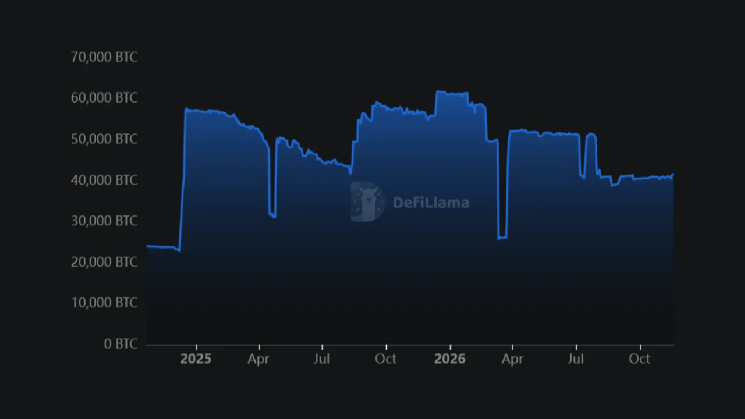
The central uncertainty is what the holders of roughly 41,600 staked $BTC — billions of dollars' worth of bitcoin — will ultimately do with their coins.
If the sunset is confirmed, the staked $BTC would not be unlocked all at once. Under the current design, a staker can exit early if Babylon's committee co-signs the request, a process that takes roughly two to seven days. Alternatively, stakers can wait until their original lock expires, which can take up to about 15 months from the stake date. That means the funds could become available at different times.
Kraken, one of the longest-running major cryptocurrency exchanges, offers bitcoin staking on Babylon to its clients and currently dominates the protocol. According to Babylon's data, about 80% of the staked $BTC is delegated to two Kraken-run providers. If the sunset is approved and Kraken unstakes, that $BTC would likely return to clients' Kraken accounts. From there, clients could move it into TBV — which would likely require first withdrawing it to their own wallets, since TBV vaults are self-custodial — or sell it, hold it, or use it in other ways, such as spending it.
Staking Yield Has Fallen to 0.03%–0.5%
Nothing, however, prevents users from making those choices now, particularly with staking rewards having dropped to almost zero: Babylon's dashboard shows a $BTC staking APR of 0.03% to 0.5%.
Why users continue to keep $BTC on the platform despite such low rewards is unknown. It may suggest that many are passive holders who are unlikely to rush to sell or redeploy their bitcoin once staking ends, though that remains speculation. As a precedent, in August, Lombard — one of Babylon's largest users — switched its LBTC yield strategy away from Babylon staking to a covered-call strategy managed by Bitwise.
Aave Integration Opens New Avenues
Yu also noted that Aave governance backed a proposal on Nov. 9 to enable native $BTC as collateral through TBV. Once live, it would let bitcoin holders borrow stablecoins from Aave V4's main liquidity pool. A final Aave vote is still needed before launch. According to Yu, TBV's mainnet is expected to start in a permissioned, private phase in late November before opening to everyone in early 2027.
Babylon said the integration with Aave could bring new opportunities for $BTC holders. Solutions already being tested include Aegis' fixed-rate borrowing application, which leverages stablecoin vaults to hedge Aave's variable rates, and Cradle's options DEX, which allows $BTC holders to generate yield by selling covered-call spread options against their bitcoin. Babylon also noted that the integration would let users earn the carry — the difference between their cost of borrowing stablecoins and the yield they earn — by deploying borrowed stablecoins into other yield opportunities.
Some initial reactions favor the sunset, as bitcoin lending gains momentum while $BTC staking offers minuscule annual percentage returns.
$BABY Is Down 95% From Its All-Time High
According to DefiLlama data, Babylon ranks second among restaking protocols by total value locked, accounting for 36% of the total — a category that tracks platforms putting already-staked assets to work securing additional protocols and services. Meanwhile, the $BABY token is down 62% over the past 12 months and approximately 95% from its all-time high, reached in April 2025.
Even if ending $BTC staking on Babylon ultimately changes nothing for the market in terms of $BTC available for trading, the fact remains that more than $2 billion worth of bitcoin sits on a platform where it earns almost nothing — at a time when the bitcoin market has tanked. From here, three pending steps bear watching: whether the forum discussion advances toward a community vote, whether Aave's final governance vote clears the TBV collateral proposal for launch, and how TBV's mainnet moves through its private phase in late November toward a public opening in early 2027.
Source: CryptoNewsNet, based on reporting from Bitcoin.com News.

