Australia Employment Falls 43,500 in October, Well Below Consensus, Fueling Recession Talk
Key Takeaways
- •Australian employment fell by 43,500 in October, a swing of roughly 69,000 jobs from the consensus forecast of a 25,500 increase.
- •The unemployment rate rose 0.2 percentage points to 4.9%, the highest jobless level in five years, despite forecasts of no change.
- •With national accounts published only quarterly and the next GDP release due December 2, monthly labor-market figures currently serve as Australia's timeliest official gauge of economic direction.
- •The Melbourne Institute's October nowcast points to +0.4% quarter-on-quarter growth for the third quarter, which, if accurate, would make a recession hard to establish under the standard two-consecutive-quarters definition.
- •Recession-warning indicators, including the NAB Business Conditions index and the Westpac–Melbourne Institute Consumer Sentiment measure, are trending downward following five Reserve Bank of Australia rate hikes this year intended to contain inflation from elevated oil prices.
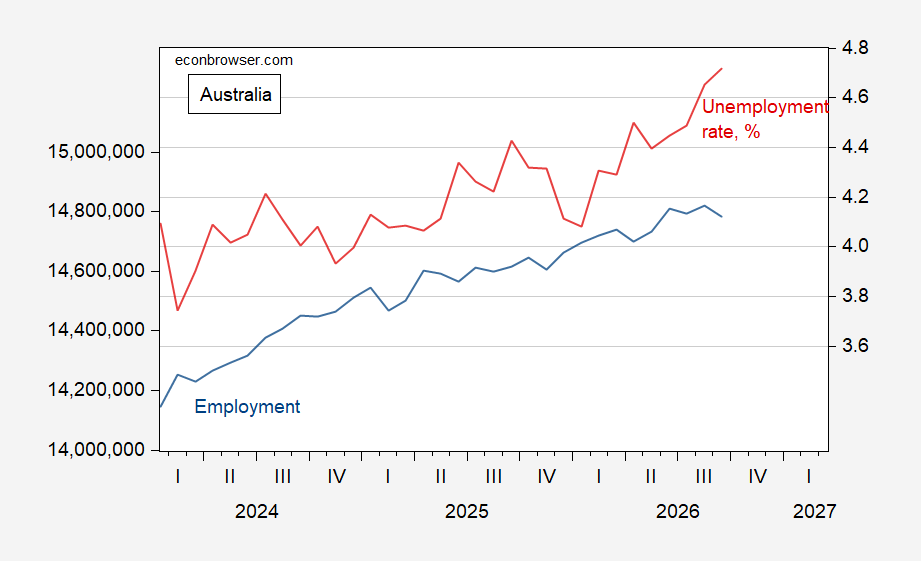
Australian employment fell by 43,500 month-on-month in October, against consensus expectations for a 25,500 gain — a swing of roughly 69,000 jobs versus forecasts — while the unemployment rate rose 0.2 percentage points to 4.9%, where forecasters had projected no change. The surprise deterioration in the labor market promptly set off talk of recession, marking a sharp reversal from expectations of continued hiring growth. Because Australia's national accounts are published only quarterly, monthly labor-market data serve as the timeliest official gauge of the economy's direction, which is why a single month's miss can shift the recession conversation this quickly.
The seasonally adjusted employment and unemployment figures — covering people aged 15 and over — come from the Australian Bureau of Statistics (ABS), as reported by Econbrowser.
While the labor market weakened unexpectedly in October, gross domestic product data extend only through the second quarter, with the next release due December 2 — leaving these monthly figures as the most current official reading on activity until then. The Melbourne Institute's October nowcast indicates +0.4% quarter-on-quarter growth for the third quarter, and its next nowcast is set for a week from now. Additional benchmarks include a Westpac nowcast dated November 20 and the RBA's November Statement on Monetary Policy forecast, with the GDP series measured in millions of 2024 chain-volume dollars.
Recessions are commonly defined as two consecutive quarters of contraction in GDP, which is why the sign of the third-quarter estimate carries so much weight in this debate. On the author's reading, if the nowcast proves accurate, it is hard to see a recession starting — although the October nowcast was based on earlier data, and even once reported, GDP will be revised repeatedly.
Two quarterly series add further texture: value added in industrial output — the sum of mining, utilities and manufacturing — and real disposable income, both available from the ABS. Disposable income is leveling off, while industrial output has gone flat after a brief recovery.
Finally, conditions and sentiment indicators that might foreshadow a recession are trending downward: Australia's NAB Business Conditions index and the Westpac–Melbourne Institute Consumer Sentiment measure, sourced via the RBA. The author cautions that neither series spans the 1990 recession.
The Guardian characterized the outlook: Australia may already have "one foot in recession" after unemployment surged to 4.9% in October, from 4.7%, in a shock increase that will add to rising worries that this year's five interest rate hikes have pushed the economy past a tipping point. The 4.9% rate is the highest jobless level in five years, as the report's own headline flags.
The author notes that the five hikes this year — delivered by the Reserve Bank of Australia (RBA), the country's central bank — were intended to contain inflationary pressures driven by elevated oil prices, and asks how many countries will be tipped into recession by "Mr. Trump's war."

